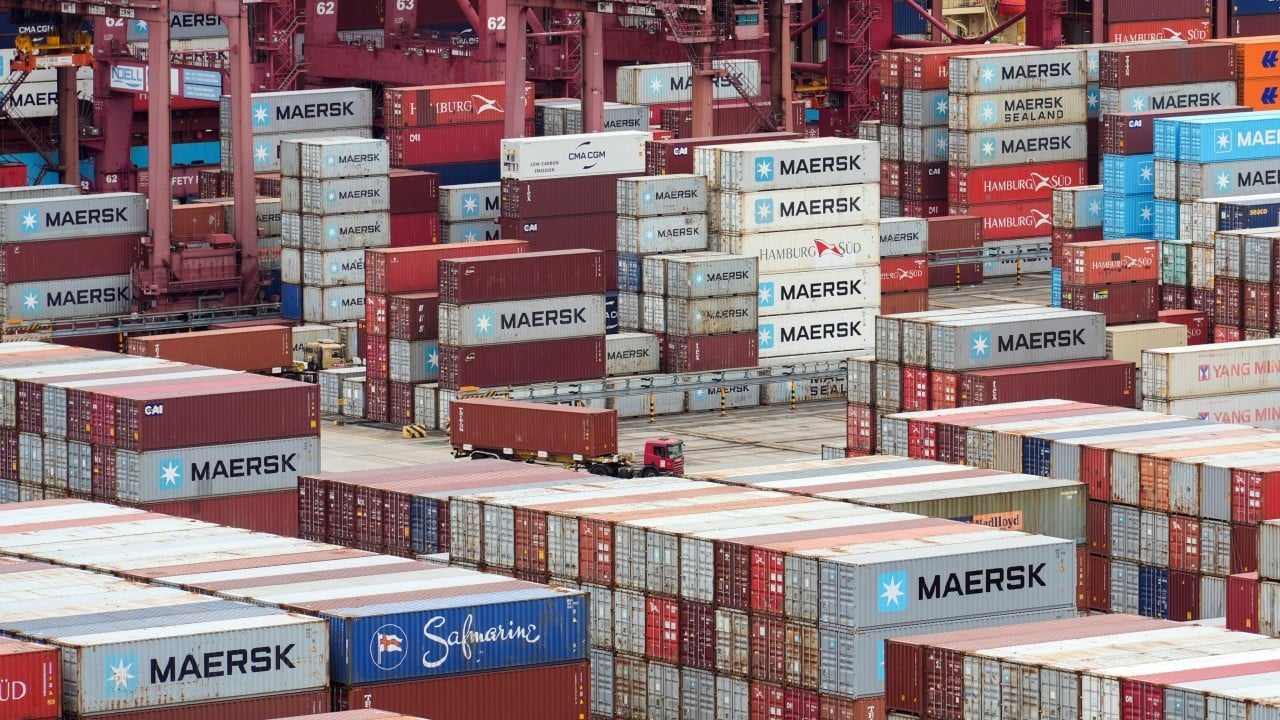
Hong Kong's total exports of goods surged by 50.7 percent year-on-year in July, reaching HK$672.5 billion and driving the city's trade deficit down to a meager HK$4.9 billion. This massive expansion is tied directly to the global obsession with artificial intelligence hardware, advanced semiconductors, and server components moving through the territory's logistics veins. Yet behind the celebratory headlines released by the Census and Statistics Department lies a volatile financial reality that official statements barely scratch.
Financial analysts tracking trade flows through the Pearl River Delta understand that headline numbers often obscure structural vulnerabilities. When a transshipment hub registers a 50 percent spike over a single year, the immediate assumption points to organic industrial expansion. But trade data is rarely that straightforward. Much of this cargo represents high-value processing, re-exporting, and component staging designed to feed hyper-scale data centers scattered across global markets. If you found value in this post, you might want to look at: this related article.
The Logistics Machinery of the Silicon Boom
To understand how Hong Kong arrived at a July export tally of HK$672.5 billion, one must look closely at the physical mechanics of the regional supply chain. Advanced graphics processing units, high-bandwidth memory modules, and specialized server racks rarely originate in the warehouses of Victoria Harbour. They arrive from manufacturing powerhouses across East Asia, pass through local administrative checkpoints, and move onward to mainland facilities or Western markets.
The city functions as a financial and logistical buffer. Insurance underwriting, letter of credit issuance, and high-speed maritime routing converge in this compact jurisdiction. When global capital expenditure on artificial intelligence infrastructure accelerates, the transactional volume handled by local intermediaries multiplies exponentially. For another look on this development, refer to the recent update from The Motley Fool.
Consider a hypothetical scenario involving a major server assembly operation. Motherboards populated with specialized processors are shipped from regional fabrication plants into container terminals in Kwai Tsing, cleared through customs, and re-allocated for final integration. The invoice value of these specific electronic subassemblies has climbed sharply due to scarcity and high performance demand. As a result, even if the actual physical volume of shipping containers remains relatively stable, the monetary value of those shipments skyrockets. That pricing power distorts traditional trade metrics, creating an illusion of broader economic breadth than what may actually exist on the factory floor.
Navigating Structural Deficits and Geopolitical Crosswinds
Despite the impressive July performance, structural fissures remain visible beneath the surface. For the first seven months of the year, Hong Kong still logged an accumulated trade deficit of HK$299.4 billion. The sudden narrowing observed in July is an acute reaction to a specific technology supercycle rather than a sign of balanced, multi-sector economic health.
Government officials have acknowledged these underlying threats. Trade protectionism among advanced economies continues to cast a long shadow over long-term forecasting. Export controls, shifting tariff regimes, and tightening restrictions on high-performance computing hardware create an environment of constant regulatory jeopardy. If a major trade partner adjusts its compliance parameters regarding microchip transshipments, the pipeline feeding Hong Kong's current export surge could experience sudden bottlenecks.
Furthermore, capital concentration creates its own set of dangers. When an entire trade economy leans heavily on a single vertical like artificial intelligence infrastructure, any correction in the underlying tech sector ripples outward with immediate force. If global enterprises begin to question the immediate return on investment for their massive data center expenditures, the subsequent cooling-off period will hit transshipment hubs with disproportionate severity.
Beyond the Official Ledger
Market observers tracking these trends must separate cyclical momentum from permanent structural transformation. The current wave of electronic component trading has pushed the local government to revise its full-year gross domestic product growth forecast upward to a range of 3.5 percent to 4.5 percent. That optimism is understandable from a short-term fiscal perspective, especially given how severely budgets were strained during previous regional downturns.
However, veteran trade watchers know that reliance on high-beta technology sectors leaves an economy exposed to sudden external shocks. Middle Eastern geopolitical tensions, fluctuating shipping insurance rates, and potential supply chain disruptions in maritime choke points pose continuous threats to the free flow of high-value goods. The remarkable 50 percent leap is a testament to the sheer scale of the global artificial intelligence buildout, but it also highlights how dependent regional stability has become on the continued spending appetite of a handful of multinational technology titans.
The numbers look pristine on paper, yet the underlying machinery operates on borrowed volatility. The true test of the local trade ecosystem will not arrive during a speculative boom, but when the inevitable market correction begins to test the resilience of those supply chains.