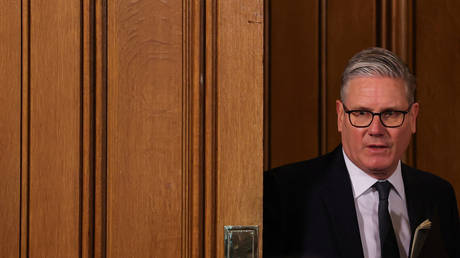
The rain in London doesn't just fall. It soaks into the Victorian masonry of Westminster until the very walls seem to sweat with the weight of old failures. Inside the Palace of Westminster, the air is thick with the smell of floor wax and the low, electric hum of anxiety. Sir Keir Starmer stands at the center of it, a man who spent his entire life preparing for a moment that now feels like it is slipping through his fingers like dry sand.
He was supposed to be the adult in the room. After years of populist pyrotechnics and the chaotic, neon-lit theater of his predecessors, the British public was promised the quiet dignity of a spreadsheet. They wanted competence. They wanted a technician who could look at the broken machinery of the state and know exactly which bolt to tighten. But as the months have ground on, a chilling realization has settled over the benches: the technician knows how to fix the machine, but he has no idea where he wants the machine to go.
The Architect of Silence
Consider a hypothetical voter named Elias. He lives in a town where the high street is a graveyard of shuttered shops and the local hospital has a waiting list that stretches into the next decade. Elias didn't vote for a revolution. He voted for the man who looked like he could manage a crisis without getting distracted by a garden party or a gold-wallpapered flat.
Elias watches the news and sees a Prime Minister who speaks in the measured, rhythmic tones of a courtroom lawyer. It is precise. It is technically correct. It is entirely devoid of blood. When Starmer speaks about "tough choices" or "fiscal responsibility," he isn't just communicating policy; he is building a fortress of gray stone around himself.
The problem with building a fortress is that eventually, people stop trying to get in. They just walk away.
The demographic shift that carried him to power was not a surge of love. It was a sigh of exhaustion. It was a negative mandate—a collective "not them" rather than a resounding "him." When a leader lacks a core of conviction, the vacuum is filled by the loudest voices in the room. We see it in the shifting stances, the discarded pledges, and the way the government seems to react to headlines rather than writing them.
The Lawyer’s Trap
Starmer is a product of the law. In a courtroom, the truth is a narrow thing, hemmed in by precedent and procedure. You don't need to inspire the jury; you only need to convince them that the other side is less credible than you are. This worked brilliantly in opposition. He could point to the wreckage of the previous administration and simply say, "I am not that."
But governing is not a trial. It is a creative act.
There is a specific kind of agony in watching a man try to find his soul by looking at a focus group. Every time a policy is floated and then retracted—every time a bold vision is sanded down until it is unrecognizable—the public sees the gears turning. They see the calculation. They see a leader who is terrified of being wrong, which is the surest way to never be right.
He sits in the back of ministerial cars, illuminated by the pale blue light of his phone, scrolling through data points while the country outside the tinted windows feels a sense of profound drift. The "pathetic demise" whispered about in the corridors of power isn't a sudden explosion. It is a slow leak. It is the sound of a balloon deflating in an empty hall.
The Weight of the Suit
The invisible stakes of this failure are higher than a simple change in polling numbers. When the "competent" option fails to deliver, the public doesn't move back to the center. They move toward the edges. They start to believe that the system itself is the problem, not just the man running it.
Think about the atmosphere in the Cabinet Room. It is a space designed for giants, for people who moved the needle of history through sheer force of will. Now, it feels like a middle-management seminar. There is plenty of talk about "deliverables" and "milestones," but very little talk about the soul of the nation.
The tragedy of the Starmer era is that he arrived at the summit only to realize he had forgotten why he wanted to climb the mountain in the first place. He is a man who won the world and found it empty.
The irony is that he is a good man by most traditional metrics. He is hardworking, disciplined, and remarkably intelligent. But politics is not an IQ test. It is an exercise in empathy. It requires a leader to stand in the rain with Elias and make him feel that the gray skies are temporary. Instead, Starmer stands under a very expensive umbrella and explains, with perfect syntax, why the rain is statistically inevitable.
The Ghost in the Machine
We are witnessing the limits of technocracy.
There is a hollow ringing sound every time the Prime Minister tries to strike a note of passion. It sounds like a rehearsal. When he tries to be "of the people," the seams show. The optics are always slightly off—the sleeves rolled up just a bit too high, the pauses for applause lasting a second too long. It is the performance of a man who has read a book on how to be a human.
History is littered with leaders who were brilliant at the "how" but failed the "why." They are the footnotes of the political world, the ones we remember only for the vacancy they left behind. As the pressure mounts and the cracks in the coalition begin to widen, the question isn't whether Starmer can survive the next scandal. The question is whether there is enough of a foundation left to support him if he does.
The light in the windows of Number 10 stays on late into the night. You can imagine him there, surrounded by stacks of briefing papers, trying to find the magic formula that will turn a 1% growth forecast into a national awakening. He is looking for a solution in the numbers that can only be found in the heart.
He is the man who won the race but forgot to catch his breath, and now the silence is starting to speak louder than his words.
The dispatch box is a lonely place when the house is quiet and the arguments have all been spent. You can see him there, gripping the edges of the wood, looking out at a room full of people who are no longer listening to what he says, but are instead watching the way his shadow flickers against the wall. It is a shadow that is growing thinner by the day, stretched out by the cold light of a public that has realized that while the grown-ups are back in charge, they have nothing left to say to the children.
The rain continues to fall on Westminster. It washes away the grime, but it also chills the bone. And in the center of the storm, the man in the sharp suit remains perfectly dry, perfectly composed, and increasingly, hauntingly, alone.