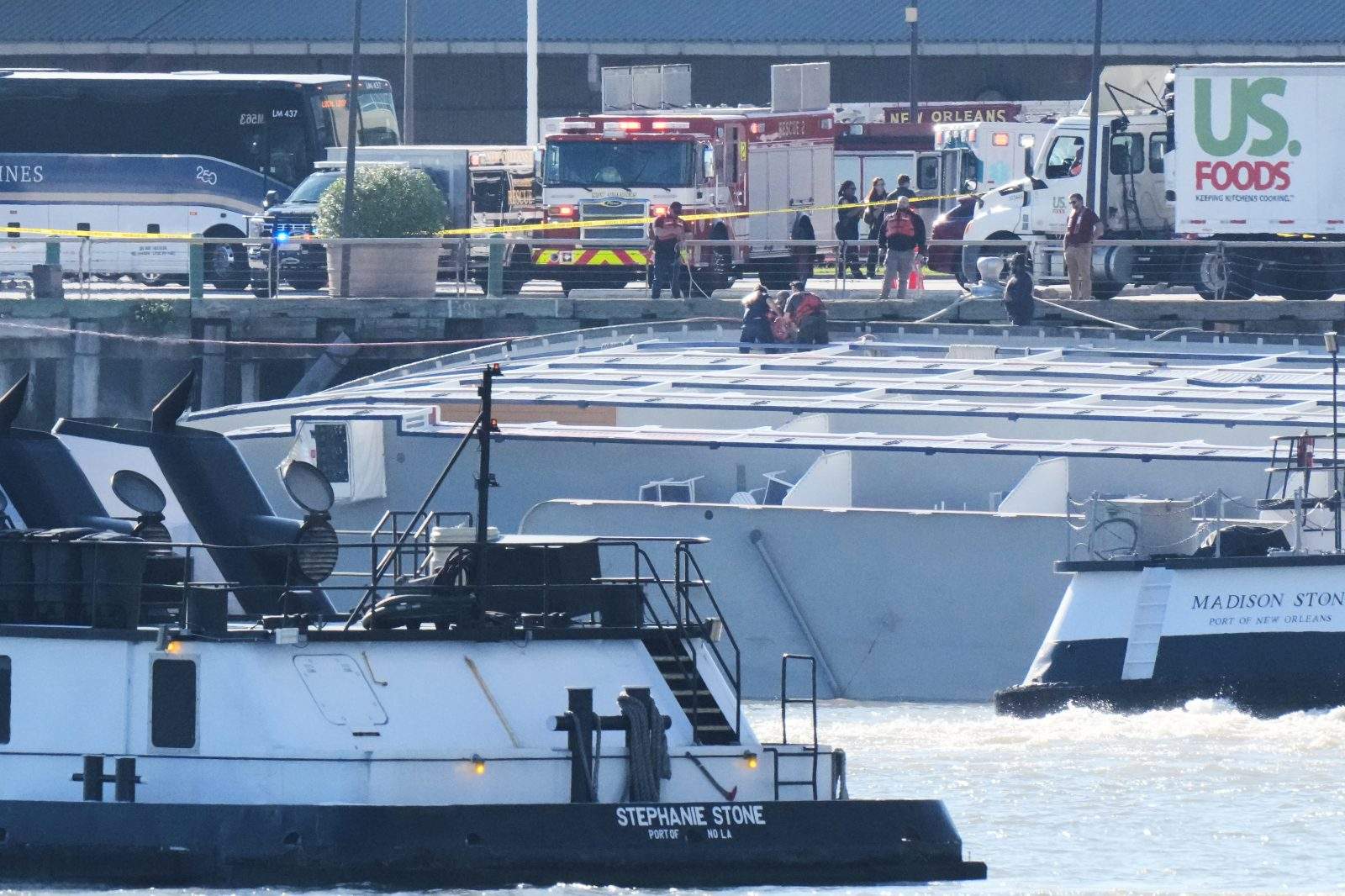
When a commercial tanker struck a cruise ship carrying 129 people on the Mississippi River in New Orleans, port officials treated it as an isolated maritime mishap. No serious injuries were reported. Operations resumed. The news cycle moved on.
That official calm masks a structural reality every veteran harbor pilot in Louisiana knows well. The Lower Mississippi River is one of the busiest, most physically unforgiving industrial waterways in North America, and the margin for error when massive deep-draft tankers share tight bends with passenger vessels has shrunk to near zero. For an alternative perspective, read: this related article.
Anatomy of a Predictable Impact
To understand how a tanker collides with a cruise ship in New Orleans, you have to look at the geometry of the river itself. Unlike coastal ports with wide basins and dredged turning areas, New Orleans sits along a narrow, winding corridor defined by sharp turns—most notably Algiers Point—and relentless, shifting currents.
The river does not flow at a uniform speed. During high-water seasons, snowmelt and rain from across the Midwest funnel down the channel, pushing current speeds past five knots. Under those conditions, a vessel moving downstream is not simply motoring through water; it is riding a moving sidewalk that degrades rudder authority. Related insight regarding this has been provided by The Washington Post.
When a deep-draft tanker slows down to navigate the river bends near the French Quarter or the Crescent City Connection, it loses steering control precisely when it needs it most. Conversely, if the captain maintains speed to keep water flowing over the rudder, the ship carries immense kinetic energy into blind turns where smaller, more agile river cruise vessels or ocean-going ships are docking, departing, or holding station.
In this collision involving 129 passengers and crew, the physical mechanics follow a familiar maritime pattern. A slight miscalculation in drift, an unexpected bank suction effect, or a delay in tugboat response turns a routine passing maneuver into steel grinding against steel. Bank suction occurs when a large hull moves close to the submerged riverbank or levee wall, creating a low-pressure zone that pulls the stern toward the shore and forces the bow outward directly into the center of the channel.
Where Bulk Cargo Meets Boutique Tourism
The Port of New Orleans and the surrounding Plaquemines and South Louisiana port districts form the largest bulk-cargo complex in the Western Hemisphere. Every day, hundreds of ocean-going tankers, grain carriers, and container ships transit these waters, hauling petrochemicals, crude oil, and agricultural exports.
Simultaneously, New Orleans has aggressively expanded its footprint as a premier homeport for both ocean cruises and domestic riverboats. Vessels carrying anywhere from a few hundred passengers—like the 129 people aboard the ship involved in this incident—to several thousand tourists share the exact same narrow artery as fully laden chemical tankers.
This coexistence creates an acute operational mismatch.
- Hydrodynamic disparity: A 600-foot tanker displaces tens of thousands of tons of water and requires more than a mile to come to a complete stop. A coastal or river cruise vessel is built with shallower drafts, higher windage profiles, and entirely different maneuverability characteristics.
- Docking exposure: Many cruise terminals in New Orleans sit directly along the main river channel rather than inside protected slips. Vessels moored at the Erato Street or Julia Street terminals, or riverboats staged near the French Quarter, sit exposed to the wake, surge, and accidental drift of passing industrial traffic.
- Communication silos: While federal Vessel Traffic Service (VTS) monitors the waterway and licensed river pilots board deep-draft ships to guide them through the bends, the sheer density of traffic—tugs pushing 30-barge tows, ferries crossing perpendicular to the main flow, tankers, and passenger ships—leaves virtually no buffer when equipment fails or weather shifts.
The Illusion of No Injuries
Maritime press releases routinely emphasize a single metric after a river collision. Nobody got hurt.
For port authorities and cruise operators, zero injuries is the ultimate containment mechanism. It keeps the story localized, prevents federal hearings from dominating national headlines, and reassures travelers that cruising out of New Orleans remains routine. Yet in maritime safety analysis, the absence of casualties in a tanker-passenger ship collision is pure luck, not proof of system resilience.
Consider the physics of hull impact. Modern cruise vessels are built with compartmentalized double bottoms and watertight bulkheads designed to survive low-speed contacts. However, the upper superstructures—where passenger cabins, dining rooms, and muster stations are located—are constructed of lighter steel and aluminum to keep the ship's center of gravity low. When the flared bow of a heavily laden tanker makes contact with the side of a passenger vessel, the point of impact rarely aligns neatly with the reinforced waterline belt. A few feet higher, or five knots faster, and the bow slices directly into occupied spaces.
Furthermore, a tanker strike carries an inherent secondary hazard that sets it apart from collisions with container ships or barges. Tankers carry volatile cargoes, bunker fuel, and pressurized piping on deck. Even a low-energy crunch at the waterline can rupture fuel tanks, spark flash fires, or release toxic vapors directly adjacent to a vessel carrying civilians who have zero firefighting or hazardous-materials training.
What the Official Investigation Actually Looks At
When the United States Coast Guard and the National Transportation Safety Board step aboard after a New Orleans river collision, their focus rarely stops at human error. Blaming a helmsman or a momentary lapse in bridge resource management is the easiest explanation, yet it almost always obscures deeper systemic vulnerabilities.
Investigators pull Voyage Data Recorders—the maritime equivalent of black boxes—to reconstruct the exact sequence of rudder commands, engine telegraphs, and VHF radio exchanges in the ten minutes preceding impact. They look for specific operational breakdowns.
Propulsion and Steering Lag
Did the tanker experience a brief loss of propulsion or a sluggish steering gear response while rounding a bend? Heavy fuel oil transitions, cooling water blockages from river silt, and aging hydraulic pumps are notorious culprits on the Mississippi. River water in southern Louisiana carries massive amounts of suspended sediment that can clog heat exchangers without warning, forcing an engine to derate at the worst possible moment.
Pilotage and Tug Escort Protocols
On the Lower Mississippi, state-commissioned river pilots take the conn of foreign-flagged vessels, relying on local knowledge that no chart can replicate. However, regulatory requirements for tractor-tug escorts vary depending on vessel size, cargo type, and river stage. Investigators examine whether the vessels involved had adequate tug assistance standing by, or if economic pressures to keep turnaround times fast left a massive hull operating without physical restraints in a high-consequence zone.
Bridge-to-Bridge Coordination
VHF Channel 67 is the lifeblood of Lower Mississippi navigation. Pilots call out their positions, agree on passing arrangements—port-to-port or starboard-to-starboard—and warn smaller vessels of their intentions. When an unannounced towboat enters the channel, or when a cruise ship prepares to cast off lines while a tanker is committed to a turn, radio agreements can unravel in seconds.
The Structural Fix Nobody Wants to Pay For
Reducing the risk of a catastrophic collision between cargo tankers and cruise ships in New Orleans requires confronting uncomfortable economic trade-offs. The port relies on unrestricted industrial flow to remain competitive with Houston and Mobile, while the city relies on cruise tourism to fill hotels and restaurants.
True separation of traffic is geographically impossible without spending billions of dollars on new off-channel basins. Dredging protected cruise slips out of the alluvial mud along the riverfront would remove passenger vessels from the direct path of passing tankers, yet land constraints, levee integrity rules, and cost projections have kept such plans largely theoretical.
Instead, meaningful risk reduction depends on stricter operational throttles that industry lobbies routinely resist. Mandatory tug escorts for all tankers transiting past active cruise terminals—regardless of river stage—would add thousands of dollars per transit in harbor fees, yet provide an immediate physical brake when steering fails. Implementing hard scheduling windows that prohibit deep-draft tankers from passing the downtown cruise terminals during peak passenger boarding and departure hours would eliminate the most dangerous overlaps, though at the cost of delaying commercial cargo schedules.
Until those operational rules change, the safety of the 129 people on that cruise ship—and the thousands more who board vessels along the New Orleans riverfront every week—rests entirely on split-second timing inside a narrow, fast-moving channel where steel hulls pass within yards of each other every hour of the day.