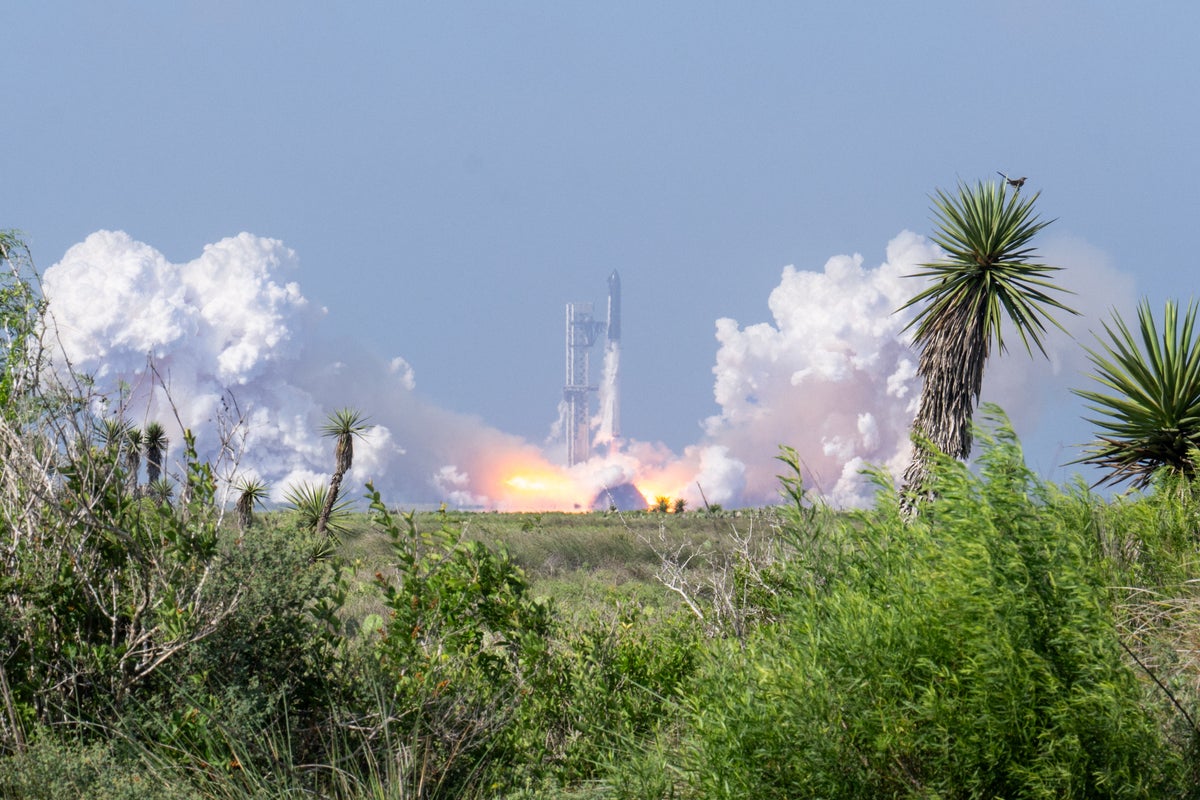
If you drive down State Highway 4 until the asphalt physically runs out of continent, you land on Boca Chica Beach. It is a raw, jagged strip of the Texas coastline where the Rio Grande sluggishly empties into the Gulf of Mexico. For generations, this was the backyard of the forgotten. It was where working-class families from Brownsville parked their trucks on the sand to fish for reddrum, where the Carrizo/Comecrudo Nation held religious ceremonies, and where Kemp’s ridley sea turtles crawled out of the surf to bury their eggs.
Then came the fire. In similar updates, read about: Why Soft Power Diplomacy Still Matters and How It Unites India and Norway.
Today, Boca Chica is better known as the blast zone for Starbase, the sprawling industrial fortress where Elon Musk builds and launches the largest rockets in human history. The conflict here has long been framed as a clean, binary choice: the infinite future of human space exploration versus a few miles of dirt. Progress versus preservation.
But a quiet ruling from the Texas Supreme Court stripped away the legal philosophy to reveal a much colder reality. The state’s highest civil court decided unanimously that while Texans technically own a constitutional right to their beaches, they do not possess the legal standing to enforce it if the government decides to lock the gates on behalf of a private corporation. NBC News has also covered this critical subject in great detail.
The decision marks a historic turning point. It arrived exactly a week after SpaceX went public on the Nasdaq exchange, an initial public offering that rocketed the company’s valuation to 1.8 trillion dollars and cemented Musk as the world's very first trillionaire. The numbers are astronomical. The financial victory is total.
But on the ground, the cost is measured in silence.
The legal battle began five years ago, in 2021. A local grassroots coalition named SaveRGV, later joined by the Sierra Club and the Carrizo/Comecrudo Nation, watched as State Highway 4—the solitary thread of road leading to the water—was repeatedly blocked by checkpoints. Rocket tests, static fires, and launch windows meant the beach was closed to the public for hundreds of hours a year.
To the people who lived there, this felt like an explicitly illegal land grab. They had history on their side, or so they thought. In 2009, a massive 77 percent of Texas voters approved a constitutional amendment guaranteeing the public’s absolute right to free and unrestricted access to state-owned beaches. It was an iconic piece of Texas identity: the sand belongs to the people.
But laws are fragile things when weighed against cosmic ambitions.
To understand how the beach vanished, you have to look back to 2013. That was the year Texas lawmakers quietly amended the state’s Open Beaches Act with House Bill 2623, a piece of legislation carved out specifically to allow spaceflight companies to close public spaces for safety reasons. It was the golden carrot used to lure SpaceX to the poorest region of the state. Armed with that local law, Musk’s company secured its federal launch licenses from the Federal Aviation Administration.
When the environmental groups sued, claiming the 2013 law directly violated the 2009 constitutional amendment, the state government did not defend the people’s access. Instead, the Texas Attorney General’s office stepped in to defend the space company.
Consider what happens next when a citizen tries to protect a constitutional right.
Justice Rebeca Huddle, writing for the unanimous court, pulled off a stunning piece of judicial acrobatics. The court did not actually decide whether closing the beach violates the Texas Constitution. It didn't have to. Instead, the ruling focused entirely on who is allowed to complain about it.
The 2009 amendment, Huddle wrote, "constitutionalized the public’s right to beach access, but it did not expand or confer on private citizens a right of enforcement."
Read that twice. It means you have a constitutional right to the sand, but if someone rolls a multi-ton rocket booster onto it and tells you to turn around at gunpoint, you are powerless to sue them. Only the government can sue to enforce your rights. And when the government is the entity that handed over the keys to the blast zone in the first place, the circle closes tightly.
"The government has essentially given Boca Chica Beach to SpaceX to use as its blast zone," Marisa Perales, the attorney representing the local groups, said quietly after the verdict. The amendment, she warned, has been rendered completely toothless.
Meanwhile, the political apparatus celebrated. Attorney General Ken Paxton took to social media to applaud the decision, stating that securing portions of the beach is "exactly what's needed to ensure SpaceX has a safe and operational launch site."
There is an undeniable, intoxicating grandeur to what is happening at Starbase. To watch a skyscraper-sized vehicle ascend into the heavens on a pillar of light is to witness human genius operating at its absolute limit. It is easy to be swept up in the narrative of multi-planetary survival, to believe that a few miles of coastal mud is a cheap price to pay for the stars.
But the view looks entirely different if you are standing in the dust of Brownsville.
The true friction of the modern era isn't between technology and nature. It is between the unchecked power of hyper-concentrated wealth and the quiet, everyday sovereignty of regular people. When a private citizen can no longer use the founding documents of their own state to protect the ground beneath their feet, the concept of public land becomes an illusion.
The court did leave one tiny window open. It noted that the Carrizo/Comecrudo Tribe’s complaints regarding their inability to practice their religion due to the closures might be pursued through a separate legal avenue. But for the fishermen, the conservationists, and the families who simply wanted to watch the Gulf waves break against the shore, the road ends permanently at the checkpoint.
The modern world is built on these trade-offs. We surrender the local to achieve the global. We give up the quiet, ancient places so that a trillionaire can build a metropolis on Mars.
As the sun sets over the Gulf, glinting off the polished steel of towering rockets, State Highway 4 sits empty, blocked by a security gate. The waves continue to roll in, tumbling over a shore that belongs to everyone in theory, and to absolutely no one in reality.