Silence.
When a military transport plane touches down on a tarmac in San Salvador carrying flag-draped coffins, the noise of the turbines fades into a heavy, suffocating quiet that no press conference can ever truly fill.
For months, the international community watched from a comfortable distance as Haiti dissolved into what diplomats politely call "institutional collapse" and what people on the ground simply call terror. Armed coalitions swallowed neighborhoods whole, turning daily commutes into gauntlets of extortion and gunfire. While major global powers debated budgets, drafted resolutions, and hesitated to put boots on the ground, one small Central American nation stepped forward with a bold promise. El Salvador, having dramatically dismantled its own entrenched gang networks through aggressive domestic crackdowns, offered to export its hard-won security model to the Caribbean.
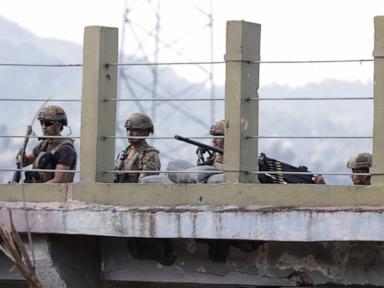
President Nayib Bukele had pledged to help stabilize Haiti, sending a specialized contingent of Salvadoran soldiers to join the multinational security support mission. It was framed as a triumph of regional solidarity—a nation that had once been the murder capital of the world now arriving as a savior. Yet, when Nayib Bukele later revealed the grim circumstances under which three Salvadoran soldiers died fighting gangs in Haiti, the glossy narrative of effortless intervention shattered against the jagged reality of urban warfare.
To understand what happened in those narrow, sun-baked streets, you have to strip away the geopolitical posturing and look at the human beings caught in the crossfire. Consider a hypothetical young corporal—let us call him Mateo, a composite drawn from the thousands of working-class recruits who fill the ranks of the Salvadoran armed forces. Mateo grew up in a neighborhood outside Santa Ana where, until recently, crossing the wrong street meant a death sentence. Joining the military was his ticket out of poverty, a chance to wear a crisp uniform and be part of the force that finally brought quiet to his grandmother's porch.
Then came the deployment orders. Haiti was not home.
The terrain was unfamiliar, the language—Haitian Creole and French—completely foreign to a Spanish-speaking squad, and the enemy operated without rules. When you fight an insurgency in your own backyard, you know the alleys, the dialects, and the subtle shifts in street noise that signal an ambush. Drop those same soldiers into the labyrinth of Port-au-Prince, and every shadow becomes an unknown equation.
The Architecture of an Ambush
Modern urban gang warfare is rarely a symmetrical clash of armies. It is a slow, grinding war of attrition fought from behind concrete walls, rusted shipping containers, and elevated rooftops where civilian life and armed combatants occupy the exact same square footage.
Think of a multinational peacekeeping force trying to clear a densely populated district like a surgeon attempting to remove a tumor while the patient is running a marathon. Every movement is visible. Every hesitation is punished. According to the details surrounding the deaths of the Salvadoran personnel, the contingent was not defeated by superior military training, nor did they abandon their posts. Instead, they encountered the brutal mechanics of asymmetric combat: coordinated ambushes, heavy-caliber weaponry smuggled into the island in staggering quantities, and the fatal friction that occurs when international units operate without unified intelligence or overwhelming air support.
In the wake of the fatalities, Bukele addressed the public with the stark details of the engagement, acknowledging the lethal reality his troops faced while attempting to secure critical infrastructure and support local police operations. The deaths underscored a sobering truth that policy papers routinely gloss over. You cannot simply copy-paste a domestic security strategy onto a foreign crisis.
In El Salvador, the state held the ultimate home-field advantage. The government controlled the courts, the prisons, the telecommunications networks, and the geography. Citizens, exhausted by decades of extortion, largely cooperated with the state's sweeping measures. Haiti presented the exact opposite environment: a hollowed-out state apparatus, a police force outgunned and outnumbered, and gangs that had spent years fortifying their strongholds while the world watched.
When Strategy Meets Concrete
I still remember the distinct smell of cordite and damp earth from covering security operations in Central America years ago—that metallic tang that hangs in the humid air long after the shooting stops, clinging to your clothes and your memory. In those moments, grand theories about foreign policy evaporate. All that remains is the immediate, terrifying calculus of cover, ammunition, and communication.
When three Salvadoran soldiers lost their lives in Haiti, that visceral reality collided with political ambition. For El Salvador, participating in the Multinational Security Support mission was a powerful statement on the world stage. It signaled that the country was no longer a recipient of international aid or a source of migration crises, but an exporter of stability.
Yet, the human cost of that diplomatic currency is paid by families in rural towns and modest urban barrios who suddenly find themselves staring at a folded national flag.
Let us look closely at the mechanics of why this mission proved so perilous. The multinational force deployed to Haiti suffered from chronic underfunding and delayed deployments from larger, wealthier nations. While pledges made headlines in New York and Washington, the actual boots on the ground remained dangerously thin. A small contingent of Salvadoran troops, alongside Kenyan police officers and personnel from a handful of other nations, was tasked with confronting armed coalitions that possessed drones, armored vehicles, and thousands of fighters who knew every drainage ditch and rooftop in the capital.
To put this in perspective, imagine asking a dozen firefighters with garden hoses to contain a wildfire already sweeping across ten thousand acres, while the promised water tankers sit parked three counties away waiting for paperwork to clear. Bravery is not a substitute for logistics. Discipline cannot stop a bullet fired from an unseen sniper nest when reconnaissance capabilities are stretched thin.
The Myth of the Universal Blueprint
There is a seductive simplicity to the idea that one country's success can be packaged and shipped abroad. Politicians love blueprints because blueprints look clean on a podium. They suggest that complex human tragedies are merely engineering problems waiting for the right contractor.
Haiti's crisis, however, is not a simple gang problem; it is a profound collapse of governance, economy, and social trust built over generations. Gangs in Port-au-Prince do not merely extort corner stores—they control ports, fuel terminals, and major highways, effectively holding the nation's caloric and economic lifelines hostage.
When Salvadoran troops entered that theater, they stepped into a conflict where the lines between criminal enterprise and de facto governance had completely blurred. Bukele's revelation of how those three soldiers died—caught in the teeth of fierce resistance while executing their mission—forced a moment of uncomfortable clarity. Even the most battle-hardened unit faces devastating odds when thrust into an environment lacking basic institutional scaffolding.
Consider what happens next when a nation absorbs casualties far from home. Back in San Salvador, mothers and fathers begin asking quiet, painful questions. It is one thing to ask young men to bleed for the safety of their own streets, their own siblings, their own future. It is another thing entirely to ask them to die in a distant land whose problems the world's wealthiest superpowers refused to confront directly with their own troops.
The Weight of the Uniform
We often speak of casualties in cold, tidy numbers. Three dead. A handful wounded. A tactical setback. Numbers insulate us from the gravity of what actually disappears when a twenty-something soldier stops breathing on foreign pavement.
What disappears is a son who used to send half his paycheck home to fix a leaking zinc roof. What disappears is a brother who promised to pay for his younger sister's university textbooks. What disappears is an entire lineage of potential, extinguished in a burst of gunfire thousands of miles from the volcanoes he grew up looking at every morning.
In the aftermath of the tragedy, official statements praised the valor and sacrifice of the fallen Salvadorans, framing their deaths as noble contributions to hemispheric peace. That valor is real; nobody walks into the streets of Port-au-Prince wearing a military uniform without knowing the stakes. Courage, however, should never be used as a shield to obscure strategic miscalculations or international negligence.
The deeper tragedy of the Haitian intervention lies in the global hypocrisy that placed young Central American and East African personnel on the front lines while wealthier nations offered rhetoric and fractional funding. When the history of this era is written, the footnotes will record that the heaviest burdens of stabilizing the Western Hemisphere's poorest nation were carried by countries with a fraction of the resources of their northern neighbors.
The Lingering Echo
Stand on a street corner in Port-au-Prince at dusk, and the city feels like it is holding its breath. Generators hum behind barred gates. Shadows lengthen across broken asphalt. Every passing motorcycle carries the potential for routine commerce or sudden violence.
Now, picture a mother in a small town outside San Salvador at that exact same hour, ironing a black dress for a funeral she never imagined attending, staring at a photograph of a boy in crisp fatigues who believed he was going abroad to save a nation.
The distance between those two scenes is measured not in miles, but in the quiet, unpayable debt left behind whenever leaders mistake the courage of their soldiers for a substitute for a real, sustainable peace.