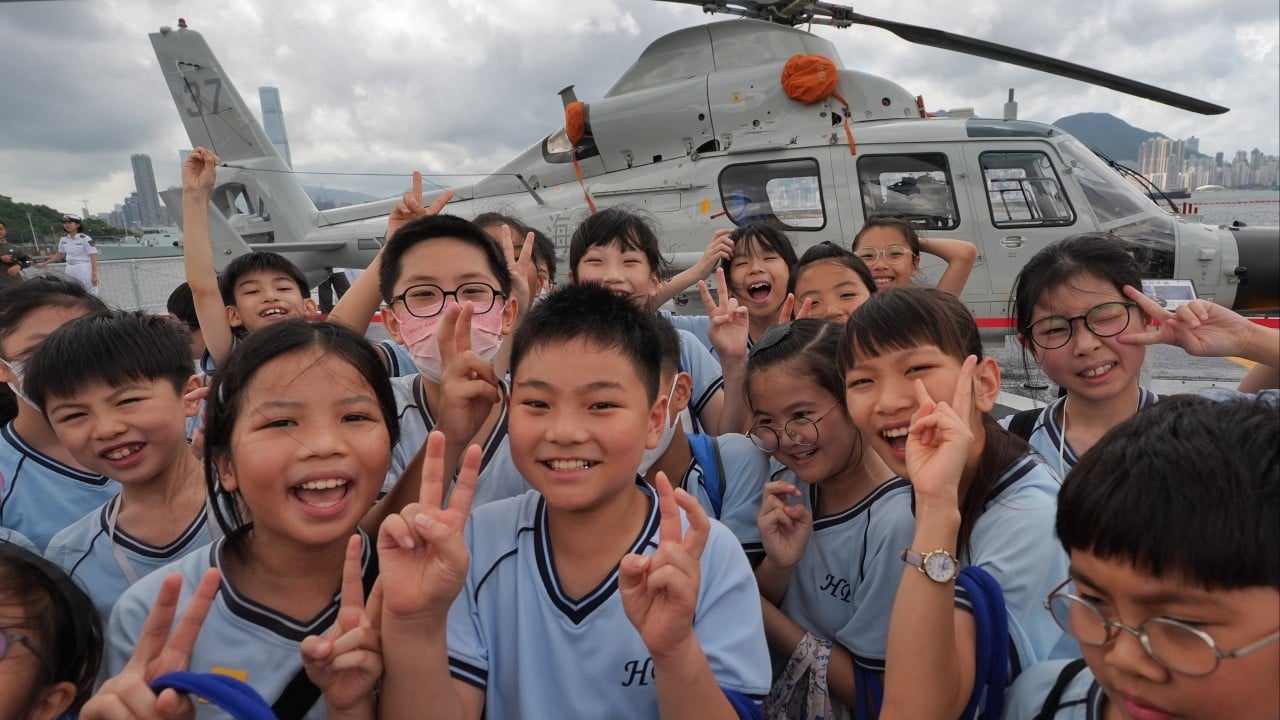
The gangway of a guided-missile destroyer does not yield to the step. It is unbending, forged from the kind of gray steel that absorbs the humid heat of the South China Sea without softening. For a seventeen-year-old who has spent his entire life navigating the neon-lit, hyper-dense verticality of Kowloon, stepping onto this deck is a jarring shift in gravity.
Consider a student named Hin. He is a fictional composite of the thousands of Hong Kong teenagers who recently lined up along the pier, but his internal friction is entirely real. Hin’s world is measured in square footage and screen time. His Saturdays are usually swallowed by cram schools, the hum of the MTR, and the endless scroll of social media feeds that flicker with global noise. He understands the concept of borders only as lines on a map or checkpoints where you scan an ID card. For an alternative view, consider: this related article.
Then, he is handed a bottle of water, guided past security cordons, and confronted with the sheer, physical mass of a People’s Liberation Army Navy warship docked in his home harbor.
This is not a standard school field trip. It is a calculated exercise in tactile reality. For years, national education in Hong Kong existed largely in text blocks. It lived in pamphlets, school assemblies, and mandated curricula that many students learned to regurgitate for exams and immediately forget. You can tune out a textbook. You can mute a video. Related coverage on the subject has been shared by TIME.
But you cannot ignore the sound of a defense siren echoing off a flight deck, or the weight of a warship that commands the horizon.
The Architecture of Impression
The water in Victoria Harbour is usually a murky green, churned constantly by Star Ferries and container ships. On this morning, the harbor serves as a backdrop for something far more austere. The sleek, angular lines of the mainland’s modern naval fleet look almost alien against the chaotic skyline of Central’s financial towers.
Step closer. The smell hits first. It is an industrial cocktail of marine diesel, fresh gray paint, and salt air. It smells like purpose.
Hin walks in a line with forty of his peers. They wear matching school tracksuits, their white sneakers squeaking against the non-slip deck coating. Officers in crisp, immaculate white uniforms stand at attention at regular intervals. Their posture is flawless. To a generation of teenagers accustomed to the casual slouch of coffee shops and study pods, this level of physical discipline feels like a performance from another era.
An officer begins to speak. His accent is distinct, carrying the sharp, northern cadences of Mandarin that contrast with the rapid-fire Cantonese bouncing quietly among the students. He does not talk down to them. Instead, he points toward the forward vertical launching system.
He explains the mathematics of defense. He talks about tracking systems, radar cross-sections, and interception vectors. The language is technical, clean, and stripped of overt ideology.
This approach is deliberate. The modern teenager possesses a highly sophisticated radar for propaganda. If you lecture them on abstract loyalty, their minds wander to their phones. But if you show them a complex engineering marvel and explain that it belongs to the collective entity they are legally part of, you bypass their skepticism. You appeal to awe.
The Shift in Scale
Every resident of Hong Kong learns early that space is the ultimate luxury. Families live stacked in concrete towers that pierce the clouds; bedrooms are often tiny, and public parks are carefully manicured and heavily regulated. Everything is small, fast, and intensely private.
On a naval vessel, space is communal, vast, yet tightly packed with lethal intent.
Hin watches a demonstration of rapid-response drills. Sailors move with a synchronized economy of motion that looks almost mechanical. There is no hesitation. No one checks a phone. No one slumps.
To understand why this matters, look at the historical context of the waters right outside the ship’s hull. A century and a half ago, these same waters were dominated by foreign gunboats that dictated the terms of Hong Kong’s existence. The city’s very identity was forged by naval vulnerability. The modern curriculum intends to flip that narrative entirely. The message delivered through the steel beneath the students' feet is simple: those days are over, and this shield is yours.
Yet, bridging that conceptual gap is a delicate process. For many of these young residents, the mainland has long been a place across the Shenzhen River—a destination for cheap shopping trips or a vague administrative power. It was rarely viewed as an emotional anchor.
One student asks a sailor where he is from.
Shandong, the sailor replies. He smiles, a brief crack in the military facade, and mentions how much he likes the warmth of the southern coast, even if the humidity makes the uniforms stick to your skin.
It is a minor interaction. Brief. Ordinary. But it serves as a reminder that the massive machine is populated by individuals not much older than the visitors themselves. The ship stops being just a political symbol and becomes a workplace inhabited by peers from across the border.
The Quiet Classroom
The afternoon sun bakes the flight deck. The students are guided inside the hangar bays, where the air conditioning struggles against the external heat. Here, the display shifts from weaponry to the daily realities of life at sea.
They see the galleys. They see the compact berths where sailors sleep for months at a time during long-range deployments.
Consider the contrast. Hong Kong youth are often criticized by older generations as being soft, pampered by the conveniences of a global city. They are the "strawberry generation"—easily bruised by hardship. Whether that label is fair or not, staring into a triple-tiered bunk bed on a warship forces a moment of self-reflection.
The silence among the tour group deepens as they walk through the medical bays and command centers. The questions shift from technical specifications to lifestyle.
"How do you call your parents?" one girl asks.
The answering officer explains the communication protocols during missions. He talks about letters, limited satellite windows, and the shared isolation that binds a crew together.
This is where the strategy succeeds or fails. It relies on empathy. By highlighting the human sacrifices required to maintain the iron shell of national defense, the organizers are trying to cultivate a sense of obligation. They are asking the youth of Hong Kong to consider what it costs to protect a nation, and whether they are willing to share in that psychological ownership.
The View from the Pier
The tour ends where it began, back on the concrete pier under the shadow of the hull. The students receive commemorative caps and pins. They take group photos, standard smiles plastered across their faces for the school website and official press releases.
But watch them after the cameras turn off.
Hin adjusts his new cap. He looks back up at the radar arrays spinning slowly against the gray sky. He does not look transformed. He does not look like a revolutionary or a fiercely converted nationalist. It would be a mistake to assume a single afternoon could rewrite a lifetime of complex identity.
But something has shifted. The next time he reads a headline about regional maritime tensions or national security laws, the abstract terms will have a physical counterpoint. He will remember the smell of the paint. He will remember the sailor from Shandong who missed the northern winter. He will remember that the state is not just a collection of directives issued from Beijing, but an immense, heavy apparatus made of iron and bone.
The students walk back toward the MTR station, melting back into the crowds of shoppers, commuters, and tourists. They carry their souvenirs in plastic bags. Behind them, the destroyer sits quiet in the harbor, a massive gray island of discipline waiting for the tide to turn.


