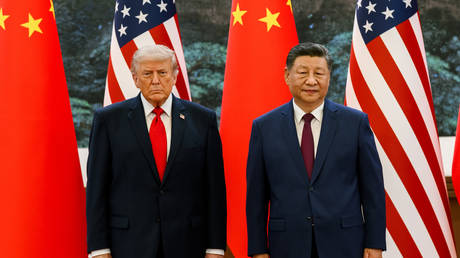
The air inside the Great Hall of the People has a specific, weighted silence. It is the kind of quiet that doesn't just signify a lack of noise, but the presence of immense, concentrated power. Imagine a single document sitting on a lacquered table, its ink still fresh, carrying the weight of two superpowers and the fragile stability of the Middle East. This isn't just about diplomacy. It is about the physical objects that move across borders—the steel, the circuitry, and the silent drones that can change the fate of a city in an afternoon.
Donald Trump recently stood before a crowd and shared a detail that had been tucked away in the high-stakes theater of international relations. He spoke of a promise. Not a vague diplomatic gesture, but a specific commitment from Chinese President Xi Jinping. The pledge was simple in its phrasing but seismic in its implications: China would not send military equipment to Iran.
To understand why this matters, you have to look past the podiums and the press releases. You have to look at a small electronics workshop in Tehran or a shipping container idling in the Port of Shanghai.
The Ghost in the Machine
Warfare in the modern age isn't always about tanks and heavy artillery. It is about the "dual-use" economy. A microchip that stabilizes a camera in a consumer drone is often the exact same piece of silicon that guides a loitering munition toward a power grid. When a world leader promises to withhold "military equipment," they are drawing a line in shifting sand.
Consider a hypothetical engineer in a windowless room, tasked with sourcing parts for a new defense project. If the supply line from Beijing dries up, that engineer isn't just inconvenienced. The entire architecture of regional influence shifts. For years, the flow of technology from East to West has been the lifeblood of proxy conflicts. When that flow is interrupted by a personal vow between two men, the gears of global tension begin to grind.
The skepticism is natural. We live in an era where words are cheap and digital footprints are easily erased. Yet, the gravity of this specific promise lies in the personal nature of the exchange. Trump didn't frame this as a bureaucratic treaty. He framed it as a handshake deal—a test of will and ego between two figures who view the world as a chessboard.
The Price of a Broken Vow
Trust is the most expensive commodity in geopolitics. It is harder to mine than lithium and more volatile than crude oil. If Xi Jinping makes a promise to a U.S. President regarding Iran, he isn't just talking about missiles. He is talking about the credibility of the Chinese state in the eyes of its largest trading partner.
Iran sits at a volatile crossroads. It is a nation under heavy sanctions, constantly seeking the technical oxygen required to maintain its military standing. For Tehran, Chinese hardware—telecommunications, satellite imaging, and precision components—is more than just equipment. It is survival. If Beijing truly closes the valve on military-grade exports, the ripple effect would be felt from the Levantine coast to the Persian Gulf.
The stakes for the American taxpayer are equally high. Every drone or missile component that doesn't reach a militia in the Middle East is a billion dollars saved in defense spending and, more importantly, lives preserved in the field. But the reality is messy. The border between "civilian" and "military" is a blur of grey market shipping and shell companies.
The Language of the Deal
Politics is often a game of "what is unsaid." When Trump recounts his conversation with Xi, he is painting a picture of a world governed by strongmen and direct consequences. It’s a narrative of personal leverage. He wants the world to believe that the trajectory of global conflict can be altered by a single conversation in a gilded room.
Is it true? Or is it a performance?
The truth likely sits in the tension between the two. China is an empire built on long-term strategy, rarely given to impulsive concessions. If Xi gave his word, he did so because the alternative—unbridled trade wars or a direct confrontation over Middle Eastern proxies—was deemed too costly.
But consider the human cost of the alternative. If these promises are broken, the result isn't a headline. It’s a kinetic reality. It’s the sound of a motor over a residential street. It’s the sudden darkness when a substation is hit. We treat these diplomatic updates as sports scores, but they are the thin membranes holding back chaos.
The Invisible Shipment
Think about the sheer scale of global trade. Millions of containers move across the ocean every day. Somewhere, right now, a crane is lifting a crate that contains nothing but circuit boards. Are those boards meant for a high-end smartphone, or are they headed for the guidance system of a ballistic missile?
This is the nightmare of the modern regulator. This is why a personal promise from the top matters more than a thousand pages of trade law. You can't inspect every box. You can't track every transistor. You have to rely on the intent of the sender.
If the Chinese state decides to enforce this promise, the "military equipment" doesn't just stop arriving; it disappears from the manifests. The factories are told to look elsewhere for buyers. The intermediaries are warned. It is a top-down silencing of a supply chain.
There is a deep, unsettling vulnerability in realizing that our safety depends on the private conversations of men who rarely see the people their decisions affect. We are all passengers on a ship where the captain and the navigator are arguing over the map in a language we don't fully speak.
The Weight of the Word
We are told that the world is governed by systems, by institutions, and by the "rule of law." But listen to the way these leaders speak. They talk about "my friend Xi" or "the deal I made." They describe a world that is profoundly personal.
If China stays true to this commitment, it marks a pivot. It suggests that Beijing sees more value in a stable relationship with Washington than in the tactical advantages of arming Tehran. It is a cold, hard calculation of interest masked as a gesture of goodwill.
But promises are not permanent. They are living things. They require constant feeding. They are subject to the whims of the next election, the next border skirmish, or the next economic dip. The "military equipment" is sitting in warehouses, ready to move the moment the political weather changes.
The silence from the Iranian side is perhaps the most telling part of this narrative. For a nation that relies on being the regional disruptor, the prospect of its most powerful patron stepping back—even slightly—is a chilling one. It forces a recalibration. It creates a vacuum where there was once a reliable stream of hardware.
The Shadow on the Wall
We often look at these news cycles and see only the surface tension. We see the orange hair and the stoic Chinese face. We see the headlines about "promising" and "withholding."
But if you look closer, you see the outlines of a new world order. It’s a world where the most dangerous weapons aren't the ones being fired, but the ones being used as bargaining chips in a game of global poker. The equipment itself is almost secondary. The real power is the ability to say "no."
Imagine the phone calls happening in the wake of such a statement. Generals in Tehran calling their counterparts in Beijing, asking for clarification. Logistics officers in the U.S. Navy adjusting their threat assessments. This is the invisible work of diplomacy—the frantic scramble to see if a verbal promise has been translated into a physical reality.
It is a fragile peace. It is a peace built on the ego of leaders and the economic necessity of trade. It is a peace that could be undone by a single shipment of specialized sensors or a change in the rhetoric of a campaign rally.
The document on that lacquered table in the Great Hall isn't just paper. It is a dam. Behind it sits the immense pressure of years of conflict, billions of dollars in weaponry, and the ambitions of a nation seeking to reshape the map. For now, the dam holds. But anyone who has lived through the last decade knows that dams are prone to cracks, and once the water starts to seep through, no promise is strong enough to stop the flood.
The true test of this handshake won't be found in a speech. It will be found in the quiet absence of Chinese steel in the sands of the Middle East. It will be found in the things that don't happen—the attacks that aren't launched because the parts never arrived. We live in the gaps between these promises. We survive in the silence of the guns that were never built because someone, somewhere, decided that a deal was worth more than a war.