The rain over Central does not fall gently. It drives down in heavy, slate-gray sheets that turn the glass skyscrapers into bleeding mirrors, washing the limestone facade of the Bank of China tower until it looks like a blade pulled straight from the stone.
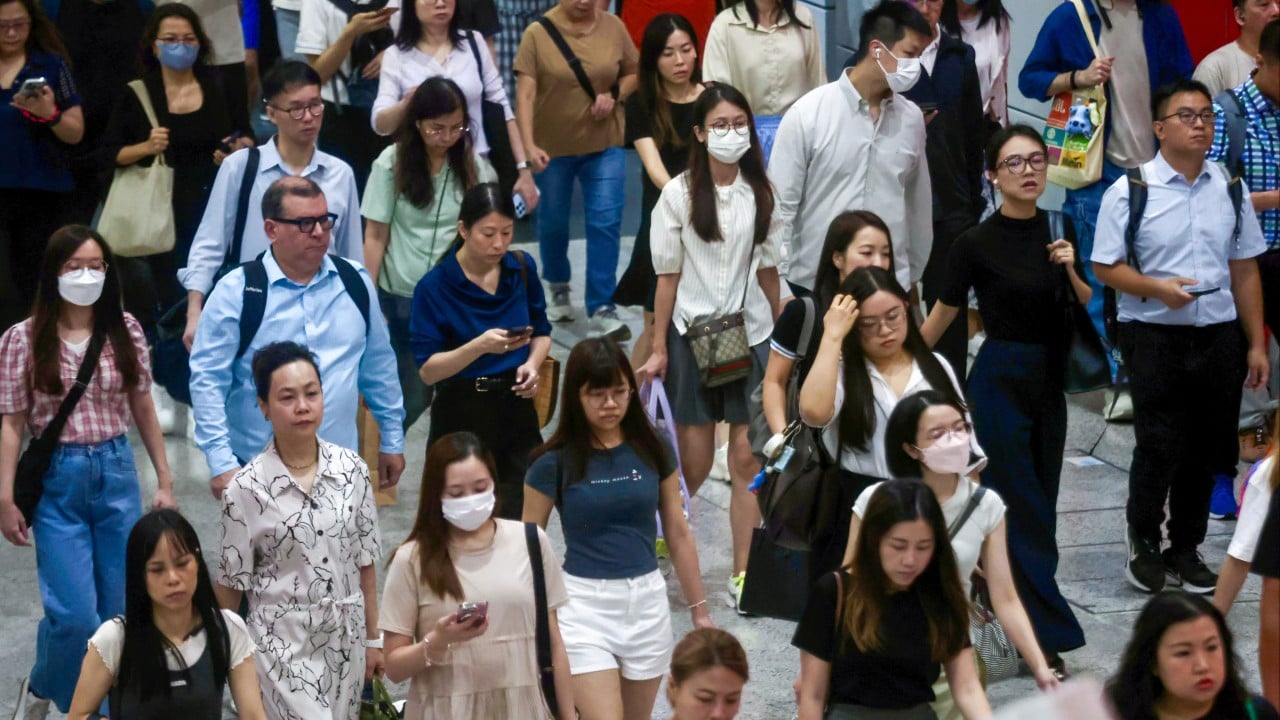
Stand on the mezzanine of the IFC mall at six in the evening. Watch the people. They move with an intent that borders on kinetic urgency. Traders, compliance officers, family office managers clutching leather folios against the damp. They are not merely walking; they are navigating the pressure drop of a financial system that has just absorbed an astronomical weight.
One point three trillion dollars.
Say it out loud. It sounds like a ledger entry from an empire that no longer exists, or a typo in a central bank's quarterly report. But it is real. That staggering sum of US dollars has quietly, relentlessly poured into Hong Kong investment products, reshaping the tectonic plates of Asian finance while the rest of the world was looking elsewhere.
To understand what that number actually means, you have to strip away the Bloomberg terminals and the sanitized jargon of asset allocation. You have to look at the human friction beneath the liquidity.
Consider Arthur. (Note: Arthur is a hypothetical family office director whose daily routine mirrors the real-world operational pressure faced by wealth managers across the territory this year.) Arthur has spent twenty-five years watching capital behave like a frightened animal. For the better part of a decade, he watched money sprint out of this city. Every geopolitical headline, every regulatory shift, every whispered rumor in the members-only clubs of Aberdeen became an excuse for capital flight. The narrative was simple, lazy, and mostly wrong: Hong Kong is finished, they said. The hub is dead.
Arthur remembers the quiet evenings of late 2022, when the office lights stayed on not because there was work to do, but because everyone was waiting to see which shoe would drop next. His phone buzzed with frantic clients wanting to move their holdings to Singapore, to Zurich, to anywhere that felt flat and predictable.
Then came the pivot. It wasn't cinematic. There was no single bell ringing on the exchange floor.
Instead, it arrived as a slow, accumulating gravity.
Money doesn't care about headlines as much as it cares about yield, access, and proximity to the world’s most dynamic manufacturing engine. When mainland Chinese wealth managers, sovereign funds, and international institutional allocators looked at the global board, they realized something fundamental: the plumbing between the mainland and the global economy still runs directly through Victoria Harbour.
One point three trillion dollars did not arrive in a single tidal wave. It drifted in through the back doors of wealth management accounts, exchange-traded funds, private equity vehicles, and bond issuances. It came because people with terrifying amounts of money needed a place where the infrastructure was steel-riveted, the legal framework was familiar, and the returns could outrun domestic stagnation.
To grasp the sheer scale of this, imagine every container ship currently docked in Kwai Tsing filled not with consumer electronics or textiles, but with physical bricks of hundred-dollar bills. Stack them floor to ceiling, stretching from the Peak down to the Star Ferry pier. That is the volume of liquidity we are talking about.
Why did it happen now? Why this sudden, massive gravitation toward Hong Kong investment products when caution was supposed to be the reigning philosophy?
Fear has a twin, and its name is opportunity cost.
For months, global investors sat on piles of cash, paralyzed by high interest rates in the West and economic deceleration in the East. But capital is a living thing. It cannot hibernate forever. Eventually, the cost of doing nothing becomes higher than the risk of doing something. And when investors surveyed the alternatives, Hong Kong offered a unique asymmetry. Valuations had been beaten down to generational lows. The market was priced for a perpetual apocalypse that never quite arrived.
When you price an entire financial ecosystem as if it has already collapsed, any pulse at all looks like a resurrection.
So the money moved. It flowed into high-yield offshore renminbi instruments, wealth management connect schemes, structured products, and tech-adjacent equities. It poured into the veins of a system that was built precisely for this kind of arbitrage between East and West.
Yet numbers of this magnitude always cast long shadows.
Walk through Sheung Wan, away from the gleaming copper-and-glass monuments of international banking, and you find the older Hong Kong. The herbal medicine shops where dried seahorses hang in glass jars. The print shops where families have pressed business cards for three generations. Here, a trillion dollars feels as distant as the rings of Saturn.
The disconnect is jarring. On one side of the harbor, asset managers are engineering complex yield strategies for ultra-high-net-worth clients whose portfolios look like small nation-states. On the other side, shopkeepers worry about commercial rents that refuse to budge and a domestic consumer base that is spending with cautious, measured restraint.
This is the central paradox of the modern financial hub. It can be simultaneously awash in historic wealth while the street-level economy feels the steady, grinding pressure of high borrowing costs and changing consumer habits. Capital is extraordinarily mobile; human lives are anchored to geography.
When a trillion dollars enters a market, it doesn't distribute itself evenly like morning mist. It pools. It inflates certain asset classes while leaving others parched. It creates intense competition for yield, driving institutional investors further out on the risk curve just to find a return that beats inflation.
Arthur sees this in his daily meetings. The clients who were hyper-conservative two years ago are now asking about private credit, structured notes, and cross-border tech plays. The psychological pendulum has swung from panic to a restless, aggressive hunt for growth. They are not asking if they should invest in Hong Kong anymore; they are demanding to know how they can get a larger slice of the incoming flow before the window closes.
This behavior exposes a universal truth about markets. We pretend they are governed by cold rationalism, by discounted cash flow models and macroeconomic indicators. But markets are actually emotional ecosystems driven by momentum, fatigue, and the deep human desire not to be left behind when the tide turns.
The record influx into Hong Kong's financial products is not just a statistical milestone. It is a referendum on resilience. It proves that despite years of institutional pessimism, regulatory friction, and shifting global alliances, the core machinery of international finance in this city retains an almost gravitational pull.
The rain over Central is starting to clear. Through the parting clouds, the late afternoon sun catches the top of the International Commerce Centre, turning the glass into a blinding pillar of gold. Down below, the crowds surge forward, stepping over the slick pavement, chasing the next yield, the next trade, the next iteration of a city that has reinvented itself a dozen times before and is currently doing it all over again, one trillion-dollar transaction at a time.