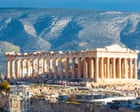
Stand on the summit of the Athenian Acropolis at dusk, when the scorching limestone finally surrenders to the cooling Aegean wind, and look up at the Parthenon. For two and a half millennia, this ruined skeleton of white Pentelic marble has dominated the skyline not merely as a temple, but as an optical legend. Generations of architects, students, and tourists have been fed a comforting, romantic narrative. We were taught that the ancient Greeks were aesthetic demigods who bent geometry to their will, deliberately curving every horizontal line and tilting every column inward to correct for the deceptive flaws of the human eye.
It is a hypnotic story. It turns the building into a living, breathing creature that actively fights against human imperfection.
There is just one problem. It is almost entirely wrong.
A modern British mathematician has recently dismantled this foundational myth, dragging our romanticized notions of classical architecture into the cold, harsh light of empirical reality. But to understand why this matters—why thousands of visitors weeping at the foot of the Acropolis have been chasing a ghost—we have to step back into the dust and sweat of the fifth century BCE, long before the tourists arrived with their wide-angle lenses and guidebooks.
Picture Ictinus and Callicrates, the master builders, standing amidst blocks of stone weighing tons each, hauled up the treacherous slopes of the sacred rock by oxen and human muscle. They are not floating above the site like Renaissance painters applying finishing touches to a canvas. They are shouting over the din of bronze chisels striking stone. They are sweating through coarse linen tunics. They are fighting against time, budget, and the brutal laws of gravity.
For generations, art historians have looked at the Parthenon’s slight upward curve in its stylobate—the platform upon which the columns rest—and declared it a masterclass in optical trickery. The prevailing doctrine claimed that long horizontal lines appear to sag in the middle to the human eye, so the ancient Greeks curved the platform upward to make it look perfectly, mathematically flat. They supposedly did the same with the columns, giving them an entasis, a subtle swelling in the middle, and leaning them inward so they would look stable rather than top-heavy.
It sounds poetic. It sounds like the ultimate triumph of human perception over inanimate matter.
Mathematics disagrees.
When modern computational analysis and precise laser measurements are applied to the surviving marble, the romantic fog lifts. The deviations from straight lines and right angles are real, yes. The stylobate really does curve upward by about six centimeters along its flanks. The columns do taper and swell. But the why of it has been fundamentally misunderstood.
Think about how a massive stone structure actually behaves. Imagine stacking thousands of multi-ton marble drums on top of one another without modern Portland cement. Gravity does not care about your aesthetic philosophy. Gravity pulls downward relentlessly, unevenly, and destructively.
When a mathematician runs the structural analysis on the Parthenon’s geometry, the curves stop looking like artistic flourishes and start looking like engineering genius of an entirely different flavor. The building is not trying to trick your eye. It is trying to survive the earth.
Consider what happens when you lay massive blocks of stone across a long foundation. If that foundation is dead flat and rigid, the immense weight concentrates at specific stress points. Seismic activity—and Athens is no stranger to earthquakes—will snap a rigid stone box like a dry twig. By introducing gentle curvatures and flexible joints, the ancient builders created a structure that could flex, distribute loads dynamically, and absorb the violent shocks of the earth.
The optical illusion theory assumes that the Greeks built the Parthenon primarily as a visual spectacle for someone standing at a single, perfect vantage point. But human vision does not work that way, and neither did ancient worship. Ancient Greeks did not walk up to the Acropolis with a camera viewfinder to check for perspective distortion. They processed around the building in large, boisterous, sun-drenched crowds during the Panathenaic festival, moving through blinding light and deep shadow, smelling burning fat from sacrifices and hearing the piercing shriek of reed pipes.
To them, the building was an organic body. And organic bodies are never entirely straight.
When the British mathematician systematically tested the optical correction hypothesis against actual human visual perception models, the numbers simply refused to align. The curvature of the platform is often too subtle to actually correct the optical illusions it was supposedly designed to fix, yet too pronounced to be an accident. It occupies a strange middle ground that makes no sense if your goal is mere visual trickery.
However, it makes absolute sense if your goal is structural resilience and dynamic equilibrium.
We have spent centuries projecting our own obsession with perfection onto a culture that was far more interested in survival. We wanted the Greeks to be gods of pure intellect, floating above the physical constraints of weight and strain. We wanted their buildings to be flawless geometric equations carved in stone.
The truth is much messier, and infinitely more impressive.
The Parthenon does not stand because its creators possessed magical insights into human optics. It stands because they understood how stone breathes. They knew how weight flows through a column. They knew that a rigid line is a brittle line, and that true strength requires a certain give, a subtle sway, a willingness to bend with the forces of the world rather than shatter against them.
The next time you see a photograph of the Parthenon silhouetted against an Athenian sunset, strip away the centuries of academic mythology. Look past the tourist crowds and the scaffolding of ongoing restoration. See the stone for what it actually is: a massive, calculated compromise with gravity.
The illusion was never in the marble. The illusion was in us. We looked at a machine built for endurance and mistook it for a painting. And in doing so, we missed the most remarkable part of the story. The Greeks did not conquer nature with their eyes. They negotiated with it using math, sweat, and stone, leaving behind a ruin that still refuses to fall.