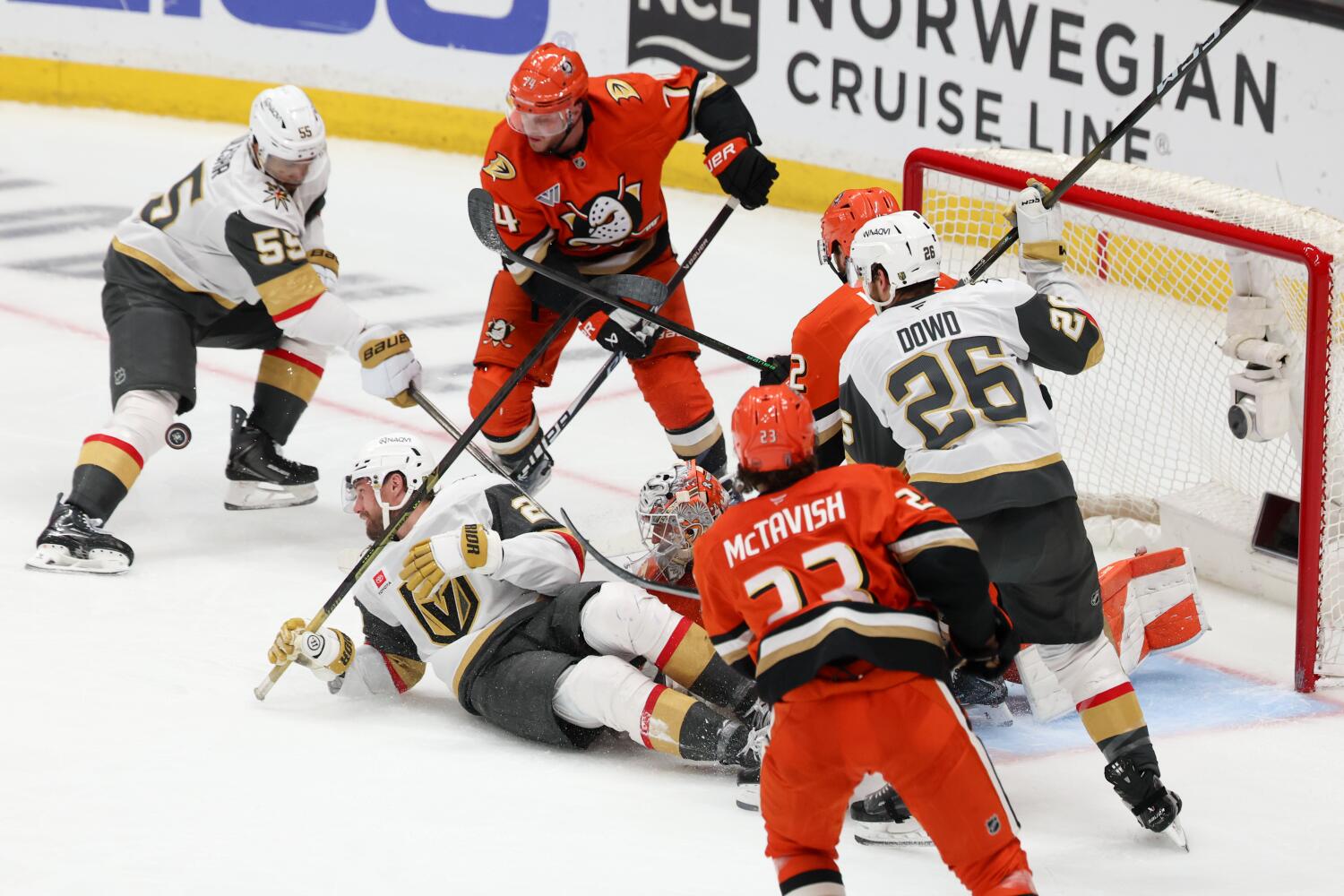
The Anaheim Ducks’ season did not end because of a bad bounce or a hot goaltender in Game 6. It ended because the Vegas Golden Knights methodically dismantled a roster that had been playing over its head for four months. While the local narrative focuses on a "storybook" run that fell two wins short of a Western Conference Finals appearance, the reality inside the rink tells a grittier story of structural failure and a talent gap that finally became too wide to ignore. Vegas didn't just win this series; they provided a masterclass in how modern, heavy postseason hockey is played, leaving Anaheim to wonder if their young core is actually ready for the heavy lifting required in May.
The Illusion of Momentum
Anaheim entered the postseason as the NHL’s most dangerous underdog. They had a rookie sensation scoring at a historic clip and a veteran goaltender who looked like he had rediscovered his Vezina-caliber form. But momentum is a fragile currency in the Stanley Cup Playoffs. It works until you hit a team that refuses to blink.
The Golden Knights spent the first three games of this series absorbing Anaheim’s speed. They allowed the Ducks to skate circles in the perimeter, keeping the shots outside and the high-danger chances to a minimum. By the time Game 6 rolled around in a deafening T-Mobile Arena, the Ducks looked spent. Their legs, which had been their primary weapon against slower opponents in the first round, had turned to lead.
The "storybook" ending was never about a lack of heart. It was about a lack of depth. When your top line is neutralized by a suffocating defensive pair like Vegas employs, you need the bottom six to chip in. Anaheim’s third and fourth lines were non-factors for the final 120 minutes of the series. They weren't just outscored; they were physically bullied off the puck in every meaningful board battle.
The Strategy That Suffocated Anaheim
Vegas head coach Bruce Cassidy didn't do anything revolutionary. He simply exploited a flaw in Anaheim’s defensive transition that had been visible since January. The Ducks rely heavily on their defensemen joining the rush to create odd-man advantages. It’s high-risk, high-reward hockey that looks great on a highlight reel but creates massive craters in the neutral zone when the puck is turned over.
Vegas feasted on these turnovers.
Every time an Anaheim defenseman pinched too deep, the Golden Knights launched a counter-attack that caught the Ducks’ forwards flat-footed. In Game 6, three of the four Vegas goals came directly from neutral zone interceptions. This wasn't bad luck. It was a calculated tactical hunt. The Golden Knights dared Anaheim to play their aggressive style, then punished them for the lack of discipline that usually accompanies a young, hungry roster.
The Faceoff Dominance Factor
If you want to know why Anaheim couldn't sustain any pressure in the third period, look at the dot. Vegas won 64% of the draws in the final frame. In the playoffs, possession is everything. If you start every shift chasing the puck because your center lost the draw, you are burning energy just to get back to even.
Anaheim’s young centers were exposed. They were pushed around by veteran Vegas pivots who knew every trick in the book—leaning into the circle, using the back of the blade, and winning the battle of the skates. It’s a subtle part of the game that fans rarely cheer for, but it’s the reason Vegas had the puck for nearly 18 minutes of the final period. You cannot score if you are stuck in a defensive shell, and you stay in that shell when you can't win a puck drop.
Power Play Paralysis
The most damning indictment of the Ducks’ exit was their performance on the man advantage. Going 0-for-14 over the final three games of the series is a statistical anomaly that borders on malpractice.
Anaheim’s power play became predictable. They looked for the cross-seam pass every single time, ignoring the dirty work in front of the net. Vegas’s penalty kill didn't even have to work that hard; they just stayed in their lanes and waited for the inevitable errant pass.
Special teams win championships.
Without a functioning power play, Anaheim had to play perfect five-on-five hockey. No team in this league is good enough to do that against a defending champion or a top-tier contender. The Ducks’ coaching staff failed to adjust, sticking with the same stagnant umbrella formation while the Golden Knights’ shot-blockers turned their bodies into human shields. By the time the Ducks tried to simplify their approach in the third period of Game 6, the deficit was already two goals and the Vegas crowd had turned the arena into a pressure cooker.
The Physical Toll of the Heavy Game
There is a specific brand of hockey played in the Pacific Division that requires a certain level of "heavy" play. You need players who can win battles in the corners and hold their ground in the crease. Anaheim, for all their speed and skill, remains a relatively light team.
The Golden Knights recognized this early in the series. They finished every check. They made sure that every time a Ducks player touched the puck, they paid a physical price. Over a seven-game series, that cumulative damage adds up. By Game 6, the Ducks were shying away from contact. They were moving the puck a second too early to avoid the hit, leading to those catastrophic turnovers mentioned earlier.
This isn't a criticism of the players' courage. It is a reality of physics. When a 220-pound defenseman hits a 185-pound winger fifty times over ten days, the winger is going to slow down. The Ducks’ "storybook" season hit a wall of meat and muscle, and they didn't have the size to push back.
The Goaltending Disparity
John Gibson did everything he could. He faced a barrage of shots, many of them from high-danger areas that his defense failed to clear. But on the other end of the ice, the Golden Knights got the kind of "boring" goaltending that wins series. Positionally sound, no rebounds, and zero soft goals.
While Gibson was forced to be spectacular just to keep the Ducks in the game, the Vegas netminder only had to be solid. That’s the difference between a team that protects its goalie and a team that relies on him to be a savior. You can win a few games with a savior in net. You cannot win a Cup that way.
A Roster in Transition
The Ducks’ front office has some difficult questions to answer this summer. This playoff run was supposed to be the arrival of the next generation, but it showed that the gap between "promising" and "contender" is wider than the standings suggest.
The reliance on aging veterans to provide the emotional spark is a red flag. When the chips were down in Game 6, it wasn't the 20-year-olds leading the charge; it was the same core that has been dragging this franchise along for years. The youth movement needs to take the next step from being contributors to being the engine.
Necessary Personnel Shifts
- Size on the Wings: Anaheim needs players who can protect the puck in the offensive zone. They have too many perimeter players who get pushed off the puck in the playoffs.
- Defensive Accountability: The "rover" style of defense needs to be tempered with a more conservative structure when leading or in tight games.
- Center Depth: They need a veteran "shutdown" center who can win a key faceoff in his own zone with two minutes left on the clock.
Vegas didn't just end a season; they provided a roadmap for what the Ducks are missing. The Golden Knights are a team built for the grind. They are comfortable in the mud. They don't care about "storybook" narratives or being the sentimental favorite. They play a cold, efficient, and violent brand of hockey that is designed to break opponents over time.
The Cold Reality of Game 6
The final siren in Las Vegas didn't just signal the end of a game. It signaled the end of an era of low expectations in Anaheim. For the last few years, the Ducks were "rebuilding." This year, they proved they could compete. But the manner in which they were eliminated shows that "competing" and "winning" are two vastly different stages of development.
The fans in Anaheim might be proud of this team, and they should be. Making it this far was an achievement. However, inside the locker room, the mood shouldn't be one of satisfaction. It should be one of frustration. They were handled. They were outclassed in the areas of the game that matter most when the calendar turns to May.
If this franchise wants to move beyond being a feel-good story and become a perennial threat, they have to stop relying on the magic of a "storybook" season and start building a roster that can survive a street fight. Vegas showed them exactly what that looks like. Now, the ball is in Anaheim’s court to see if they are willing to do the uncomfortable work necessary to match it.
The Golden Knights are moving on because they are the better, stronger, and more disciplined hockey team. The Ducks are going home because, in the end, speed and spirit are no match for a heavy system executed with surgical precision.
Stop talking about the "storybook." Start talking about the blueprint.