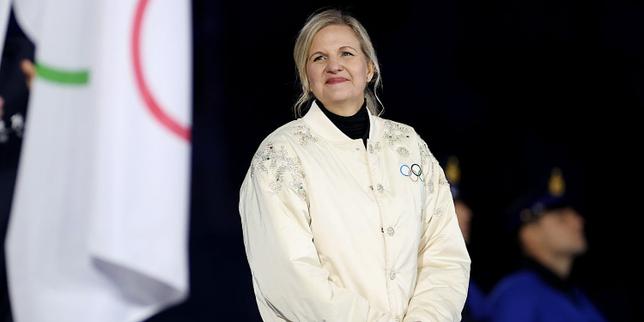
The water in an Olympic pool doesn't care about your passport, your politics, or the hormone levels coursing through your veins. It is a silent, heavy witness. For Kirsty Coventry, that water was once a sanctuary. In 2004 and 2008, the world watched a lithe, determined woman from Zimbabwe slice through the blue to become the most decorated individual swimmer in African history. She was the "Golden Girl," a symbol of hope for a fractured nation.
But the water is different from the boardroom. In the pool, the clock is the only judge. In the halls of the International Olympic Committee, the metrics of success are far messier.
Now, as the President of the IOC, Coventry finds herself standing at the edge of a different kind of abyss. She isn't just looking at a stopwatch anymore; she is looking at the very definition of what it means to be a woman in elite sport. Her decision to reinstate sex-based eligibility testing—frequently called "femininity tests"—for the Los Angeles Games has sent a tremor through the athletic world. It is a move that feels like a step back into a darker era of sports history, yet Coventry frames it as the only way to save the future of the female category.
Consider a runner like "Maya," a hypothetical sprinter from a rural village. She has spent ten years training in the dirt, her lungs burning, her heart hammering against her ribs. She wins her national trials. She qualifies for LA. Then, a man in a suit tells her she needs to step into a clinic to prove she is who she says she is. The humiliation isn't just a byproduct; it’s the process.
This is the reality Coventry is navigating. She is a woman who reached the pinnacle of sport, now presiding over a system that questions the biological legitimacy of those following in her wake.
The Ghost of 1966
We have been here before, though we like to pretend we’ve evolved. In the 1960s, "nude parades" were the standard. Female athletes were forced to walk past a panel of doctors to verify their anatomy. It was crude, dehumanizing, and scientifically flimsy. Eventually, the IOC moved to chromosomal testing—the simple XX and XY. But biology is never simple. Nature doesn't always work in binaries; it works in gradients.
When the tests were largely scrapped in the late 90s, the world breathed a sigh of relief. The focus shifted to testosterone levels, a policy that famously entangled Caster Semenya in a decade-long legal battle that stripped her of her dignity and her career.
Coventry’s pivot back toward broader testing isn't just a policy tweak. It is a philosophical shift. The argument from the IOC under her leadership is that "fairness" for the majority of female athletes requires a rigid gatekeeping of the category. They argue that without these checks, the biological advantages of male puberty will eventually render the female category obsolete.
But how do you define the boundary of a woman? Is it a level of testosterone? The presence of a Y chromosome? The shape of a pelvic bone?
When Coventry speaks, she often uses the language of "protection." She wants to protect the "sanctity" of women’s sports. It’s a powerful word. It evokes images of a walled garden that must be defended against intruders. But for the athletes caught in the gray areas—those with Differences of Sexual Development (DSD)—that wall isn't a defense. It’s a cage.
The Weight of the Blazer
Kirsty Coventry knows what it’s like to be an outsider. She competed for a country in the midst of hyperinflation and political collapse. She carried the weight of Zimbabwe on her shoulders every time she stepped onto the blocks. She was the underdog who became the queen.
That lived experience makes her current stance all the more complex. One might expect a former athlete to lead with empathy for the individual. Instead, Coventry has adopted the cold, utilitarian logic of the institution. In the IOC’s view, the individual must be sacrificed for the "integrity" of the collective.
The logistical nightmare of LA is looming. How do you test thousands of women without creating a human rights catastrophe? The plan involves "targeted" testing, a phrase that carries an ugly scent of profiling. History shows us that these tests rarely target white, Western athletes. They target the "suspiciously" fast, the "too" muscular, the women who don't fit a traditional, Eurocentric mold of femininity.
Imagine the tension in the Olympic Village. You are there to perform the greatest feat of your life, but instead of focusing on your start time, you are wondering if your body will be flagged as a "technicality."
The Biological Lottery
Sport is fundamentally unfair. We celebrate the biological outliers. We marvel at Michael Phelps’ wingspan and his body’s ability to produce less lactic acid than his rivals. We didn't ask him to undergo surgery to "level the playing field." We called him a freak of nature and gave him twenty-three gold medals.
Why is it that when a woman has a biological advantage, we call it a threat?
The answer lies in the unique way we gender competition. Men’s sport is seen as the "open" category—the limit of human potential. Women’s sport is a protected sub-set, created specifically to allow those without the physiological boost of testosterone to achieve glory. If you remove the barriers to that sub-set, the logic goes, you lose the reason for its existence.
Coventry is caught in the middle of this existential crisis. She is being lobbied by feminist groups who demand the exclusion of anyone with male biological traits, and by human rights advocates who see sex testing as a form of state-sponsored harassment.
There is no middle ground. There is no compromise that leaves everyone whole.
The Los Angeles Horizon
The sun is going to rise over the Los Angeles Memorial Coliseum, and the world will expect a celebration of human spirit. But beneath the surface, the medical commissions will be working.
Coventry’s legacy is now inextricably tied to this. If the LA Games are remembered for a string of disqualifications and leaked medical records, her brilliant career in the water will be overshadowed by her role as the gatekeeper of the locker room. She is betting that the public prefers a "pure" category over the messy reality of human biology.
It is a high-stakes gamble.
We often talk about the Olympics as a place where the world comes together, but these tests are designed to pull us apart. They ask us to look at our heroes not as legends, but as specimens. They turn the podium into a laboratory.
The irony is that Coventry herself was once the ultimate proof that the system worked. She came from nowhere and beat the giants. She didn't need a test to prove she belonged. Her speed was her testimony.
Now, she is the one holding the clipboard. She is the one asking the questions that have no easy answers. The "Golden Girl" has become the Iron Lady of the IOC, and the ripples she is making in the water today will be felt long after the final torch is extinguished in Los Angeles.
The stadium lights will eventually go down. The crowds will head home. But for the women whose lives were dissected in a quest for "fairness," the race never truly ends. They are left running against a ghost, a standard of femininity that is as shifting and elusive as the water in a pool.