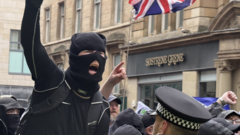
A predictable script played out on the streets of Glasgow. An anti-racism rally assembled. A group of masked individuals arrived to disrupt it. The media rushed to file copies about "clashes," "rising tensions," and "threats to democracy."
This standard narrative misses the entire point of modern street politics.
The conventional view treats these public disruptions as organic explosions of ideological hatred or spontaneous breakdowns of public order. That is a naive misreading of the mechanics of public dissent. Street confrontations in the modern era are not arguments; they are highly choreographed theater designed to exploit the mechanics of the attention economy. By treating these incidents as genuine ideological battlegrounds rather than cynical media plays, mainstream commentary feeds the exact radicalization cycle it claims to deplore.
The Symbiotic Theater of Street Protests
Look closely at the anatomy of the Glasgow disruption. You have two opposing factions who claim to share absolutely nothing in common. In reality, they share a mutual dependency.
The masked agitators do not show up expecting to convert anyone to their cause. They do not expect to win a debate on municipal policy or demographic shifts. They show up for the imagery. A line of black-clad, masked figures clashing with police or shouting down opponents creates an immediate, visceral visual product.
Street agitations are factories for content production. The clash is the product.
The organizers of the original rally need this opposition just as badly. Without the threat of an immediate, tangible adversary, a peaceful march is just a crowd of people standing in the Scottish rain. It struggles to make the evening news. It fails to generate the outrage necessary to drive digital donations, newsletter sign-ups, and organizational relevance. The presence of the masked counter-protester instantly elevates a local gathering into a high-stakes battle between good and evil.
I have watched political organizations across the spectrum operate for over a decade. The pattern never changes. Organizations on both the left and the right use the threat of the "other side" as their primary recruitment tool. When the masked disruptors show up, they are not ruining the event; they are validating it.
The Failure of the Policing Paradigm
Whenever these disruptions occur, the immediate public demand is for more aggressive policing, stricter laws on masks, or outright bans on assembly. This reaction operates on a flawed premise: that the state can legislate away political friction without destroying civil liberties in the process.
Consider the logistics of banning face coverings at public demonstrations. It sounds like a straightforward fix to prevent anonymous intimidation. However, enforcement in a chaotic crowd dynamics situation is a logistical nightmare.
- Selective Enforcement: Police officers must decide who is wearing a mask for medical reasons, who is wearing a scarf due to the Glasgow chill, and who is wearing a balaclava for criminal anonymity.
- Escalation Dynamics: Attempting to forcibly remove masks from non-compliant individuals in a tense crowd instantly triggers the exact physical violence the policy was meant to avoid.
- The Streisand Effect: Banning a group or a symbol simply drives it underground, wrapping it in an aura of forbidden rebellion that appeals directly to disaffected young demographics.
When the state steps in with heavy-handed tactics, it merely provides the disruptors with a secondary, even more valuable target: the government itself. The narrative shifts from a squabble between local factions to a grand struggle against state oppression. The masked agitators win either way. If the police leave them alone, they dominate the local space. If the police crack down, they secure the martyrdom they crave for their next promotional video.
Dismantling the PAA Fallacies
The public discourse surrounding these events is dominated by flawed assumptions that routinely appear in "People Also Ask" search trends. Addressing these queries requires discarding polite euphemisms.
Why do protests turn violent?
They turn violent because violence is the most efficient mechanism for capturing scarce public attention. In a crowded digital ecosystem, a peaceful march that adheres strictly to local ordinances is invisible. Violence creates an immediate news hook, forces algorithmic amplification on social platforms, and compels public figures to issue statements. The violence is not a failure of the protest; it is the ultimate realization of its media strategy.
Do masked counter-protests change public opinion?
No. They polarize it. There is a comfortable myth that a neutral citizen sitting at home sees a group of masked disruptors and decides to side with the peaceful marchers. Data on political polarization suggests otherwise. These events do not change minds; they entrench existing biases. They force individuals into tribal camps, shutting down the middle ground where actual legislative compromise occurs.
How should cities handle extremist disruptions?
The current playbook involves flooding the zone with riot police, creating physical barriers, and treating the event like an active combat zone. This is a massive drain on municipal budgets and local businesses.
The counter-intuitive solution is strategic marginalization. Deny the performance its stage. This involves a combination of two tactics that local councils routinely resist:
- Strict Spatial Segregation: Do not allow opposing groups within sight or hearing distance of one another. If the masked disruptors cannot provoke a direct reaction from their targets, their performance falls flat. They are reduced to shouting at empty air and police barriers, which makes for terrible propaganda footage.
- The Media Blackout: This requires an editorial discipline that modern digital journalism completely lacks. If media outlets refused to publish images of masked agitators, or stopped treating every street scuffle as a national crisis, the incentives for these disruptions would collapse overnight.
The High Cost of Outrage Inflation
The real damage of the Glasgow incident—and others like it across Western Europe—is not the temporary disruption of traffic or the breaking of a few shop windows. The damage is the inflation of political currency.
When every minor street confrontation is framed as an existential threat to the fabric of society, the language of crisis becomes devalued. We lose the ability to distinguish between a fringe group of fifty internet-radicalized youths looking for a fight and a genuine, systemic breakdown of democratic institutions.
This constant state of high alert breeds public cynicism. People grow weary of the perpetual emergency. Eventually, they tune out entirely, leaving the public square exclusively to the loudest, most extreme voices on either side.
Stop looking at the masks. Stop listening to the pre-packaged chants. Start looking at the cameras filming them. The disruption in Glasgow wasn't a political event. It was a content generation exercise. And by reacting precisely the way the participants expected you to, you just helped them hit their metrics.