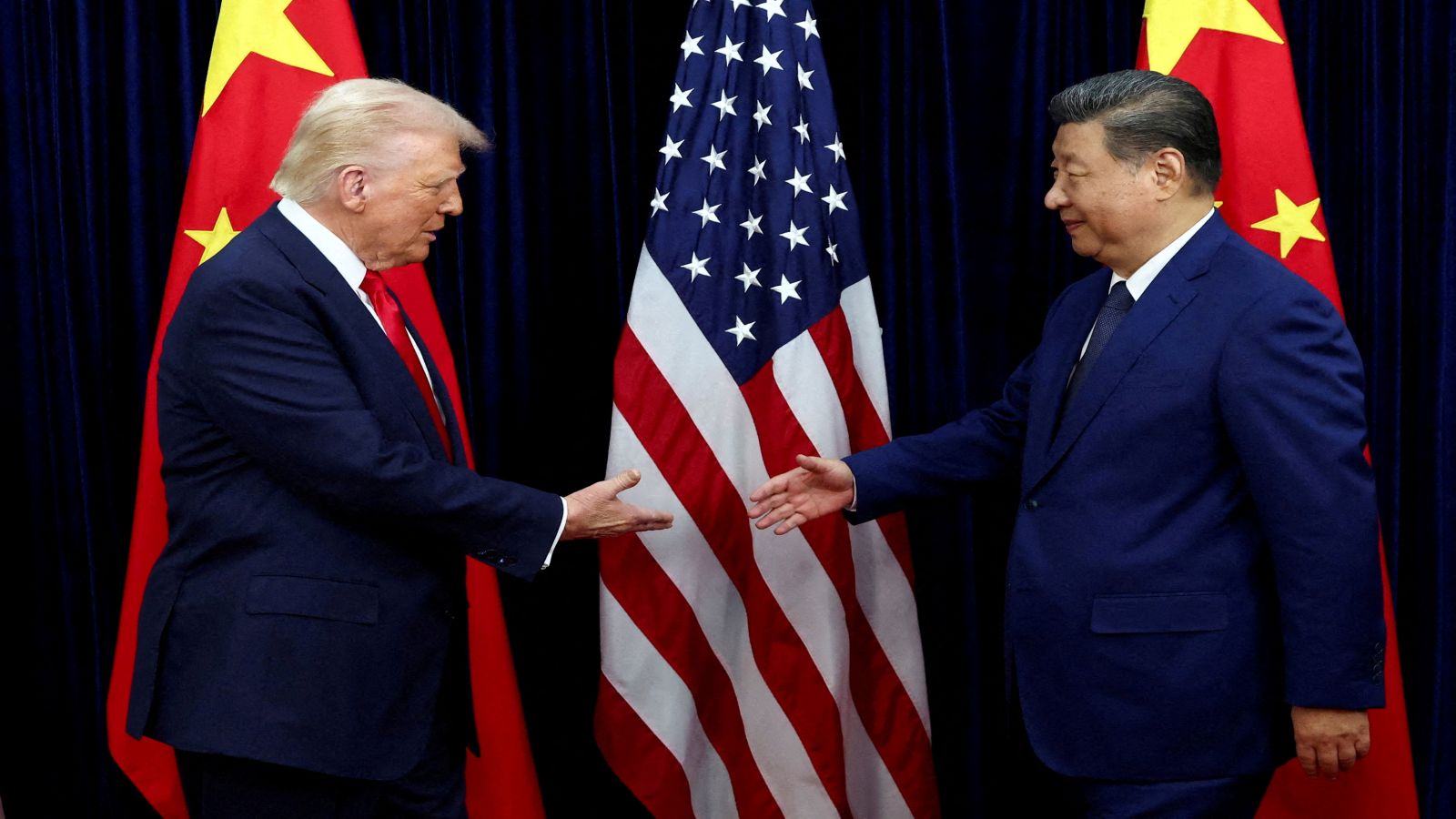
The air in Beijing during November has a way of tasting like cold iron and coal smoke. It settles in the back of the throat, a physical reminder that you are standing in the engine room of the second-largest economy on earth. When the wheels of Air Force One touched the tarmac, they didn't just carry a president; they carried a desperate, high-stakes hope wrapped in the suits of twenty-nine American CEOs.
Goldman Sachs was there. Boeing was there. General Electric was there.
These weren't just names on a delegation list. They were the architects of the American century, standing on a windswept runway, looking at a horizon of cranes and smog, wondering if the door was finally going to swing open or if they were just being invited in to see the locks.
Donald Trump’s arrival in China wasn't a standard diplomatic check-in. It was a collision. For decades, the narrative of global trade had been a steady, predictable hum. But the hum had turned into a screech. The "opening up" of China—a phrase that has been whispered in Washington boardrooms like a prayer since the 1990s—remained the great unfinished symphony of the Pacific.
The Architect and the Apprentice
Imagine a mid-level executive at a firm like Teradyne or Thermo Fisher Scientific, two companies that joined this specific pilgrimage. Let’s call him Robert. Robert has spent twenty years watching his company’s intellectual property move across the ocean. He has seen the joint venture requirements that feel less like partnerships and more like forced organ donations. He knows that to sell a single sensor in Shanghai, he might have to hand over the blueprints that took a decade to draft.
Robert represents the invisible stake. While the headlines focus on the theater of the Great Hall of the People, men like Robert are looking at the fine print of $250 billion in potential deals.
The tension is thick enough to choke on. On one side, you have the American demand for "reciprocity"—a simple word that hides a mountain of grievances. It means if a Chinese company can buy a tech firm in California, an American company should be able to do the same in Guangdong without a government "minder" sitting in the boardroom. On the other side, you have a Chinese leadership that views its state-led model not as a barrier to trade, but as the very reason they lifted 800 million people out of poverty.
The math of the trip was staggering. $250 billion. It sounds like a victory. But in the world of high-level trade, a "Memorandum of Understanding" is often just a fancy way of saying "we’ll talk about it later."
The Great Wall of Paperwork
The struggle isn't just about tariffs or the price of soybeans. It is about the fundamental plumbing of the future.
Consider the energy sector. West Virginia’s Department of Commerce was part of this delegation, eyeing an $83 billion investment from China Energy. To a worker in a coal town, that number isn't a statistic. It’s a mortgage payment. It’s the difference between a main street with glowing shopfronts and one with boarded-up windows.
But the friction remains. The US delegation arrived with a list of "structural" changes they wanted to see. They wanted an end to forced technology transfers. They wanted a level playing field for financial services. They wanted the "Great Firewall" to have a few more cracks in it so American data companies could breathe.
The Chinese response is often a polite, inscrutable nod. They offer "purchasing agreements"—huge, flashy buys of Boeing jets or American beef—that act as a pressure valve. These buys soothe the immediate anger over trade deficits, but they don't change the rules of the game. They are the equivalent of buying a dinner for someone whose house you are slowly moving into.
The Ghost in the Boardroom
There is a specific kind of silence that happens in these high-level meetings. It’s the silence of two powers realizing they are operating on two completely different timelines.
The American CEO is thinking about the next quarterly earnings report. They need the China win now to satisfy shareholders and keep the stock price from dipping. They are sprinting.
The Chinese official across the table is thinking about 2049—the centenary of the People's Republic. They are running a marathon.
When Trump walked through the Forbidden City with Xi Jinping, the symbolism was heavy enough to sink a ship. This was the first time a foreign leader had been granted a state dinner inside the literal heart of ancient Chinese power since 1949. It was a gesture of immense "face."
But "face" doesn't fix a trade deficit.
The CEOs in the room knew the score. They were being treated like royalty while their market share was being treated like a resource to be harvested. This is the central paradox of the US-China relationship: we are too integrated to leave, but too different to ever truly trust one another.
The Cost of the Open Door
What happens if China doesn't "open up" the way the delegation hopes?
The alternative isn't just a trade war; it's a decoupling. It’s the creation of two separate internets, two separate financial systems, and two separate supply chains. It’s a world where a chip designed in Austin can’t be used in a phone in Shenzhen.
For the American companies on that trip, the stakes were existential. If they are locked out of the Chinese middle class—a group of people larger than the entire population of the United States—they lose the scale they need to compete globally. But if they stay and continue to lose their technology to state-backed competitors, they are merely funding their own eventual replacement.
It is a trap. A gilded, high-velocity trap.
The delegation spent their days in hushed meetings and their nights at lavish banquets where the Moutai flowed like water. They smiled for the cameras. They signed the papers. They shook hands with the men who controlled the fate of the world’s most lucrative markets.
But as the motorcade sped back toward the airport, through the neon-lit corridors of a Beijing that looks more like the future every day, the feeling in the cars wasn't one of triumph. It was one of wary exhaustion.
The deals were signed, yes. The "hope" was expressed. But the fundamental wall—the one made of policy, ideology, and a deep-seated desire for national self-sufficiency—remained standing.
The Americans went home with suitcases full of promises. The Chinese stayed behind, already looking past the next four years, watching the smoke from the factories drift over a city that has seen empires come and go, waiting to see who would blink first in a game that has no intention of ending.
The lights of the Great Hall dimmed, leaving only the shadow of the giant standing at the door, holding a key he isn't quite ready to use.