Two miles down, the sun is a physical impossibility.
The ocean at this depth does not merely lack light; it absorbs it, consumes it, and leaves behind an absolute, crushing stillness. Temperatures hover just above freezing. The pressure is a ruthless architectural force, capable of reducing a steel submarine to a crumpled soda can in milliseconds. For centuries, humanity assumed this abyssal plain was a monotonous desert. A flat, featureless sheet of dark mud stretching across the abyss, undisturbed by time or tide.
Then we looked closer.
Drifting aboard a research vessel under a salt-stung midnight sky, marine scientists stared at monitor screens projecting real-time sonar and camera feeds from the seafloor. What they saw should not have been there.
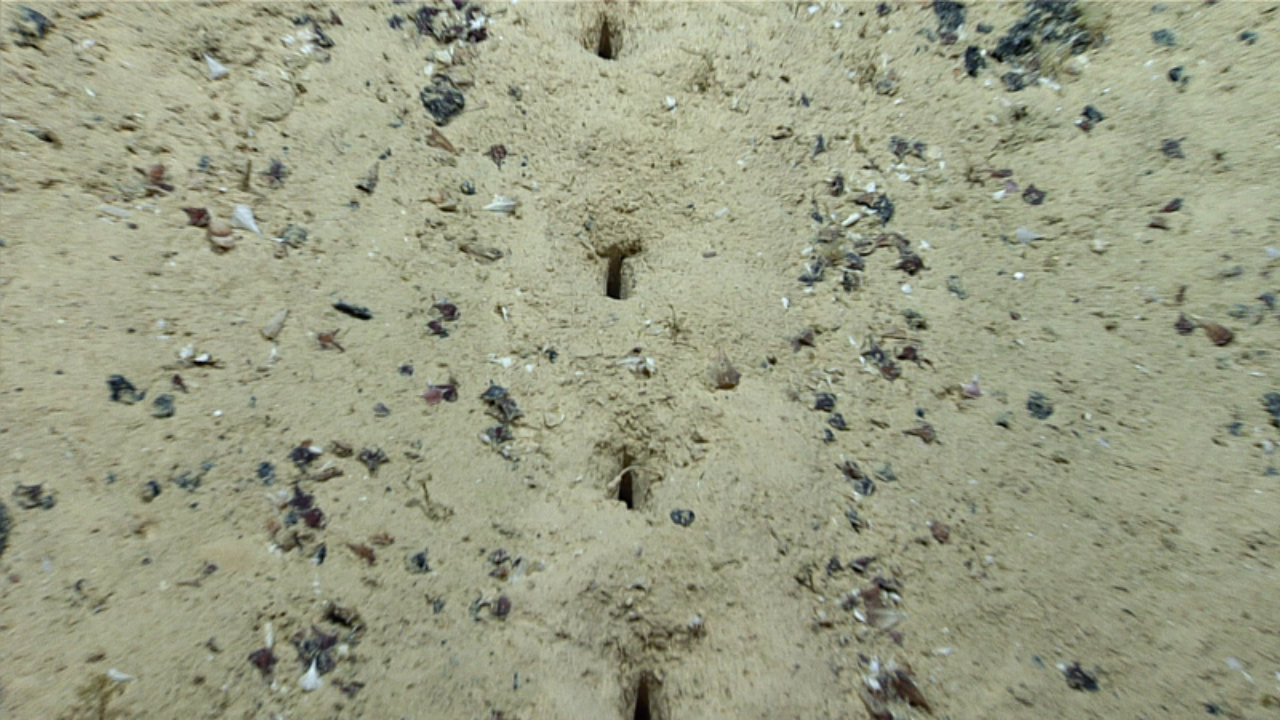
Row upon row of perfectly aligned, perfectly circular indentations. Pitted into the sediment like ghostly punctuation marks, these holes defied every conventional rule of marine geology. They were not clustered randomly, nor were they carved by the clumsy crawl of a bottom-dwelling scavenger. They stood in precise geometric alignments, small craters surrounded by tiny ramparts of displaced silt.
Sediment tests came back. They offered no sanctuary of logic. The surrounding mud showed no unusual chemical anomalies, no thermal vents fueling localized microbial life, no sudden drops in density. The physical composition of the seafloor inside the holes was identical to the barren sediment inches away.
Nothing was there. And yet, something had left its mark.
To understand why this discovery rattles marine geologists, you have to understand the sheer alien nature of the deep pelagic zone. Down here, life is a masterclass in desperation. Organisms survive on marine snow—the slow, decaying rain of organic detritus drifting down from the sunlit upper layers of the ocean. It is a world governed by an excruciatingly slow metabolic clock. A creature that might move an inch a week in the shallows might not move at all down here for years.
When researchers first published the existence of these mysterious Pacific holes, the immediate reaction was quiet bewilderment.
Imagine sitting in a windowless room, staring at a patch of dust on your desk, only to realize the dust has been meticulously arranged into tiny, equidistant dots. You sweep your hand across the desk, wipe it clean, and return the next morning to find the dots back again. Not a footprint. Not a trail. Just isolated, perfect impressions stamped into the surface.
Geologists call them pits. Biologists call them enigmas.
To solve a mystery of the deep, science must first eliminate the mundane. Could these be the exhaust ports of hydrothermal activity? Sediment core samples proved otherwise; there were no thermal signatures, no mineral crusts, no bubbling gases escaping from the Earth's mantle. Could they be the abandoned burrows of known benthic fauna, like crabs or polychaete worms?
Consider what happens next: robotic submersibles glide inches above the silty bottom, their high-intensity LED arrays cutting through millennia of darkness. Cameras zoom in on the rims of the mysterious craters. Marine biologists comb through hours of high-definition video footage, searching for movement, for a twitch of a tentacle, for a hidden shell.
Silence. The holes are empty.
Some researchers hypothesized that unknown deep-sea fish might be diving headfirst into the mud to feed on microscopic organisms buried beneath the surface. It is a neat hypothesis, but it fractures under scrutiny. Why the geometric precision? Why the distinct, raised rims of sediment that look less like a random plunge and more like an engineered excavation?
Nature rarely draws a straight line. Geometry is the fingerprint of life, or the rigid law of physics. Yet here, four thousand meters below the surface, nature appears to be doing both.
The implications stretch far beyond a biological curiosity. The deep Pacific seafloor is not just a remote wilderness; it is the planet's final unexplored frontier. As commercial interests eye the abyssal plains for mineral harvesting and rare earth elements, our profound ignorance of basic benthic ecology becomes glaringly apparent. We are preparing to industrialize a realm we barely know how to observe, let all the more understand.
Every time humanity believes it has mapped the boundaries of the known world, the ocean pulls back the curtain to reveal a brand-new question mark.
Down in the dark, beneath the crushing weight of thousands of tons of water, the holes remain. They do not answer our calls, they do not register on our seismic instruments, and they do not reveal the identity of the sculptor. They simply wait. Perfectly round, perfectly silent, reminding us that we are absolute strangers on our own planet.