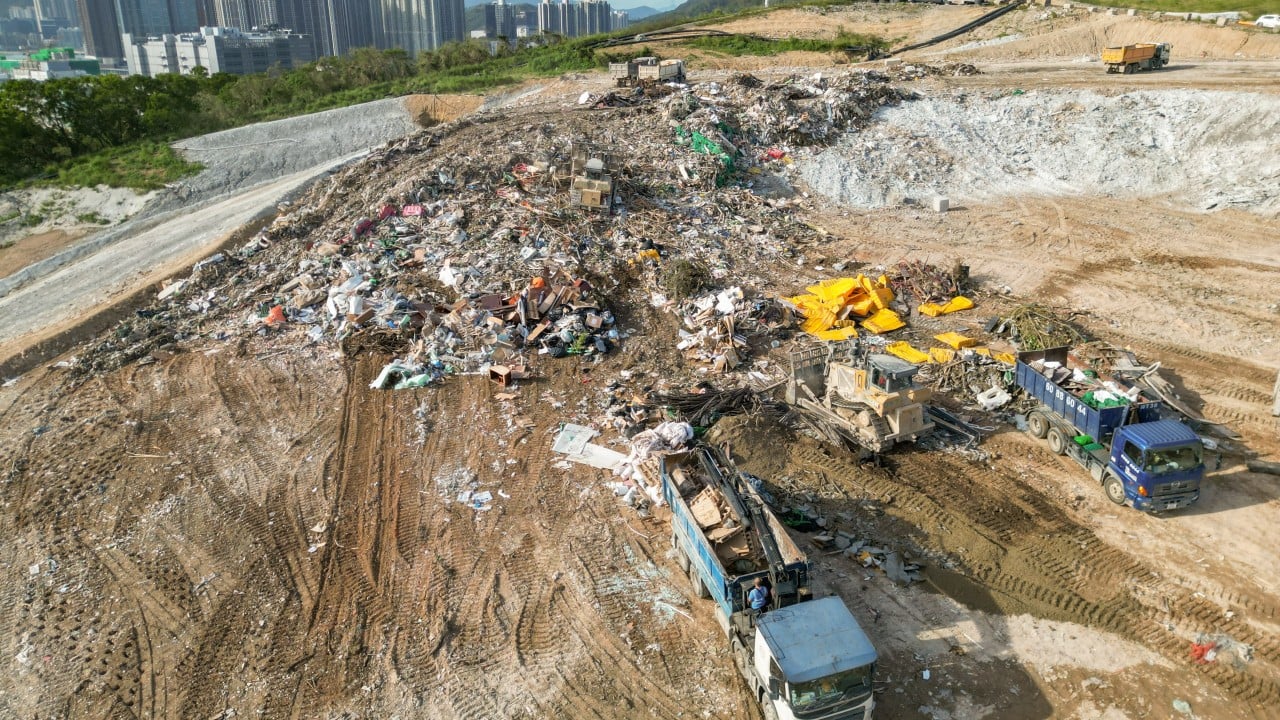
Hong Kong's solid waste containment model faces a distinct physical and economic bottleneck. In 2025, commercial operators disposed of approximately 1,500 tonnes of High Liquid Content Waste (HLCW)—spanning bulk liquids, emulsified foods, sauces, personal care products, and industrial cleansers—directly into the city’s strategic solid waste landfills. While 1,500 tonnes represents a minor percentage of total annual municipal solid waste, the geometric expansion of this volumetric fluid mass introduces disproportionate mechanical liabilities to landfill infrastructure, drastically accelerating structural stabilization risks and driving up environmental remediation outlays.
The immediate optimization blueprint requires moving from a variable-permitting disposal model to a strict source-segregation architecture. Resolving this operational friction requires isolating the mechanical impact of fluid mechanics within landfills, mapping the current administrative failure modes, and deploying dedicated industrial downstream treatment pathways.
The Geotechnical Mechanics of Fluid Insertion in Solid Mass Landfills
The entry of raw bulk liquid waste into engineered landfills compromises structural integrity via two primary physical mechanisms: pore water pressure elevation and the degradation of effective shear strength.
Landfill stability relies on the fundamental engineering principle of effective stress, governed by the classic relationship:
$$\sigma' = \sigma - u$$
Where $\sigma'$ represents effective stress, $\sigma$ represents total stress, and $u$ represents pore water pressure. When high-volume liquids are co-disposed with solid municipal waste within a confined cell, the fluid cannot rapidly drain or evaporate. This trapped volume elevates the internal pore water pressure ($u$). As $u$ escalates, the effective stress ($\sigma'$) driving the friction between solid waste particles drops.
This drop directly downscales the material’s shear strength, which is mathematically defined by the Mohr-Coulomb failure criterion:
$$\tau = c' + \sigma' \tan\phi'$$
Where $\tau$ is the shear strength, $c'$ is effective cohesion, and $\phi'$ is the effective angle of internal friction. Because the co-disposal of liquids reduces $\sigma'$, the maximum shear resistance ($\tau$) of the landfill mass collapses. Structurally, this manifests as slope instability, localized shifting, and accelerated structural failure of the landfill face.
Beyond geotechnical risks, bulk fluid insertion alters the internal biochemical reaction curve of the containment system. The concentrated addition of highly organic liquids (e.g., discarded beverages, dairy, and sauces) rapidly elevates moisture levels past the optimum threshold required for controlled anaerobic digestion. This saturation shifts the waste matrix into an unmitigated acidogenic phase, producing an oversupply of highly corrosive volatile fatty acids. This process results in two distinct operational bottlenecks:
- Leachate Surge Volumes: The excess liquid mixes with precipitation and decomposition fluids, creating a high-volume hydraulic load that overwhelms downstream wastewater infrastructure and increases the probability of liner breaches.
- Chemical Oxygen Demand (COD) Spikes: The organic load increases the COD concentrations of the generated leachate, which exponentially drives up the chemical and energy costs required at treatment facilities to normalize the liquid before environmental discharge.
Dissecting the Regulated Variable-Ticket Bottleneck
The structural vulnerability of Hong Kong’s current system stems from an administrative allocation mechanism known as the Disposal of Special Waste at Landfills Admission Ticket.
[Commercial Producers / Retail Logistics]
                   │
                   ▼
[Disposal of Special Waste Admission Ticket] ──(Regulated Volume Bottleneck)
                   │
                   ▼
  [Direct Strategic Landfill Injection]
                   │
                   ▼
     [Geotechnical Mass Failure]
In 2025, the Environmental Protection Department (EPD) recorded exactly 27 active ticket holders authorized to execute bulk HLCW land disposal. This cohort comprises a concentrated group of manufacturers, retail conglomerates, and third-party logistics firms. The presence of this ticketing model indicates a structural failure in market pricing: the economic cost levied on ticket holders for landfill deposition historically sat below the capital expenditure required to establish decentralized on-site treatment or third-party recycling contracts.
The market footprint of these 27 ticket holders exposes an acute risk within corporate supply chains. In a typical logistics setup, product expiration, batch contamination, or off-specification manufacturing runs generate massive waves of packaged liquid waste. Because these products arrive at the landfill intact—encased in aluminum cans, polyethylene terephthalate (PET) plastic bottles, or multi-layer beverage cartons—the waste occupies excessive spatial volume while preserving the fluid inside a non-biodegradable shell. Over time, heavy compactors rupture these packages under extreme mechanical pressure, releasing sudden, concentrated hydraulic surges directly into the landfill's structural core.
The Tri-Pathway Alternative Blueprint
Mitigating this risk demands an immediate administrative pivot toward a zero-landfill mandate for commercial HLCW. Displacing 1,500 tonnes of specialized fluid mass from the solid waste stream requires a structural shift toward three distinct, closed-loop processing configurations.
                  ┌──► Packaged Liquids ──► Mechanical Depackaging ──► Material Recovery (PET/Alu/Glass)
                  │
[Commercial HLCW] ├──► Organic Fluids  ──► Anaerobic Digestion   ──► Biogas / Grid Electricity (O.PARK)
                  │
                  └──► Hazardous Liquids ──► Physicochemical Fixation ──► Neutralized Industrial Water
1. Mechanical Depackaging and Material Decoupling
The primary processing bottleneck is not the fluid itself, but the composite packaging sheltering it. Scaled deployment requires the mandatory integration of automated, high-throughput mechanical depackaging lines. These industrial systems apply mechanical compression, shredding, or centrifugal force to separate the containment vessel from its liquid cargo.
- Solid Phase Recovery: Cleanly separated aluminum fractions, glass substrates, and high-density plastics are diverted directly into standard secondary raw material streams, achieving immediate circular recovery.
- Liquid Phase Capture: The homogenous fluid output is stabilized inside buffer tanks to normalize pH and viscosity before routing to secondary processing.
A localized proof-of-concept executed in mid-2026 confirms the viability of this model: a single beverage producer rerouted 300,000 discarded bottles through dedicated mechanical recyclers, achieving complete material reclamation of the packaging and eliminating the downstream landfill footprint. Similarly, a dairy producer initiated a structural transition to divert 50,000 multi-layer milk cartons per month away from landfill points into advanced delamination lines.
2. High-Load Anaerobic Co-Digestion
For food-grade, high-sugar, and high-protein liquid fractions, the optimal thermodynamic pathway is biochemical conversion via the city's Organic Resources Recovery Centres (O.PARKs). These facilities utilize multi-stage anaerobic digesters optimized for high-solids and liquid organic slurries.
Introducing food-derived HLCW into anaerobic digesters leverages the high volatility of organic liquids to optimize the methane ($CH_4$) generation yield. The carbon-rich fluid serves as an immediate substrate for methanogenic archaea, converting volatile solids into biogas with high thermal efficiency. The resulting biogas is scrubbed of hydrogen sulfide ($H_2S$) and combusted in combined heat and power (CHP) units, exporting surplus electricity directly into the municipal power grid while transforming a structural liability into a decentralized energy asset.
3. Dedicated Physicochemical and Biological Sewage Treatment
Non-food, high-moisture industrial and commercial streams—such as expired personal care cosmetics, surfactants, and water-based paints—require distinct processing protocols based on their chemical composition:
- Chemical Contamination: Materials bearing hazardous chemical binders or heavy metal stabilizers are restricted to the Chemical Waste Treatment Centre (CWTC). Here, they undergo advanced physicochemical precipitation, redox reactions, or high-temperature destruction.
- Non-Hazardous Industrial Fluids: Standard personal care items and mild cleansing agents are routed to advanced on-site industrial wastewater pre-treatment plants. Once chemical oxygen demand (COD) and total suspended solids (TSS) are mechanically and biologically reduced to levels within statutory communal sewer discharge limits, the effluent is safely introduced into municipal sewage treatment networks for final biological processing.
Supply Chain Realignment and Infrastructure Constraints
Transitioning to this source-segregated model introduces structural frictions that logistics networks and environmental services providers must resolve. The structural limitations of this transition are driven by two main operational bottlenecks.
First, decentralized capital expenditure requirements impose an initial cost burden on the 27 primary ticket holders. Smaller manufacturing and retail enterprises lack the physical footprint and capital required to install automated depackaging systems or advanced wastewater pre-treatment reactors. Consequently, the strategy relies entirely on the processing capacity and pricing structures of third-party waste management firms. If these service fees exceed the structural penalty of landfilling, illegal dumping or macro-inventory hoarding will emerge.
Second, the recycling sector faces an equipment mismatch. The EPD’s deployment of capital through the local Recycling Fund is designed to subsidize industrial-scale depackaging machinery and storage tanks. However, until this capacity scales to match localized demand fluctuations, a processing bottleneck will persist. The transition timeline must be tightly calibrated against verified operational throughput metrics rather than arbitrary administrative deadlines.
Strategic Operational Mandate
To prevent structural landfill failures and optimize asset allocation across Hong Kong’s waste infrastructure, corporate supply chain directors and environmental regulators must immediately execute the following operational protocol:
- Inventory Management Restructuring: Implement real-time predictive analytics within logistics nodes to dynamically adjust manufacturing outputs and retail delivery schedules. This minimizes the structural generation of expired, high-volume inventory at the supply source.
- Upstream B2B Donation Linkages: Establish permanent, vetted logistics pipelines with secondary distribution networks and charitable organizations to intercept intact, unexpired retail consumables before they transition into the waste stream.
- Mandatory Separation Contracting: Phase out the utilization of Special Waste Admission Tickets. All entities handling packaged fluid goods must structurally transition to certified third-party recovery agreements featuring audited mechanical depackaging and down-stream energy recovery metrics.