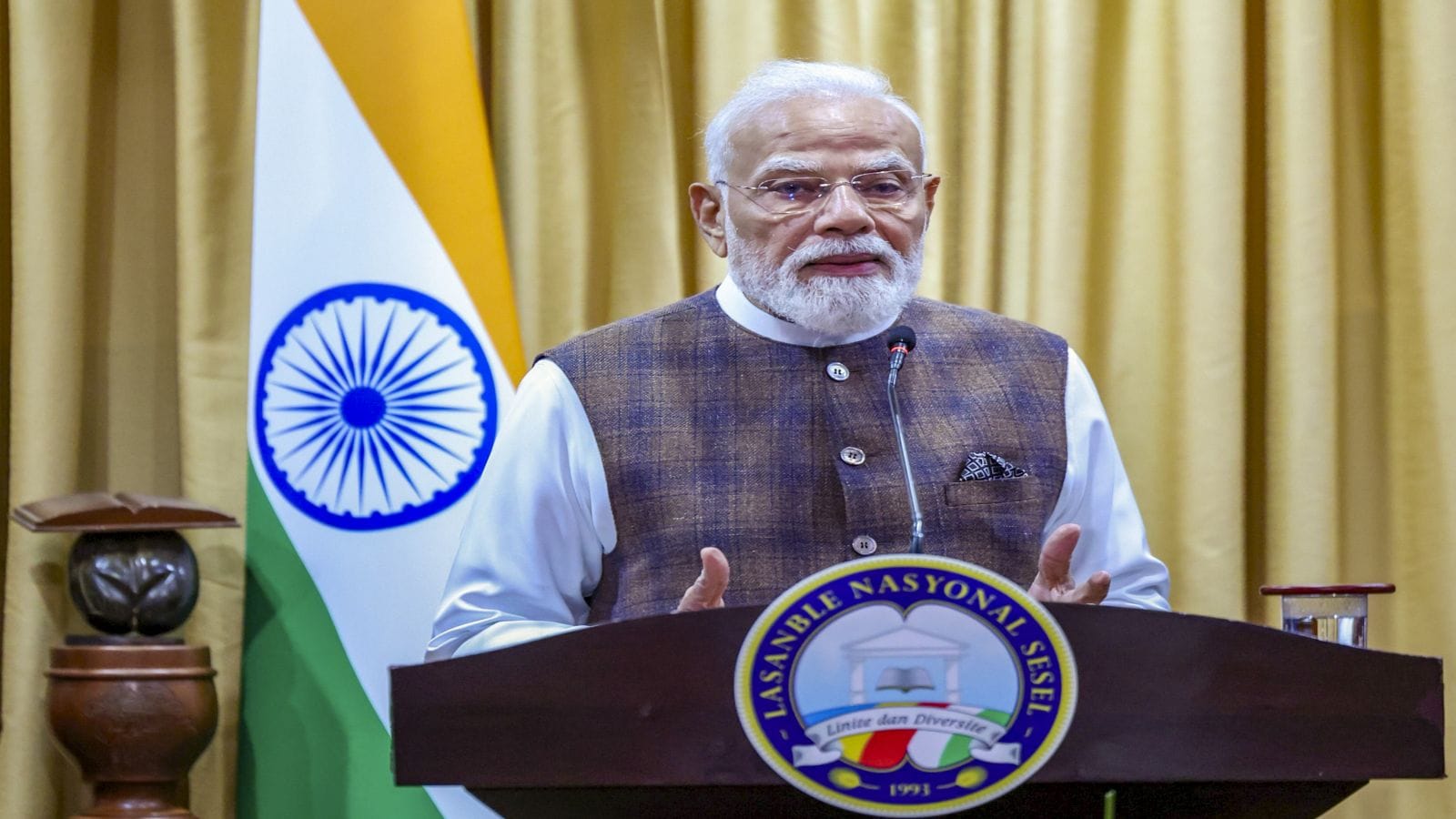
India has secured a major diplomatic symbolic victory in the western Indian Ocean, yet the real heavy lifting happens beneath the surface of the water. During a high-profile state engagement, Seychelles conferred its prestigious honorary 'Guardian of the Blue Horizon' title upon Indian Prime Minister Narendra Modi. While official press releases frame this purely as a celebration of shared ecological values and maritime conservation, the accolade marks a deeper, highly contested geopolitical reality. New Delhi is aggressively anchoring its security presence in the region to counter expanding Chinese naval footprints, and Seychelles sits directly at the center of this maritime chessboard.
The title itself highlights the "Blue Economy," a framework focused on sustainable ocean development. For India, however, guarding this specific horizon involves a blend of environmental diplomacy and hard military security. If you liked this article, you should read: this related article.
The Strategic Anatomy of an Ocean Honor
Awards of this nature rarely happen in a vacuum. To understand why Seychelles chose this moment to honor the Indian Prime Minister, one must look at the map. Seychelles controls an exclusive economic zone of over 1.3 million square kilometers. Monitoring this vast expanse of water is impossible for a nation with a population of just over 100,000 people.
India has quietly stepped into that governance vacuum. Over the past decade, New Delhi has supplied Seychelles with maritime patrol aircraft, naval helicopters, and fast attack defense vessels. India also set up a coastal surveillance radar system across the island nation, linking it directly into India’s own naval intelligence networks. For another look on this development, check out the latest update from Associated Press.
When Seychelles calls India a guardian, it is recognizing a donor-recipient relationship that keeps local waters safe from piracy, illegal fishing, and drug trafficking.
The transaction works both ways. India receives critical maritime domain awareness in return. The western Indian Ocean serves as a primary chokepoint for global trade and oil transit. By embedding its military personnel and monitoring hardware into the Seychelles Coast Guard, India ensures it can track every commercial and military vessel moving through these waters.
The Shadow of Assumption Island
The public celebration of environmental stewardship masks a long-running, tense negotiation over actual military infrastructure. For years, India has sought to develop a joint naval facility on Seychelles’ Assumption Island. The project aims to give the Indian Navy a forward operating base to project power toward the East African coast.
The plan hit severe domestic roadblocks within Seychelles. Local opposition leaders and environmental activists raised alarms over national sovereignty and the ecological impact on nearby Aldabra atoll, a UNESCO World Heritage site. The political backlash forced the Seychelles government to alter the deal, insisting that the base would not be a sovereign Indian outpost but a shared facility strictly managed by local forces.
[Indian Ocean Maritime Influence Network]
       [India]
          |
    (Radar Link & Assets)
          |
          v
    [Seychelles] <---> [Assumption Island Facility]
          ^
          | (Contested Influence)
          v
   [Chinese Naval Transit]
This tension shows the delicate line India must walk. Capital-to-capital diplomacy might produce grand titles and smooth communiqués, but local politics on the ground can derail strategic ambitions instantly. New Delhi cannot simply buy influence through defense hardware; it must constantly manage the anxieties of a smaller nation wary of being swallowed by a regional superpower's ambitions.
Beijing’s Quiet Counterweight
China remains the unspoken catalyst for this entire diplomatic push. Beijing has steadily increased its presence in the southwestern Indian Ocean through infrastructure loans, port investments, and regular deployments of its dual-use research vessels. These ships, capable of mapping the ocean floor for submarine warfare, frequently dock in regional ports under the guise of scientific exploration.
India views these deployments as a direct threat to its traditional sphere of influence. The honorary title given to Modi is a public signal that, despite China's deep pockets, Seychelles still views India as its primary security partner.
Diplomatic loyalty is fluid. Seychelles, like many small island developing states, practices a foreign policy of non-alignment. They welcome Indian radars and naval vessels, but they also accept Chinese grants for government buildings and school construction.
The Ecological Front for Security Operations
By framing the partnership around the concept of the Blue Horizon, both nations find a politically safe language to justify deep military cooperation. Climate change, rising sea levels, and maritime poaching are real threats to Seychelles. India can deploy its navy under the banner of humanitarian assistance and disaster relief, fulfilling a genuine local need while simultaneously maintaining a permanent naval presence.
This dual-use diplomacy is highly effective. It allows India to build out infrastructure that serves a defensive purpose while keeping the public focus on coral reef protection and maritime safety.
The challenge lies in sustaining this momentum without triggering further domestic resistance within Seychelles. As long as the collaboration delivers tangible benefits, such as stopping illegal fishing fleets and securing maritime trade routes, the political consensus in Victoria will likely hold. If India pushes too hard for exclusive military access, the political winds in the islands could shift overnight, proving that even the most glittering titles offer no permanent guarantee of geopolitical loyalty.

:max_bytes(150000):strip_icc()/parts-of-a-swamp-cooler-2718628-a477e6f0787b4f8bb62ddf2def31d495.png)