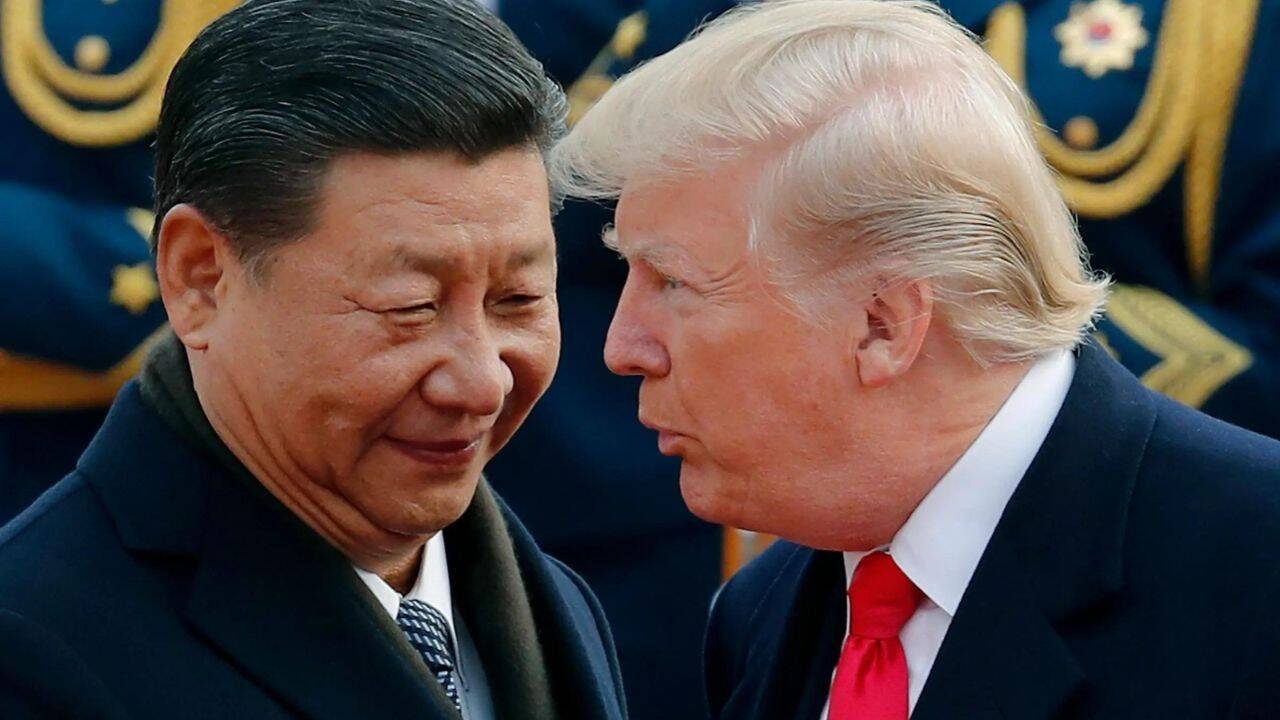
High-stakes diplomatic summits operate on a strict hierarchy of bargaining chips, where individual corporate controversies rarely survive the filter of national security priorities. When analyzing why Donald Trump is unlikely to raise allegations involving Nvidia and Alice Huang during bilateral talks with Xi Jinping, standard political commentary often relies on speculation about personal rapport or media cycles. A rigorous structural assessment reveals a much simpler reality: the asymmetry between macro-level trade leverage and micro-level corporate compliance issues dictates that bringing up a localized personnel or governance dispute yields zero diplomatic return for the United States.
To understand this dynamic, one must separate the noise of financial media from the mechanics of statecraft. In executive-level negotiations between Washington and Beijing, bandwidth is the scarcest resource. Every agenda item introduced by a head of state carries an opportunity cost, displacing broader macroeconomic demands such as tariff structures, intellectual property enforcement, or export control regimes.
The Architecture of Executive Diplomatic Bandwidth
Diplomatic agendas between superpower leaders are constructed through an interagency filtering process designed to maximize strategic yield. Topics reach the presidential talking points only if they meet specific thresholds of state interest.
- Systemic Economic Impact: Issues must affect entire sectors, supply chains, or bilateral trade balances rather than single corporate entities, unless that entity serves as a direct proxy for state sovereignty.
- Negotiable Concession Value: A topic is only worth raising if the counterparty can offer a concrete, verifiable concession in return.
- Domestic Political Utility: Raising an issue must generate measurable domestic political capital without inadvertently undermining the broader negotiating posture.
Allegations surrounding an individual executive, researcher, or corporate figure—such as the controversies tied to Alice Huang and Nvidia—fail all three tests at the presidential level. While corporate governance, export compliance, and talent acquisition in the artificial intelligence sector are critical regulatory concerns, they belong to the operational domain of the Department of Commerce, the Bureau of Industry and Security (BIS), and the Department of Justice. Elevating a granular corporate controversy to a head-of-state summit signals a lack of strategic discipline and allows the counterparty to deflect from structural trade imbalances.
The Asymmetry of Semiconductor Statecraft
Nvidia occupies a unique position in the global economy as the primary bottleneck for advanced artificial intelligence compute. Because its hardware architectures underpin both commercial AI development and defense-related modeling, the company is constantly scrutinized for compliance with U.S. export controls designed to restrict China's access to high-end graphics processing units (GPUs).
However, there is a distinct operational boundary between macro-level export control enforcement and micro-level corporate personnel controversies.
- Macro-Level Enforcement: This involves blanket restrictions on specific compute thresholds, interconnect speeds, and lithography equipment. These are state-to-state rules enforced through licensing regimes and entity lists.
- Micro-Level Controversies: These involve internal corporate structures, individual executive ties, or localized compliance disputes. While these issues attract intense scrutiny from investigative journalists and retail investors, they do not alter the fundamental physics or economics of the semiconductor supply chain.
If the U.S. executive branch were to introduce specific personnel or governance allegations regarding Nvidia into a summit with Xi Jinping, it would create an immediate diplomatic trap. Beijing's standard negotiating doctrine relies on transactional equivalence; if Washington raises a specific corporate grievance, Beijing will counter with demands for specific regulatory exemptions or the removal of targeted Chinese firms from U.S. restricted lists. Trading a structural national security framework for a case-by-case corporate debate is a losing proposition for any U.S. administration.
Opportunity Cost and the Deterrence Function
In trade negotiations, deterrence relies on ambiguity and scale. When a U.S. president negotiates with the Chinese leadership over technology transfer and semiconductor restrictions, the primary objective is to maintain the integrity of the broader regulatory perimeter.
Introducing granular allegations into these discussions introduces three distinct failure modes:
1. Validation of Counter-Narratives
Beijing routinely frames U.S. technology restrictions as targeted containment aimed at specific companies rather than neutral national security measures. Raising a specific corporate controversy at the highest diplomatic level validates this framing, allowing Chinese negotiators to argue that U.S. policy is driven by arbitrary corporate interference rather than consistent legal standards.
2. Erosion of Interagency Authority
Regulatory bodies like the Department of Commerce derive their power from autonomous, rules-based enforcement. When a head of state intervenes verbally on a specific corporate matter during a foreign summit, it signals to foreign governments that regulatory outcomes are politically negotiable at the top, bypassing standard legal and administrative channels.
3. Dilution of Core Trade Demands
The core friction points in U.S.-China economic relations—industrial overcapacity, currency valuation, market access for U.S. financial services, and systemic intellectual property theft—require sustained, uninterrupted pressure. Every minute spent discussing a specific corporate figure is a minute subtracted from extracting concessions on macro-level tariffs or agricultural purchase commitments.
Separating Regulatory Risk from Diplomatic Theater
For institutional investors, supply chain managers, and corporate strategists, misinterpreting the absence of a topic at a diplomatic summit is a common analytical error. The fact that Trump is unlikely to raise Nvidia-related allegations with Xi Jinping does not imply that the underlying regulatory scrutiny has vanished. It simply confirms that the risk resides in the administrative and legal layers of the U.S. government rather than the diplomatic layer.
Operational risk in the semiconductor sector must be evaluated through the correct institutional lens:
- Administrative Enforcement: Watch the Federal Register, BIS rule updates, and Department of Justice filings. These mechanisms operate independently of summit rhetoric and carry binding legal consequences, including fines, license revocations, and supply chain injunctions.
- Congressional Oversight: Select committees in the House and Senate frequently use corporate controversies to pressure executive agencies into tightening compliance loopholes. This pressure manifests as legislative riders or subpoena actions, not presidential talking points.
- Corporate Governance Adjustments: Companies facing scrutiny over personnel ties or regional operations typically mitigate risk quietly through internal restructuring, compliance audits, and supply chain ring-fencing long before a diplomatic summit occurs.
The limitations of this analytical framework center on black-swan political events. If a corporate controversy escalates into a major public scandal that threatens domestic electoral support, a populist leader may override standard diplomatic protocol to score immediate rhetorical points. Absent a massive media-driven domestic backlash, however, cold transactional logic governs the room.
The Strategic Play for Market Participants
Decision-makers navigating the intersection of U.S.-China trade policy and AI hardware supply chains must decouple their risk models from diplomatic summit headlines. Do not treat the omission of a corporate controversy from presidential talks as a clearance signal for compliance risk, nor treat its inclusion in media cycles as a precursor to bilateral trade collapse. Allocate analytical resources to tracking bureaucratic rule-making within the Department of Commerce and internal corporate governance shifts, as these are the actual mechanisms that dictate market access and operational continuity in the semiconductor sector.