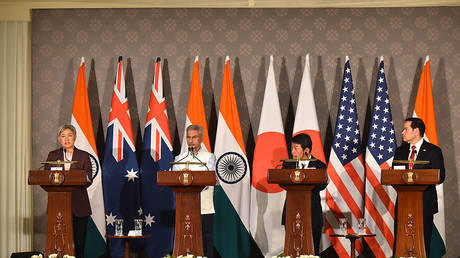
The Quadrilateral Security Dialogue (Quad) operates under a fundamental strategic asymmetry: its minilateral structural design is built to contain an expansive regional hegemon, yet its constituent nations are constrained by deep economic interdependencies with that very target. As foreign ministers from the United States, India, Japan, and Australia convene in New Delhi, the diplomatic signaling from Beijing warning against "bloc confrontation" and "exclusive small circles" misdiagnoses the structural evolution of the alliance. Rather than hardening into a military bloc analogous to a regional NATO, the Quad is shifting from an ideological, security-first posture to a techno-economic defense cooperative. This pivot is driven by two variables: the high economic cost of direct military containment and the critical vulnerabilities exposed by China's control over global resource nodes.
The Structural Realignment Framework
To understand why the Quad is abandoning high-level ideological rhetoric in favor of operational initiatives, one must evaluate the grouping's strategic utility function. The historical consensus viewed the Quad as a balancing coalition. However, asymmetric economic dependencies create friction inside the alliance. The divergent national interests of the four member states prevent the formation of a unified military command:
- The United States seeks to maintain systemic maritime primacy across the First Island Chain while simultaneously exploring tactical trade accommodations with Beijing.
- India operates on a doctrine of strategic autonomy, maintaining an independent security posture along its land borders while avoiding formal alliances that restrict its geopolitical optionality.
- Japan requires localized maritime stability in the East China Sea while managing severe vulnerabilities in its energy import channels.
- Australia balances structural security integration with Washington against its commodity export exposure to Chinese industrial markets.
The structural prose of the joint ministerial statement reflects these realities. The group announced a $20 billion Critical Minerals Initiative Framework designed to mobilize public and private capital into mining, processing, and recycling supply chains. The initiative serves as a direct hedge against Beijing’s export restrictions on rare-earth minerals. By shifting the objective function from overt military deterrence to supply chain resilience, the Quad is optimizing for the lowest common denominator of absolute agreement among its members.
The Techno Economic Cost Function
The operational model of the Quad can be quantified as a risk-mitigation framework. The primary objective is no longer the deployment of hard kinetic power, but the reduction of systemic vulnerabilities across three distinct operational layers.
1. Critical Raw Material Decoupling
The $20 billion framework acts as an insurance premium against supply chain weaponization. Because China maintains a near-monopoly on downstream processing of elements crucial for defense systems and energy transition technologies, the Quad's capital allocation strategy aims to lower the marginal cost of building alternative refining infrastructure in friendly jurisdictions like Australia and India.
2. Grey-Zone Information Asymmetry
Rather than conducting joint freedom-of-navigation operations that carry high escalatory risks, the Quad is scaling the Integrated Maritime Domain Awareness (IPMDA) initiative. This system integrates commercial satellite data with national intelligence networks to track dark vessels and maritime militia fleets. The objective is to eliminate information asymmetry in the South China Sea, forcing grey-zone actors to operate in full view of global scrutiny without triggering a kinetic response.
3. Critical Infrastructure Chokepoints
The newly announced infrastructure partnerships in Pacific island nations like Fiji focus on port development, undersea cable resilience, and Open RAN telecommunications architecture. This addresses a critical geographic vulnerability. If regional data networks and transport hubs are monopolized by a single state actor, the cost of communication and logistics for the remaining states increases exponentially.
Institutional Decay Versus Pragmatic Informality
A primary critique of the Quad's efficacy points to the absence of a leader-level summit since 2024. The transition of leadership in Washington and Tokyo has led to a perceived loss of political momentum. The marginalization of the Quad in foundational national security documents, paired with bilateral trade tensions and tariff disputes between Washington and New Delhi, highlights the institutional fragility of the grouping.
The analytical flaw in this critique lies in the mischaracterization of informal networks. Traditional treaty alliances possess high institutional rigidity, which makes them fragile when the national interests of the signatories diverge. The Quad’s informality is its structural advantage. By operating without a centralized secretariat or a binding collective defense clause, it reduces the diplomatic friction associated with national sovereignty concerns.
This informal architecture allows the network to adapt its density based on external pressures. When bilateral relations between individual members fracture—such as trade friction over agricultural tariffs or energy procurement strategies—the minilateral network can bypass the gridlock by shifting focus to technical, sub-political coordination. The ministerial meetings in New Delhi prove that while top-level political theater can stall, lower-level administrative integration across energy security frameworks and maritime data synchronization can continue unimpeded.
The Long Term Strategic Playbook
The Quad must abandon the illusion that it can function as a rigid, comprehensive security umbrella. The structural divergence in the economic profiles of India, Japan, Australia, and the United States guarantees that a complete decoupling from Chinese markets is impossible. The optimal path forward requires the institutionalization of the techno-economic pivot through binding capital commitments and standardized technology protocols.
The first operational step requires the formalization of the $20 billion critical minerals fund into a public-private risk-sharing mechanism. Governments must provide floor-price guarantees for alternative rare-earth supplies to insulate private investors from predatory pricing strategies executed by state-backed monopolies. Without these market-clearing mechanisms, capital deployment will underperform the targets set in New Delhi.
The second operational imperative is the expansion of data interoperability standards across the Indian and Pacific Oceans. The IPMDA must evolve from a data-sharing agreement into an automated, AI-driven tracking grid that feeds real-time maritime anomalies directly into regional coast guard centers. By converting raw data into actionable enforcement tracking, the Quad transitions from a passive monitoring forum into an active infrastructure steward.
Finally, the group must decouple its operational workflows from the domestic electoral cycles of its members. The technical working groups managing undersea cable resilience, 6G telecommunication standards, and port security must be granted multi-year regulatory mandate windows. This structural insulation ensures that regardless of leadership churn in Washington, New Delhi, Canberra, or Tokyo, the underlying technological and logistic integration continues to raise the geopolitical cost of altering the regional status quo by force.