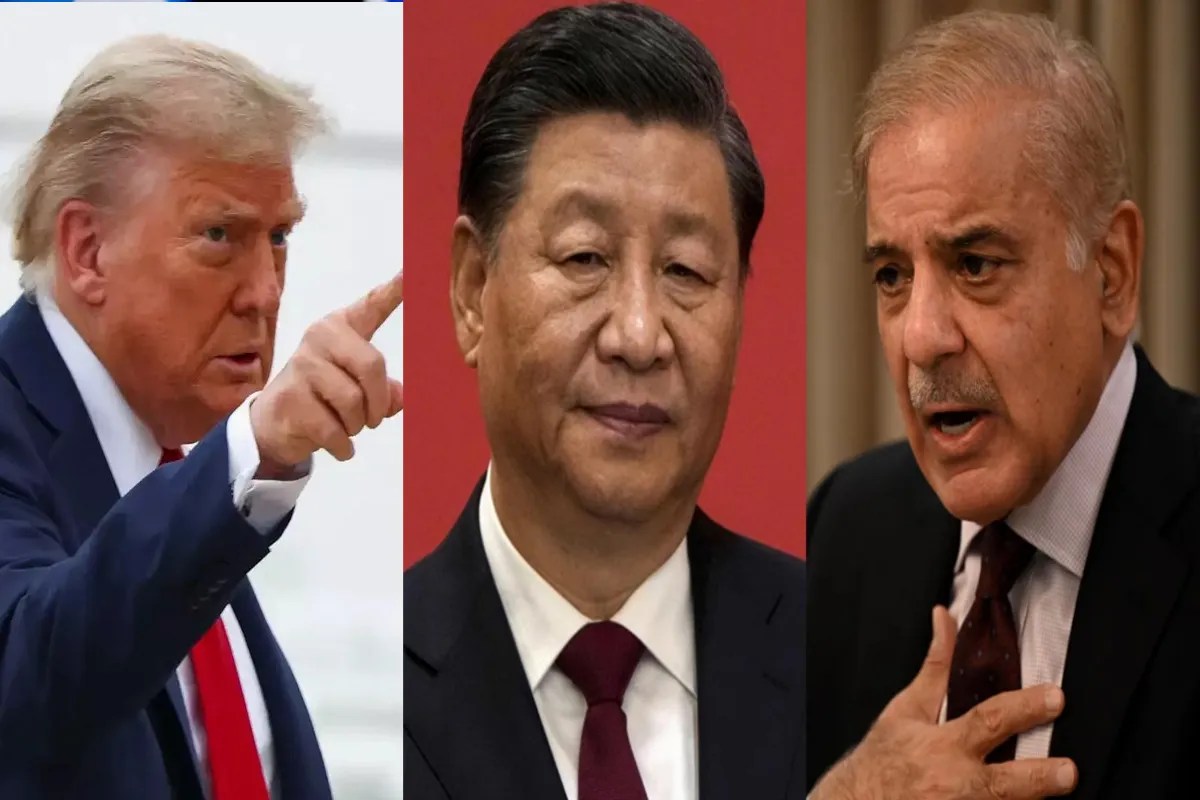
The recent disclosures regarding a synchronized strategic framework between Iran, China, and Pakistan indicate a fundamental shift from opportunistic cooperation to a structured, defensive-offensive alliance. This convergence is not a matter of shared ideology but a calculation of survival and power projection under the pressure of Western sanctions and US-led containment strategies. To understand the gravity of these "secret plans" requires a deconstruction of the three structural pillars supporting this tri-party relationship: kinetic deterrence, economic insulation, and asymmetric technology transfer.
The Tri-Pillar Framework of the Alignment
The relationship between Tehran, Beijing, and Islamabad operates through three distinct functional layers. Each layer serves a specific strategic objective that compensates for the individual weaknesses of the member states. Also making news recently: Where Concrete Meets the Soul.
1. Kinetic Deterrence and Military Interoperability
The primary objective of this axis is to raise the cost of any potential military intervention in the Middle East or the South Asian periphery. While Iran provides the geographic depth and ideological motivation, China provides the precision hardware, and Pakistan offers the tactical blueprint for operating in a nuclear-shadow environment.
- Asymmetric Denial: China’s investment in Iran’s missile and drone programs is designed to create an "Anti-Access/Area Denial" (A2/AD) zone in the Strait of Hormuz. This mimics China’s own strategy in the South China Sea.
- Intelligence Synchronization: The "secret plan" frequently referenced involves the integration of satellite data and electronic warfare capabilities. By linking Iranian ground intelligence with Chinese orbital surveillance (BeiDou), the axis can track naval movements with a precision that was previously the sole domain of NATO.
2. Economic Insulation through the Energy-Infrastructure Swap
The axis utilizes a circular economic model designed to bypass the SWIFT banking system and USD-denominated trade. More information on this are explored by TIME.
- The Energy Sink: China requires long-term energy security; Iran requires a guaranteed buyer for its sanctioned crude. The 25-year Comprehensive Cooperation Agreement acts as a price-floor mechanism, ensuring Iran remains liquid while China secures energy at a significant discount to Brent crude prices.
- The CPEC Extension: The China-Pakistan Economic Corridor (CPEC) is no longer a bilateral project. The strategic intent is to extend these transit routes into Iran, creating a land-based energy artery that is immune to naval blockades in the Malacca Strait.
3. Asymmetric Technology Transfer
The most critical component of the disclosed plans is the transfer of "dual-use" technologies. This includes artificial intelligence for autonomous weapon systems, advanced encryption for secure communications, and ballistic missile reentry vehicle technology.
The Strategic Cost Function of Iranian Engagement
When assessing the risk of a regional conflict involving Iran, one must calculate the Cost of Engagement ($C_e$). Unlike previous decades where the cost was purely kinetic, the involvement of China and Pakistan introduces variables that escalate the global economic impact exponentially.
The $C_e$ formula now includes:
- Direct Kinetic Costs: The price of neutralizing Iranian domestic defenses.
- Symmetry Displacement: The risk of China accelerating its timeline for regional objectives (e.g., Taiwan) while US resources are diverted to the Middle East.
- Proxy Multipliers: The activation of Pakistani-backed or Iranian-funded non-state actors across multiple theaters.
The "Secret Plan" revealed by recent intelligence suggests that China has agreed to provide early-warning systems to Iran. This removes the element of surprise from any pre-emptive strike, forcing an aggressor into a high-attrition, long-duration conflict.
The Pakistan Variable: Logistics and Nuclear Cover
Pakistan’s role in this alignment is often misunderstood as merely secondary. In reality, Islamabad acts as the logistical and nuclear hinge. Pakistan provides China with a warm-water port at Gwadar, which is geographically adjacent to the Iranian border. This proximity creates a "safe zone" for Chinese naval assets to refuel and resupply outside the immediate reach of the US Fifth Fleet’s primary strike zones.
Furthermore, Pakistan’s expertise in managing a "Cold Start" doctrine against a larger adversary (India) provides Iran with a tactical template for limited, high-intensity border skirmishes that do not escalate into full-scale war but achieve specific territorial or political objectives.
Disruption of the Global Sanctions Regime
The efficacy of Western sanctions relies on the universality of the dollar and the compliance of global manufacturing hubs. The Iran-China-Pakistan axis represents the first viable "Sanctions-Proof Circle."
- Digital Currency Integration: The transition toward a digital Yuan (e-CNY) for oil settlements removes the visibility of transactions from Western regulators.
- Industrial Autarky: By offshoring certain manufacturing processes to Iran and Pakistan, China creates a secondary industrial base that is not subject to trade tariffs or export controls.
This creates a bottleneck for Western diplomacy. If sanctions no longer cause economic contraction, the primary non-military lever of international relations is neutralized. The "Secret Plan" is essentially a blueprint for an alternative global trade architecture.
The Intelligence Paradox: Why Disclosure Happens Now
The timing of these revelations—often attributed to high-level political figures or leaked intelligence dossiers—serves a specific psychological operation (PSYOP) function. By making the "secret" cooperation public, the axis achieves two goals:
- Deterrence by Transparency: Showing the opponent that their intervention will trigger a multi-front response involving three nuclear-capable or near-nuclear powers.
- Internal Consolidation: Forcing domestic populations in Iran and Pakistan to view China as the sole viable partner, thereby marginalizing pro-Western political factions.
The structural reality is that China has moved from being a silent investor to an active security guarantor. This transition is motivated by the "Malacca Dilemma"—China's fear that its energy supply could be cut off at the Malacca Strait. A secure land and sea route through Pakistan and Iran solves this vulnerability permanently.
Technical Analysis of the Military Cooperation
The disclosed plans point toward specific hardware integration that alters the regional balance of power:
- J-10C Integration: Pakistan’s acquisition and potential facilitation of Chinese fighter jets to Iran would modernize Tehran's aging air force, which has struggled under decades of embargoes.
- Submarine Technology: The deployment of Type 039A (Yuan-class) submarines in the Arabian Sea provides the axis with stealthy, AIP-equipped (Air-Independent Propulsion) platforms capable of threatening carrier strike groups.
- Drone Swarm Intelligence: Iranian drone airframes combined with Chinese AI guidance systems create a low-cost, high-leverage weapon capable of overwhelming sophisticated missile defense systems like the Aegis or Patriot.
This is not a traditional alliance of equal partners. It is a vertical integration of Chinese technology into Iranian and Pakistani geography.
The Geopolitical Bottleneck: The Baluchistan Factor
The weakest link in this "Secret Plan" is the internal stability of the transit corridor. The Baluchistan region, spanning both Pakistan and Iran, is home to a long-standing insurgency. For the China-Iran-Pakistan axis to succeed, they must secure this territory.
The strategy involves a "Security-for-Infrastructure" trade-off. China is reportedly funding advanced biometric surveillance and paramilitary training for both Pakistani and Iranian forces to suppress local dissent. This creates a moral and political liability for the axis but is viewed as a necessary operational cost for the stability of the trade routes.
Strategic Forecast and Implementation
The emergence of this tri-party axis necessitates a shift in global strategy. The era of isolating these nations individually is over; they must now be viewed as a single, integrated block. Any policy directed at Tehran will have immediate repercussions in Beijing and Islamabad.
The primary strategic move for opposing powers is no longer direct confrontation, which has become prohibitively expensive according to the $C_e$ model. Instead, the focus must shift to Incentive Decoupling.
- Identify Economic Friction: Exploit the inherent tension between China’s need for regional stability and Iran’s reliance on revolutionary instability.
- Technological Interdiction: Focus sanctions not on crude oil, but on the micro-components required for the "dual-use" technologies being transferred between Beijing and Tehran.
- Diplomatic Bifurcation: Offer Pakistan alternative security guarantees that reduce its total dependency on Chinese capital, thereby weakening the logistical bridge to Iran.
The "Secret Plan" is a reality of a multi-polar world where the geography of the Middle East and the capital of East Asia have finally merged. The success of this axis depends entirely on its ability to maintain internal cohesion under the weight of its own internal contradictions. If the logistical corridor in Baluchistan holds and the digital Yuan gains traction, the traditional map of global power will be permanently redrawn.