If you stand on the white sands of Mahé and look out into the sapphire expanse of the western Indian Ocean, the water looks infinite. It feels isolated. For decades, the people of the Seychelles, an archipelago of 115 islands, have lived with this beautiful, terrifying isolation. Beautiful because it is paradise. Terrifying because when you are a small island nation, everything—from the penicillin in your clinics to the security of your waters—depends on someone willing to cross that vast blue horizon to reach you.
Geopolitics often sounds like a game played on a chalkboard by people in heavy suits. Bureaucrats love lists. They love numbers. On a Sunday in Victoria, the capital of Seychelles, the official press releases announced nineteen specific outcomes. Nineteen pacts spanning maritime security, digital infrastructure, space tracking, and healthcare.
But treaties do not live on paper. They live in the daily anxieties and small reliefs of real people.
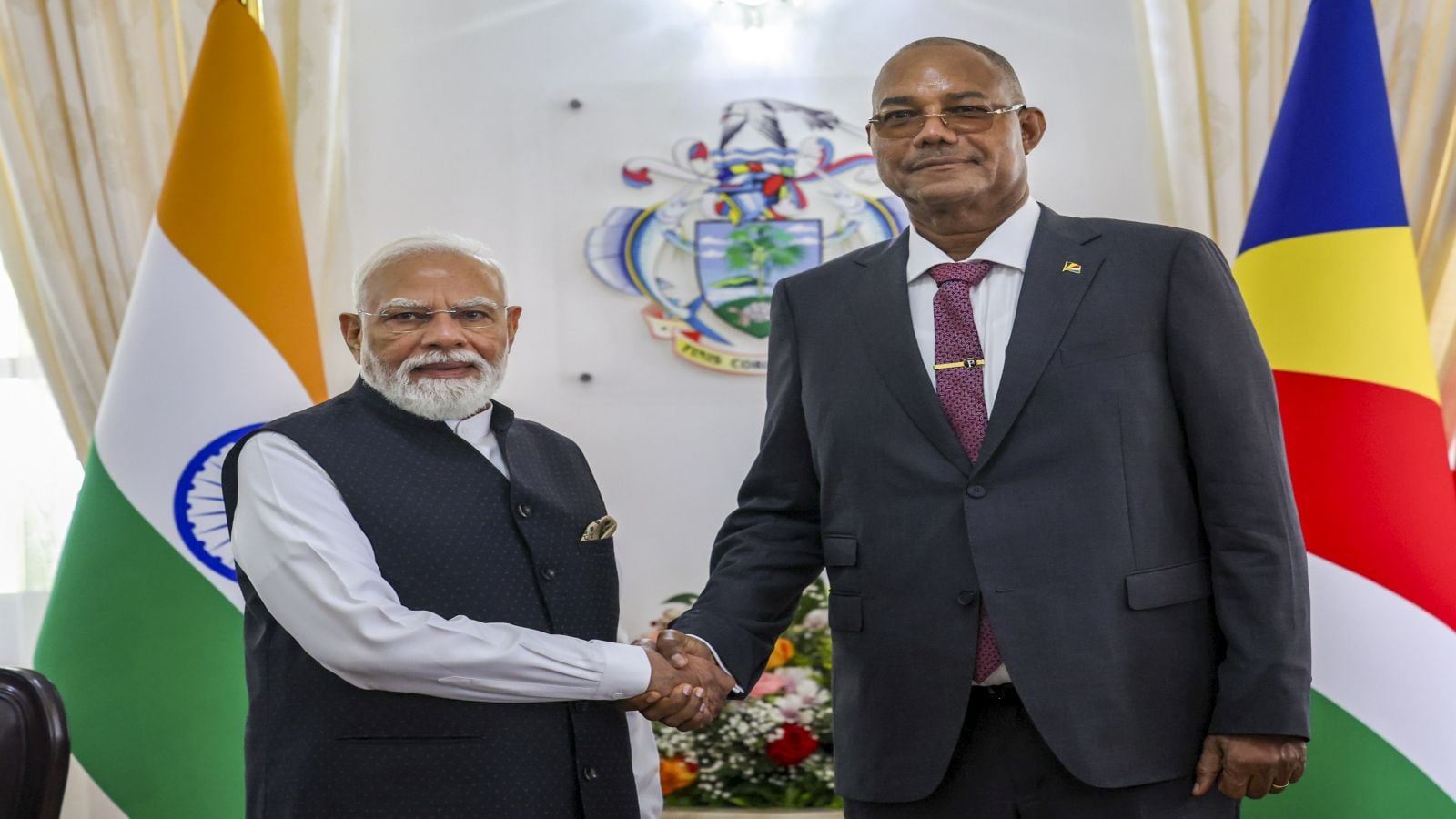
To understand what happened during this diplomatic summit, look past the handshakes between Indian Prime Minister Narendra Modi and Seychelles President Patrick Herminie. Look instead at a hypothetical clinic on Praslin Island. Let us call the doctor there Marie. For years, Marie has faced a quiet, recurring nightmare: the soaring cost of imported specialized medication. When your country has a population smaller than a typical European town, you have no buying power. You pay whatever the global pharmaceutical giants demand, or your patients go without.
One of those nineteen paper outcomes changes Marie’s world. By linking the Seychelles health ministry with India’s Jan Aushadhi scheme, the islands gain direct access to high-quality, low-cost generic medicines manufactured across the ocean. Suddenly, the financial wall blocking affordable care crumbles. This is not just a trade agreement. It is the difference between a grandmother receiving her daily blood pressure medication or risking a stroke because the pharmacy shelves are empty.
The distance between New Delhi and Victoria is roughly three thousand kilometers. Historically, that distance was measured in weeks of sea travel. Later, it was measured in expensive international wire transfers and lagging communications. If an Indian tourist wanted to buy a local painting in a market stall in Victoria, the transaction required a complex dance of currency conversions, credit card fees, and waiting periods.
Consider the friction of the old world. A traveler stands before a local vendor, both wishing to trade, separated by the invisible walls of legacy banking systems.
The introduction of India’s Unified Payments Interface, known as UPI, into the Central Bank of Seychelles dissolves those walls. It digitizes the ocean. By connecting the archipelago to a system that processes billions of instant, phone-to-phone transactions every month, the local economy changes shape. A small guesthouse owner on La Digue can now accept an instant payment from a traveler from Mumbai as easily as if they were standing in the same room. The technology is complex, but the human result is simple: the friction of being small and remote begins to vanish.
Isolation also brings vulnerability. The ocean that feeds the Seychelles also hides modern threats. Piracy, illegal fishing fleets that steal the local livelihood, and illicit trafficking networks operate in the dark spaces where local radar cannot reach. The Seychelles Coast Guard watches over an Exclusive Economic Zone of over 1.3 million square kilometers. It is a vast, impossible territory to police with a handful of vessels.
The defense agreements signed during the state visit are often described by analysts as strategic maneuvers to counter regional rivals. That is the chalkboard view. The human view is found aboard the PS Zoroaster, a Seychelles Coast Guard vessel that just underwent a complete refit in an Indian shipyard. It is found in the cockpit of a Dornier aircraft, newly upgraded with a modern glass cockpit, flying maritime surveillance patrols over the horizon.
When a rogue fishing trawler enters Seychellois waters to drain the local tuna stocks, it is not a theoretical violation of international law. It is a direct assault on the income of local fishermen who rely on those waters to feed their families. The gift of a new fast patrol vessel, ten utility vehicles, and five Laser Radial class boats to the Seychelles Defence Force is not just a military transfer. It is a shield placed over a fragile ecosystem and the economy that relies on it.
Then there is the question of what happens when the land itself fails. Small islands are the front lines of a changing climate. A rising sea level is not a future projection here; it is a current reality. The announcement that Seychelles is joining the Coalition for Disaster Resilient Infrastructure reveals the deeper anxiety of island life. When a tropical cyclone hits, a remote nation cannot simply call for ambulances from the next state.
Among the concrete items delivered were six ambulances and eighty-five hundred metric tonnes of Indian cement. It sounds mundane. Cement does not capture headlines the way space treaties do. But that cement forms the foundations of social housing units designed to withstand intense storms. Those ambulances will navigate the narrow, winding roads of Mahé when the next storm cuts off coastal villages. The narrative of statecraft is written in these heavy, unglamorous materials.
Even the stars are involved. The agreement on the peaceful uses of outer space sounds abstract, almost science fiction, for an archipelago known for its giant tortoises and coco de mer palms. Yet, monitoring the oceans, tracking weather patterns, and managing shipping lanes requires an eye in the sky. By anchoring Seychelles into India’s expanding space capabilities, the islands gain a vantage point they could never build on their own.
International relations are fundamentally built on whether you believe the person across the table will show up when the sky turns black. By spreading cooperation across nineteen distinct sectors—rather than betting everything on one massive, high-profile infrastructure project—the strategy becomes clear. It is an architecture of interdependence.
When the state visit ended, and the official aircraft lifted off from the runway in Victoria, it left behind more than a list of signed documents. It left behind a framework where a local fisherman, a village doctor, and a market vendor are now invisibly linked to the technological and industrial engine of a subcontinent. The infinite ocean between them has not shrunk, but it no longer feels quite so empty.

:max_bytes(150000):strip_icc()/parts-of-a-swamp-cooler-2718628-a477e6f0787b4f8bb62ddf2def31d495.png)