The frost clings to the windowpanes of Narva like delicate, white wire. Across the river stands an ancient fortress, its stone walls mirroring another fortress just yards away, on the other side of the water, where a different flag snaps in the biting wind. To stand here, on the eastern edge of Estonia, is to feel the curvature of the earth tilting toward a precipice. Maps are paper; borders are ink. But fear has weight. Fear smells like diesel fumes and wet wool and damp cellars where people sleep with their coats on.
Thousands of miles away, in sunlit capitals where cafes spill onto cobbled sidewalks and espresso machines hiss in rhythmic harmony, war is often discussed as a broadcast. It is a graphic on a screen, a chyron rolling beneath an anchor's serious expression, an abstract friction of commodities, sanctions, and GDP contractions. People debate grain corridors and artillery shell production quotas over brunch, pausing only to butter a croissant before returning to their spreadsheets.
Kaja Kallas knows better.
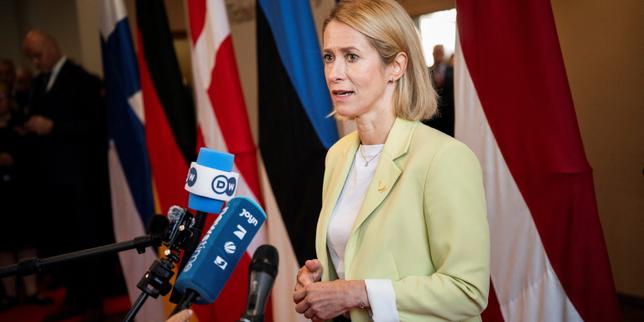
When the former Prime Minister of Estonia—now towering as a central voice in European defense—looks across the eastern horizon, she does not see a localized border dispute or a diplomatic misunderstanding that can be smoothed over with a carefully worded communique. She sees an appetite. She sees a machine that feeds on hesitation. Her warnings are direct, stripped of diplomatic varnish and bureaucratic softening: aggression does not retreat because it is reasoned with; it only advances until it hits an immovable object.
Listen to the silence that follows her words in European chambers. It is the silence of discomfort. It is the sound of governments realizing that the post-Cold War architecture of absolute safety was not a permanent law of nature, but a fragile temporary lease signed by a generation that forgot how easily freedom can be pawned.
To understand why Kallas speaks with such unyielding urgency, one must look backward into the family albums of the Baltic states. Picture a cold morning in March 1949. Kallas’s mother, Ingrid, was just a six-year-old child when Soviet secret police officers knocked on their door in Tallinn. With no warning, no trial, and no recourse, the family was packed into cattle cars and deported to Siberia. They survived on frozen potatoes and raw grit, shaped by an empire that viewed human lives as disposable fuel for ideological expansion. When you grow up listening to stories whispered in dimly lit kitchens about cattle cars and permafrost, you develop a distinct allergy to naive optimism. You recognize the specific cadence of totalitarian ambition long before it arrives at your own front door.
This is why the refrain echoing from Tallinn and Kyiv carries such heavy resonance. They will not stop unless they are stopped.
It is a simple sentence, yet it shatters the comforting illusions that many Western democracies have spent years constructing. For decades, the dominant political theology in parts of Western Europe was built on the belief of trade as a pacifier. The theory went that if you tie an authoritarian regime into global supply chains, if you buy their gas, sell them luxury cars, and invite their oligarchs to London townhouses, they will become stakeholders in stability. Commerce would tame conquest.
The theory failed. It failed because it projected bourgeois rationalism onto autocracy. It assumed that a dictator calculating his legacy views wealth the same way a CEO views quarterly returns. In reality, land, blood, and historical grievances are currencies that do not trade on the open market. When tanks rolled across the border toward Kyiv in the freezing dawn of February 2022, they tore through more than just Ukrainian sovereignty. They shredded three decades of willful self-deception.
Yet, even now, a quiet weariness haunts the Western capitals. Inflation bites at grocery bills. Energy prices fluctuate. Election cycles churn, turning politicians' eyes toward domestic grievances and short-term electoral survival. There is a persistent, whispering temptation to seek a grand bargain, to trade a slice of someone else’s land for a fragile, temporary lull in the fighting, hoping that the monster will gorge itself on the offered morsel and fall asleep.
History offers a brutal ledger on this specific brand of hope.
In the autumn of 1938, leaders gathered in Munich to carve up a neighbor's territory in exchange for the promise of peace in our time. The signature was barely dry before the tanks rolled anyway. Appeasement is not a shield; it is an invitation. Every square mile surrendered, every principle compromised for the sake of quietude, only lowers the cost of the next assault.
Consider the daily reality for a family in a frontline town like Orikhiv or Kupiansk. For them, geopolitics is not an academic seminar. It is the screaming whistle of a gliding bomb descending through the gray sky. It is the frantic scramble to a damp basement while the ceiling plaster rains down in powdery sheets. It is the sound of silence returning after the blast, broken only by the whimpering of a frightened dog and the crackle of a distant fire consuming someone's kitchen, someone's photographs, someone's entire life's work reduced to gray ash.
When people in these towns look westward, they are not asking for charity. They are asking for consistency. They are asking whether the abstract values etched into the preambles of international treaties—democracy, sovereignty, human dignity—are actual convictions or merely decorative phrases to be discarded when the weather turns cold.
Kallas articulates the terrifying mathematical reality that many prefer to ignore. If an aggressor is rewarded with territory, the lesson learned is not repentance; it is reinvigoration. Factories retool. Doctrines are refined. The lessons of battlefield failures are studied and corrected. The pause in the assault is not peace; it is merely an intermission.
This is why the defense of Ukraine has become the ultimate stress test for the free world. It is not simply about borders on an eastern European plain. It is about whether international law still possesses teeth, or whether the world is sliding back into a brutal era where might makes right and small nations exist only at the whim of their larger, more violent neighbors.
In a functioning democracy, citizens enjoy the luxury of abstraction. We debate tax policy, infrastructure spending, and cultural shifts. We can afford these domestic preoccupations only because generations before us built and defended the ramparts that keep chaos at bay. But ramparts require maintenance. They require stone, mortar, and people willing to stand on the wall when the wind turns bitter.
The complacency of the 1990s and early 2000s is gone, never to return. The illusion that history had ended—that humanity had somehow graduated past the age of conquest—lies shattered on the muddy fields of the Donbas. What remains is a stark, unvarnished choice.
To look away is to invite the storm closer. To hesitate is to pay a compounding interest rate in blood and treasure later.
Night falls quickly over the Baltic coast. The lights of the border city twinkle across the dark water, illuminating a quiet, tense boundary where two entirely different futures collide. Somewhere out there, a soldier adjusts a helmet strap against the freezing damp, staring into the dark. Somewhere in a European capital, a desk lamp burns late as officials weigh budgets against survival. And across the continent, millions sleep in warm beds, blissfully unaware of how thin the glass is that separates their morning coffee from the roar of history returning with a vengeance.
The sentry on the wall does not blink. The dawn will come, cold and gray, demanding to know what we are willing to save.