The heat in Kinshasa does not just sit in the air. It presses down on your chest, thick with the scent of exhaust fumes, roasting maize, and the metallic tang of oncoming rain. By 5:00 PM, the equatorial sun begins its rapid slide beneath the horizon, and a familiar anxiety settles over the Lemba neighborhood.
Tonight, the Leopards—the national football team of the Democratic Republic of Congo—are playing.
In a city of roughly seventeen million people, a football match is not entertainment. It is a collective exhale. It is the one ninety-minute window where the crushing weight of daily survival evaporates, replaced by the shared heartbeat of a nation. But as the countdown to kickoff begins, the grid fails. The hum of refrigerators dies. The streetlights flicker once and vanish. Darkness wins again.
In the West, a power outage during a major sporting event triggers a call to the utility company or an angry tweet. In the DRC, where less than fifteen percent of the population has reliable access to electricity, it triggers an immediate, chaotic, and brilliant manifestation of human ingenuity.
The match will be watched. It has to be.
The Price of Light
To understand why a football match matters so much, you have to understand the silence that precedes it.
When the power cuts out in Kinshasa, the silence is physical. Then, slowly, the counter-attack begins. It starts with the pull-start of a hundred small, coughing gasoline generators.
Consider a young man named Papa Wemba—not the legendary musician, but a twenty-four-year-old electronics tinkerer from the Ngaba district who carries the same name and a similar flair for the dramatic. In a hypothetical but entirely accurate composite of a typical Congolese fan, Papa Wemba doesn't own a television. He owns something far more valuable in a blackout: a car battery, a rudimentary inverter, and a reputation for making things work.
For days leading up to the Africa Cup of Nations or a crucial World Cup qualifier, Papa Wemba hoards Congolese francs to buy fuel. Gasoline is a luxury. Every liter poured into a sputtering generator or converted through a battery setup represents a skipped meal or a deferred bus fare.
The math of Congolese football fandom is brutal. The state electricity company, SNEL (Société Nationale d'Électricité), operates an aging, fragile infrastructure that simply cannot cope with demand. When the national team plays, demand spikes exponentially. The system chokes.
So, the burden shifts to the streets. If you want to see the Leopards run, you have to pay for the privilege in sweat and fuel.
The Architecture of the Pop-Up Stadium
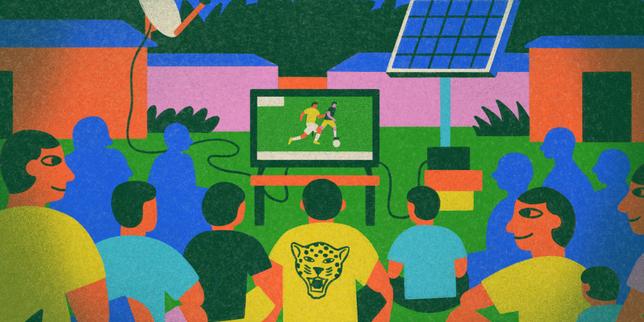
What happens next is a masterclass in spontaneous engineering. Within thirty minutes of a blackout, the courtyards and dirt alleys of Kinshasa transform into open-air theaters.
A single entrepreneur who owns a working generator or a heavy-duty truck battery becomes the center of a temporary universe. They set up a television—often an old, bulky CRT monitor or a cheap flat-screen with a cracked bezel—on a plastic table in the middle of the street.
Wooden benches appear from nearby churches. Plastic chairs are rented for a few hundred francs. Those who cannot pay stand ten deep in the dust, peering over shoulders, balancing on the walls of open drainage ditches.
The air becomes thick with the smell of burning gasoline and cheap palm oil from neighboring food stalls. The sound is deafening. It is a symphony of competing generators, each one vibrating violently against the packed earth, fighting to be heard over the commentary blasting from a pair of distorted speakers.
This is not a passive viewing experience. It is a communal struggle against infrastructure. When the screen flickers—a frequent occurrence when a generator chokes on bad fuel—a collective gasp ripples through the crowd of three hundred people. Total strangers turn to each other, holding their breath as the technician jiggles a frayed wire. When the picture snaps back, the cheer is as loud as if a goal had been scored.
The Invisible Stakes
It is easy to romanticize this resourcefulness. Western observers often look at these scenes and talk about "African resilience," a patronizing term that sanitizes systemic failure into a feel-good story.
The truth is much darker, and much more frustrating. The DRC sits on some of the world's greatest renewable energy potential. The Inga Dams on the Congo River theoretically possess enough hydroelectric capacity to power the entire African continent. Yet, through decades of conflict, corruption, and systemic neglect, the citizens living just a few hundred kilometers from the source of this immense power are left begging for crumbs of electricity.
The stakes during a football match are not just about who wins or loses on the pitch. The match is a mirror. When the Leopards win, it feels like a victory over the darkness, over the broken roads, over the politicians who have failed them. For ninety minutes, the fans are not victims of a failed state; they are the proud citizens of a footballing powerhouse.
If the TV goes dark in the eighty-fifth minute with the score tied, the heartbreak is visceral. It feels like another promise broken by the world outside their neighborhood.
The Network of the Night
But the real magic lies in how information flows when the screens fail completely.
In the furthest reaches of the city, where even the generators are too expensive or fuel has run out completely, people rely on a human network that operates faster than cellular data.
Men stand on corners with old transistor radios pressed tightly against their ears, their faces illuminated only by the faint orange glow of a burning cigarette. They become the town criers. A sudden shout from a radio listener on one block travels down the street like a wave.
"Goal?"
"Who scored?"
"Wissa! It's Wissa!"
Within seconds, an entire neighborhood knows the score without having seen a single blade of grass. It is a social contract built on absolute trust. In these moments, the lack of electricity ceases to be an isolating force. It forces people out of their homes and into the collective consciousness of the street. You cannot watch a match alone in Kinshasa during a blackout. You are forced to belong to the crowd.
The Final Whistle in the Dark
The match ends. The Leopards have secured a hard-fought draw on foreign soil, keeping their qualification hopes alive.
Slowly, the tension drains from the alleyway. The entrepreneur turns off the generator, and the sudden absence of its mechanical roar is shocking. The screen blinks out, swallowing the green pitch and the bright stadium lights thousands of miles away, returning the street to the heavy, equatorial night.
People linger in the dark, their voices low and animated as they dissect every pass, every missed opportunity, every heroic save. They will walk home in the dark, navigating the unlit potholes and broken sidewalks by the faint light of their mobile phones.
Tomorrow, the daily grind will return. The search for clean water, the battle with inflation, and the hunt for a steady income will resume at dawn. But tonight, for a few hours, they outsmarted the grid. They conjured light from a dead car battery and a gallon of petrol, ensuring that a corner of Kinshasa could bear witness to its own pride.
The dust kicked up by hundreds of feet slowly settles back into the earth, illuminated briefly by the headlights of a passing motorbike, before the darkness reclaims the street entirely.