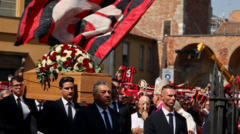
Thousands of people flooded the streets of Milan on a Tuesday morning to say goodbye to a man who basically defined what loyalty meant in modern sport.
The funeral of Franco Baresi took place at the historic Basilica di Sant'Ambrogio, drawing football legends, lifelong supporters, and ordinary fans wearing the red and black stripes of AC Milan. Baresi passed away at the age of 66, leaving behind a legacy that stretches far beyond the city of Milan or the borders of Italy.
If you only look at his Wikipedia page, you'll see the numbers: 719 appearances, 20 professional seasons, six Serie A titles, and three European Cups. But numbers don't explain why grown men wept outside the church or why former rivals like Inter Milan set aside decades of animosity to pay their respects. Baresi wasn't just a great player. He was the literal heartbeat of a golden era.
The Defender Who Didn't Need to Be Tall to Dominate
Modern football loves physical freaks. We praise center-backs who stand six-foot-four, win every aerial duel, and clear balls into the upper tier. Baresi broke every single one of those rules.
He stood relatively short for a central defender, yet strikers couldn't beat him. Why? Because he lived two steps ahead of everyone else on the pitch.
As a libero, or sweeper, Baresi didn't rely on crunching tackles or brute force. He read the geometry of the game. He intercepted passes before they were even fully kicked, stepping out of the backline with a calm elegance that left opponents bewildered. Diego Maradona called him one of the toughest opponents he ever faced. When Pele puts you on his list of the greatest living footballers, you know you're doing something right.
Twenty Years, One Club
Footballers changing clubs for a few extra million euros makes loyalty feel like an outdated concept. Baresi lived through the exact opposite.
When AC Milan suffered relegation to Serie B in the early 1980s, star players packed their bags and fled. Baresi stayed. He took the club back to the top, captained them at just 22 years old, and built a defensive dynasty alongside Paolo Maldini, Alessandro Costacurta, and Mauro Tassotti under managers like Arrigo Sacchi and Fabio Capello.
When he retired in 1997, Milan didn't just hand his number six jersey to someone else. They retired it permanently. No one else has worn it since. That kind of reverence is earned through decades of uncompromising integrity.
Saying Goodbye at Sant'Ambrogio
The turnout in Milan on Tuesday felt like a collective exhale of grief for a city that treats football like a religion.
Faces from Italian football history filled the pews and lined the square. Paolo Maldini, his long-time defensive partner, came to mourn the man he called a mentor. Roberto Baggio stood among the crowd, alongside former teammates like Marco van Basten and coaches like Fabio Capello. Even club owner Gerry Cardinale attended, though frustrated fans made their voices heard regarding the current state of the club's management.
Outside, a massive banner stretched across the barricades captured what everyone was thinking: "Ciao capitano."
Baresi battled health issues over his final year, including surgery for a lung nodule. Yet, true to form, he made one of his final public appearances earlier this year carrying the Olympic flame at the opening ceremony of the Milano Cortina Winter Games. He faced illness with the same quiet resilience he showed when stepping onto the pitch against the world's best attackers.
The streets of Milan are quieter now. The number six shirt hangs in the club museum as a monument to a standard of excellence we rarely see anymore.