The heavy glass doors of the coffeeshop near Raffles Place muffled the roar of the afternoon traffic, but they could not keep out the low, persistent hum of unease. Outside, the tropical heat pressed down on the pavement like a heavy hand. Inside, the air conditioning hummed, cooling businessmen in crisp white shirts who scrolled through their phones with furrowed brows.
On screens across the island city-state, a singular word was flashing across newsfeeds: Air India. Behind that corporate name—behind the talk of bilateral aviation agreements, economic growth, and cross-border capital investment—lay something much more fragile. Prejudice.
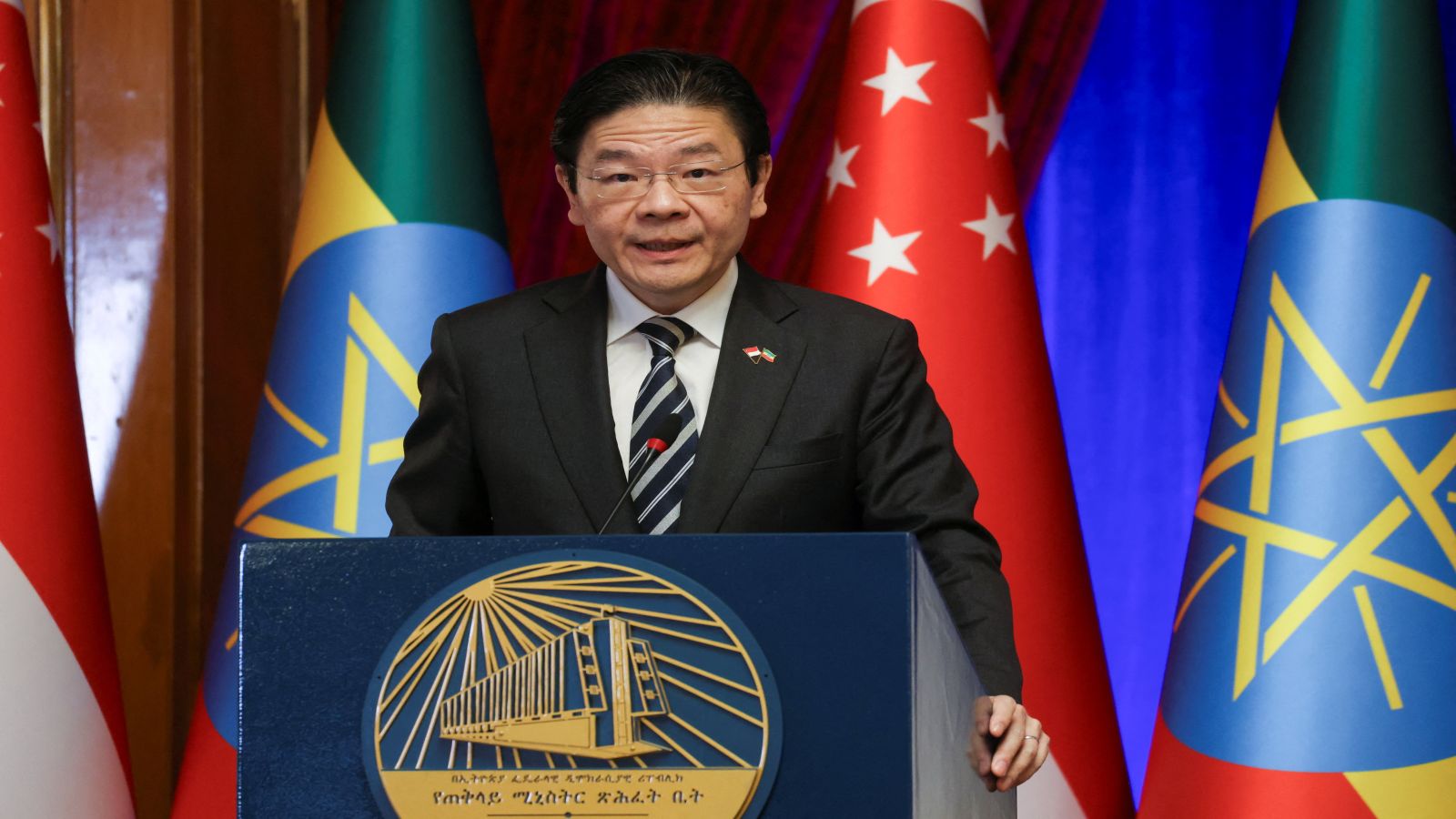
Prime Minister Lawrence Wong stood before the public recently and did something leaders rarely do with such raw candor. He didn't just manage optics; he named a sickness. He warned against the insidious creep of racism, pointing directly to a disturbing surge of anti-Indian abuse that had spilled out into the open during the public debate over the Air India investment discussions.
To understand why this matters, you have to look past the stock market tickers. You have to walk through the damp corridors of the heartland void decks where whispered anxieties turn into loud, ugly online vitriol.
Consider a hypothetical resident named Ramesh. For twenty years, Ramesh has woken up before dawn to sweep the sidewalk outside his provision shop, greeting neighbors in fluent Hokkien, Malay, and English. He is Singaporean through and through. Yet, the moment geopolitical friction arises thousands of miles away—the moment a corporate deal involving an Indian airline hits the headlines—the invisible line dividing "us" and "them" is violently redrawn. Suddenly, online trolls and casual bigots treat Ramesh not as an individual neighbor who shares their love for chicken rice and humid evenings, but as a proxy for an external threat.
That is the hidden cost of economic debates in a multiracial society. The guardrails are thin.
Singapore has long prided itself on being a masterclass in social engineering. It is an engineered miracle of concrete and coexistence where Chinese, Malays, Indians, and Eurasians share housing estates through strict ethnic quotas designed to prevent enclaves. For decades, this formula worked with clockwork precision. Generations grew up sharing school canteens, celebrating Deepavali with neighbors, and bowing their heads in unison during the national anthem.
Peace was treated as a permanent fixture of the landscape. But peace is never permanent. It is a garden that requires weeding every single day.
When complex economic discussions about foreign investments or global aviation pacts enter the public square, they frequently drag latent tribalism along with them. Xenophobia often wears the mask of economic anxiety. People worry about jobs, about culture, about the dilution of identity in a hyper-connected world. Those are valid fears in a globalized economy. But too often, those fears are weaponized, targeted not at abstract corporate structures, but at flesh-and-blood human beings who happen to share an ethnic heritage with the subject of the debate.
Lawrence Wong’s warning was not merely a political talking point. It was an urgent SOS.
He pointed out a fundamental truth that many prefer to ignore: multiculturalism is not a passive state. It is an active choice. Every time a racist comment is left unchecked beneath a news article, every time a coworker makes a passive-aggressive joke in the pantry, the mortar between the bricks crumbles just a fraction more.
Look at what happened globally over the last decade. Around the world, we have watched advanced democracies tear themselves apart along ethnic and cultural fault lines. We have seen how quickly tolerance gives way to hostility when political or economic stress hits. Singapore has always viewed itself as an exception to this global rule. An oasis of calm in a chaotic world.
Yet, the digital age has flattened distance. The venom circulating in forums across the planet now pools directly into the smartphones of teenagers sitting on the Mass Rapid Transit trains in Singapore. Algorithms do not care about social harmony; they care about engagement. And nothing engages quite like outrage.
The debate over the Air India investment should have been a straightforward conversation about aviation hubs, passenger volume, and trade corridors. Instead, it exposed a raw nerve. It revealed that beneath the gleaming facade of world-class infrastructure and financial prowess, old prejudices are waiting for an excuse to claw their way back to the surface.
This is where the stakes become deeply personal.
If a nation allows its minorities to be treated as second-class citizens or foreign agents whenever a trade dispute arises, that nation loses its soul. The economic capital might remain, but the human capital—the trust, the psychological safety, the quiet confidence of knowing you belong—evaporates. And once trust is gone, no amount of foreign investment can buy it back.
The afternoon rush hour in Singapore is beginning to wind down now. The office workers are packing their laptops, stepping out into the cooling twilight where the neon lights of the skyscrapers are beginning to flicker to life against the darkening sky.
The commuters on the train will avoid eye contact, as they usually do. Some will scroll through their feeds, pausing for a split second on headlines about commerce and culture, borders and belonging.
The real test is happening right there, in the quiet spaces between us, where the choice is made whether to look away or to stand up. Lawrence Wong drew a line in the sand. But a line on a beach is useless unless the tide respects it—and the tide only listens to those willing to push back.