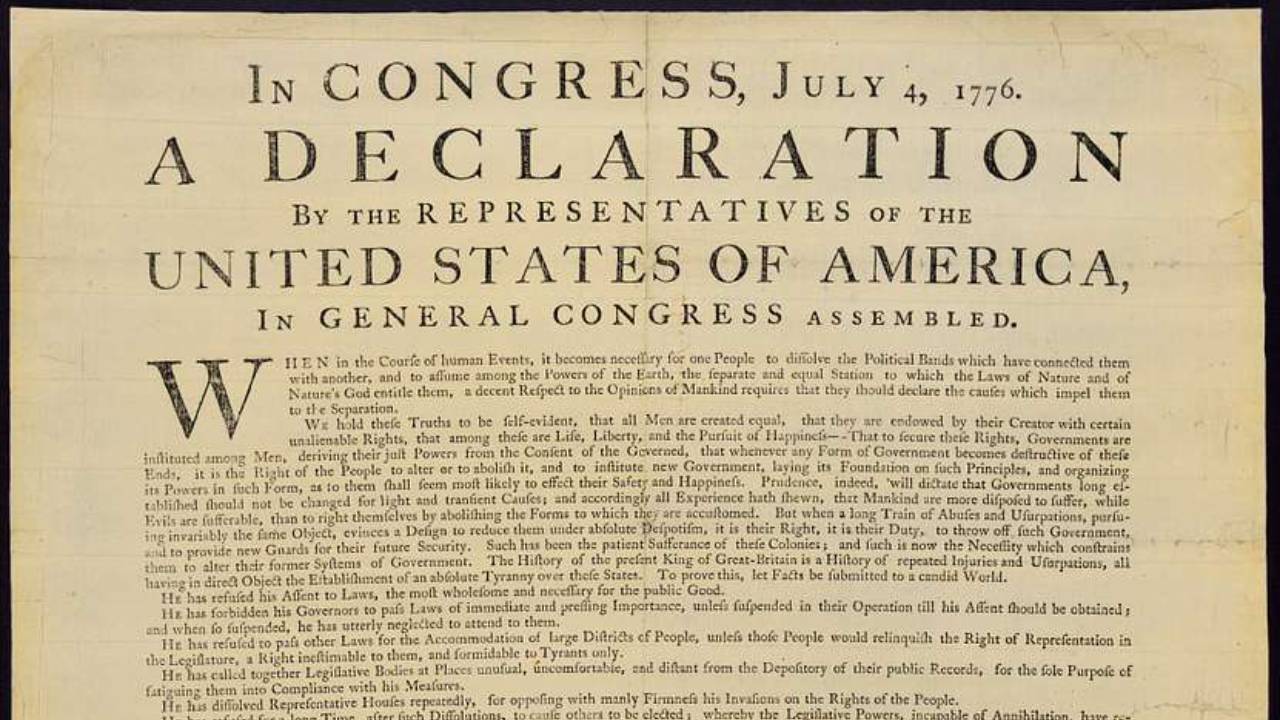
A volunteer archivist sifting through uncatalogued British maritime records recently pulled a folded sheet of paper from a bundle of 18th-century letters. It had spent nearly 250 years classified simply as "another paper." When carefully opened, the document revealed itself to be a vanishingly rare 1776 printing of the United States Declaration of Independence. Discovered at Great Britain's National Archives in Kew, this document represents the only known original copy of its specific regional printing found outside the United States. Its discovery, intentionally unveiled right on the eve of America's semiquincentennial, alters our understanding of how the young nation weaponized its founding ideals at sea.
This is not a clean, pristine diplomatic relic. It is a piece of psychological warfare captured mid-transit in a theater of war.
The Administrative Oversight That Preserved History
Historians have spent generations scouring archives for surviving broadsides of America's founding text. Most known copies survived in domestic libraries or family estates. This particular document escaped destruction because of the meticulous, cold-blooded bureaucracy of the British Royal Navy.
In May, retired insurance executive Michael Scurr was volunteering on a project to catalog the vast correspondence of British captains during the American Revolutionary War. He was reviewing a file belonging to Captain Thomas Fitzherbert of the 64-gun HMS Raisonnable. On Christmas Eve in 1776, Fitzherbert’s warship cornered and captured an 18-gun American privateer named the Dalton off the coast of Portugal.
When a privateer was seized, every scrap of paper on board was confiscated to be used as evidence in the High Court of Admiralty in London. The goal was simple. Prove the vessel was operating as a legal combatant or an illegal pirate, and inventory its contents for prize money.
Fitzherbert bundled the Dalton's official papers together. He included the ship's rules of engagement and its official privateering commission, which was signed boldly by the President of the Continental Congress, John Hancock. Tucked inside those legal documents was a regional copy of the Declaration of Independence.
The British Admiralty court cared deeply about the commission, which proved the Dalton was a legitimate target. They cared very little for the ideological tract attached to it. To the British legal system, the declaration was merely an unauthorized political statement by rebellious subjects. It was noted in the inventory as an incidental enclosure and filed away. By treating the document as worthless political noise, the Admiralty inadvertently protected it from light, handling, and destruction for over two centuries.
The Weaponization Of Print On The High Seas
The discovered document is an original "Exeter printing." It was produced by a local press in Exeter, New Hampshire, between July 16 and July 19, 1776, just two weeks after the Continental Congress approved the text in Philadelphia. Only 11 copies of this specific regional run are known to exist today.
The presence of an Exeter broadside on an armed ship off the coast of Europe reveals how quickly and systematically the revolutionary government distributed its ideological framework to its maritime forces. The Dalton, commanded by Captain Eleazer Johnson, did not carry this paper as a souvenir. It was carried as an operational tool.
Life on a privateer was brutal, dangerous, and motivated primarily by financial gain. Privateers were privately owned merchant vessels authorized by the Congress to attack enemy shipping. The crews were not regular navy sailors; they were mariners working for a share of captured cargo.
Amanda Bevan, the head of legal records at the National Archives, points out that maritime custom required captains to read official orders aloud to their crews to maintain discipline and unity. For an American privateer operating far from home waters against the largest navy in the world, the declaration provided immediate, legal legitimacy to their actions.
When Captain Johnson stood on the deck of the Dalton and read those famous lines regarding life, liberty, and the pursuit of happiness, he was transforming a crew of mercenaries and merchant sailors into political actors. He was giving men a reason to face imprisonment or death that extended beyond a split of prize money. The text functioned as an official notice that they were no longer committing treason against their king; they were executing the sovereign will of a new nation.
The Human Cost of the Dalton's Mission
The discovery of the document refocuses historical attention on the maritime war, an aspect of the revolution frequently overshadowed by land battles like Valley Forge or Yorktown. The fate of the Dalton’s crew underscores the immense stakes involved for the men who carried these broadsides into battle.
Following their capture by Captain Fitzherbert on that Christmas Eve, the 120 crew members of the Dalton were stripped of their liberty and transported to England. They were thrown into Mill Prison in Plymouth. The British government refused to recognize captured American privateers as official prisoners of war, classifying them instead as rebels and traitors guilty of high treason.
Conditions inside the prison were notoriously severe. Charles Hebert, a 19-year-old sailor aboard the Dalton, kept a clandestine journal during his two years of captivity. His writings document a grim routine of institutional neglect, systemic hunger, virulent disease, and freezing winters.
Despite the harsh punishments handed down by British jailers to break their morale, the majority of the Dalton's crew held out until they were eventually released in a formal prisoner exchange later in the war. The physical document survived in London while the men who fought under its premise languished in cells just a few hundred miles away.
Preservation and Public Reemergence
The National Archives has completed delicate conservation work to stabilize the 250-year-old paper, repairing a minor tear and ensuring the text remains legible. The document will be integrated into the archive's ongoing exhibition, joining three existing copies of the Philadelphia Dunlap broadside already held in London.
The artifact serves as a reminder that institutional archives are not static dead zones. They are dense, unmined landscapes where administrative indifference routinely hides historical treasures. The British Empire filed the paper away as a worthless piece of a rebel captain's baggage, ensuring that the very text celebrating Britain's defeat would be perfectly preserved by the British state itself.