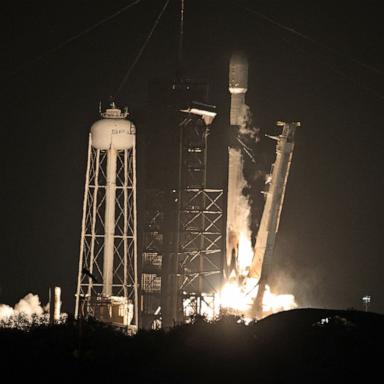
We tend to think of our footprint in space as clean. We imagine silver needles piercing the dark, slipping past the atmosphere, and vanishing into the eternal silence of the void without leaving a trace. It is a comforting illusion.
Down here, we are messy. We leave oil on driveways, plastic wrappers in gutters, and rusted chassis in the weeds behind old barns. Up there, it turns out, we are just as untidy. Don't miss our recent coverage on this related article.
Seven years ago, a piece of industrial hardware finished a violent, fiery job and was simply let go. It was a Falcon 9 upper stage booster, discarded after pushing a deep-space weather observation satellite far beyond the gentle pull of our immediate orbit. Once its fuel ran dry, it became space junk. Not a dramatic, tumbling piece of science fiction shrapnel glowing red with atmospheric entry, but a four-ton cylinder of steel and aluminum drifting through the quiet vacuum of cislunar space.
Gravity is patient. If you want more about the history of this, Wired provides an in-depth summary.
For nearly three thousand days, that discarded hunk of metal performed an invisible, chaotic dance between the Earth and the Moon. It tumbled. It caught the solar wind. It drifted along an eccentric, chaotic orbit known to orbital dynamicists as a gravitational three-body problem—a mathematical knot so complex that predicting its exact path was like trying to forecast where a single leaf will land in a hurricane.
Then came the impact.
Imagine standing on a silent plain where the only sound is the crunch of basalt under your boots. The sky is an ink-black sheet punctured by stars that do not twinkle. Overhead, a pale blue marble hangs in the void, glowing with the faint, fragile light of home. Now, imagine watching a falling star—except it is not a pebble of space dust burning up in an atmosphere that does not exist here. It is four tons of terrestrial machinery, traveling at nearly six thousand miles per hour, slamming into the bone-dry dust of the Hertzsprung crater on the lunar far side.
There was no sound. Sound requires air, and the Moon is an ocean of vacuum. But there was violence. A kinetic energy release equivalent to tons of TNT, instantly vaporizing metal, churning up ancient regolith, and carving a fresh, jagged scar into a world that has kept a diary of impacts for four and a half billion years.
(To be clear: this scenario is drawn from orbital tracking data and independent astronomical calculations verified by independent trackers like Bill Gray, who first flagged the imminent collision path.)
We barely noticed when it happened. A brief blip in news cycles, a few diagrams shared among astronomers on specialized forums, and then the world went back to scrolling.
Why should we care about a piece of trash hitting a dead rock a quarter of a million miles away?
Because it is a mirror.
For decades, space was a frontier reserved for superpowers with bottomless budgets and strict operational discipline. Every launch was an event. Every piece of hardware was tracked, cataloged, and accounted for—or so we liked to believe. But the calculus has shifted. The commercialization of the upper atmosphere and beyond means our backyard is becoming crowded. We are filling the space between worlds with constellations of internet satellites, fuel tanks, fairings, and dead boosters.
Consider what happens next: as traffic increases, the margin for error shrinks. Today, it is an empty crater on the lunar far side. Tomorrow, it could be a collision in low Earth orbit that cascades into a dense cloud of shrapnel, trapping us beneath a cage of our own high-speed garbage—a scenario known to science as the Kessler Syndrome.
We have exported our bad habits upward.
We look up at the night sky and still see poetry. We see the constellations of our ancestors, the compass that guided ships across dark oceans, the muse for poets and lovers. But the reality up there is rapidly industrializing. It is becoming an extension of our terrestrial supply chain, complete with the externalities we spent centuries ignoring down here.
The booster that hit the Moon did not carry malice. It carried only the momentum of our ambition. It was the physical receipt for a satellite that now orbits the Sun, monitoring solar windstorms that could disrupt our power grids on Earth. Every technological leap requires a trade-off. We wanted the weather data. We wanted the global communications. We wanted the bridge to the stars. And so, we accepted the invisible debris left trailing in our wake.
When the dust finally settled on the lunar surface, settling back into the eternal quiet of the vacuum, it left behind a new crater. Not a monument to human achievement, but a footprint. A reminder that we are no longer just visitors to the cosmos.
We are residents. And the mess we make follows us wherever we go.
The night sky is no longer empty. It is waiting for us to clean up after ourselves.



-annual-meeting.jpeg?width=1200&auto=webp&trim=0%2C0%2C0%2C0)