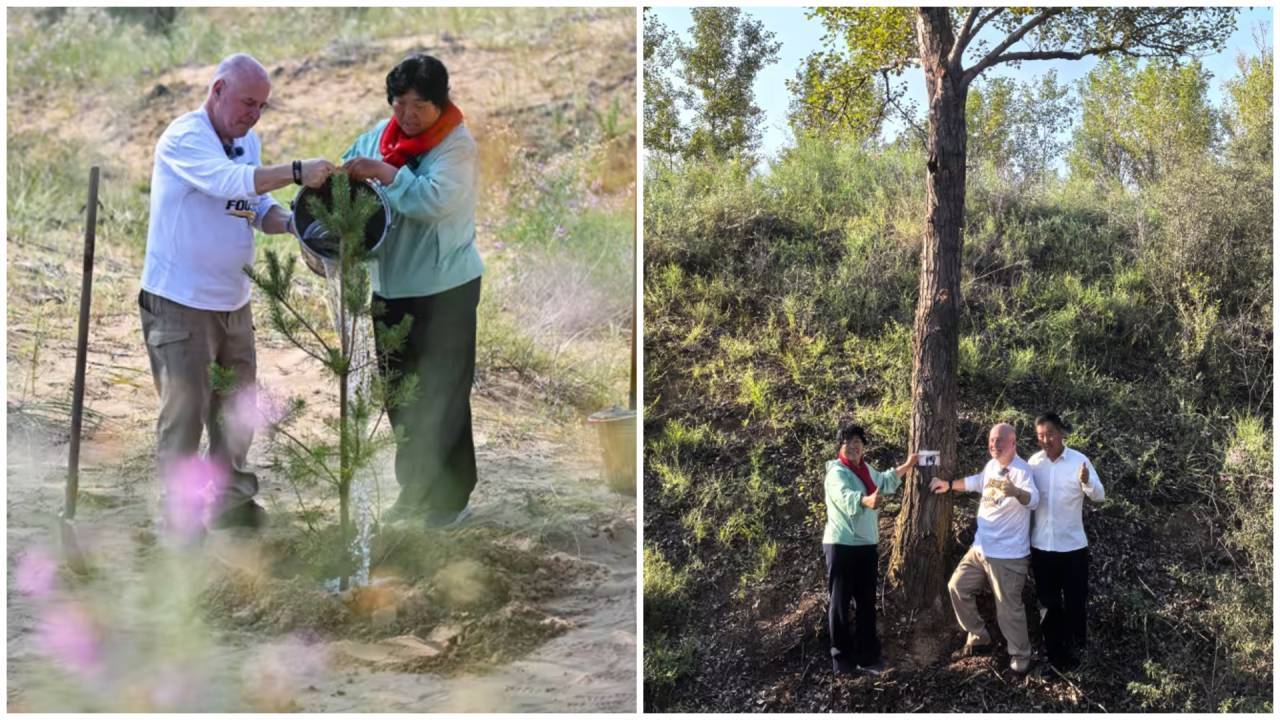
Back in 1999, Ronald Sakolsky was sitting in his Pennsylvania home watching a brief evening television segment. On the screen, a Chinese farmer named Yin Yuzhen was locked in a brutal, exhausting battle against the encroaching sands of the Maowusu Desert. She wasn't backed by a massive environmental conglomerate or a government grant. She was just a person with a shovel, fighting a landscape that wanted to swallow her home.
Sakolsky didn't just watch the segment and change the channel. He wept. He felt an immediate, unshakeable urge to send help halfway across the world. What started as a modest $5,000 donation—an astronomical sum relative to Yin’s actual income at the time—turned into a multi-decade testament to what happens when everyday people refuse to accept defeat. Today, that single contribution has blossomed into a thriving ecosystem of roughly 50,000 trees, proving that grand global change often starts with an individual who simply decides to care.
The Reality of Fighting the Dunes
Most people think desertification is an abstract geological problem best left to scientists. Spend five minutes looking at what Yin Yuzhen faced in Inner Mongolia, and you'll realize it's an intensely physical, soul-crushing war. When Yin and her husband first settled in the area in 1985, they lived in a makeshift mud hut buried beneath shifting sand dunes. The wind howled constantly. Crops failed. The desert expanded every single day.
Planting trees in sand isn't like dropping a seed into rich garden soil. Saplings wither under blistering heat, get buried by sudden dust storms, or die of thirst before their roots can anchor. Yet Yin kept digging. She planted trees by hand, year after year, working until her hands bled and her back gave out.
When Sakolsky saw her struggle on television, his teacher's instinct kicked in. He spent two months tracking down organizations and channels to get funds directly to her. He didn't want a plaque, a press release, or a corporate thank-you note. He just wanted to help a stranger make her patch of the planet a little greener.
When Small Acts Compound
We live in an era obsessed with scale. If an initiative doesn't cost billions or involve tech unicorns, we tend to dismiss it. But the Maowusu Desert transformation shatters that cynical mindset.
Yin used Sakolsky’s $5,000 to buy saplings and basic tools that were otherwise entirely out of reach. Those early trees survived. They broke the wind, held the soil in place, and created microclimates that allowed subsequent generations of plants to take root. Over twenty-seven years, that initial financial spark helped turn barren, hostile dunes into a dense forest covering a massive portion of the region.
When Sakolsky and Yin finally
How One Teacher Turned a Barren Chinese Desert Into a Forest
news
Most people think massive environmental restoration requires billions of dollars from governments or multinational corporations. They assume individual action is completely useless against planetary crises like desertification. They are wrong.
A single teacher from Pennsylvania proved that small contributions can spark massive ecological shifts. By donating five thousand dollars, this educator helped transform parts of China’s unforgiving Maowusu Desert into a thriving green expanse containing fifty thousand trees. This wasn't just a symbolic gesture or a corporate PR stunt. It was a targeted financial intervention that tackled one of northern China’s most stubborn environmental headaches.
If you look closely at how the Maowusu Desert recovery actually happened, you realize that grassroots funding models often outpace bureaucratic red tape. Let's break down how a modest contribution turned into thousands of living trees and why this project matters for the future of land restoration.
The Reality of the Maowusu Desert
The Maowusu Desert spans parts of Inner Mongolia and Shaanxi province. For decades, it was notorious for violent sandstorms, encroaching dunes, and aggressive soil erosion that choked nearby towns and crippled local agriculture. People living on the edge of the desert watched their homes get swallowed by sand year after year.
Traditional containment methods failed because they lacked local community buy-in and sustained funding. Planting trees in an arid environment sounds simple on paper, but keeping those saplings alive requires water management, protective fencing, and manual labor.
Local farmers and regional authorities eventually started a massive campaign to push back the sand. They planted drought-resistant species like shrubs and hardy trees that could anchor the loose soil. But scaling these operations takes capital. Seedlings cost money. Irrigation infrastructure costs money. Labor isn't free.
This is where foreign contributors and grassroots donors entered the picture. When a Pennsylvania teacher sent a five-thousand-dollar donation to support local afforestation efforts, that money went straight into purchasing and planting resilient vegetation tailored to the local ecosystem. Five thousand dollars doesn't sound like much on a national budget scale, but on the ground in Shaanxi, it funded thousands of individual saplings that fundamentally changed the local microclimate.
Why Small Donations Matter More Than You Think
Donors often suffer from impact fatigue. You give ten dollars here or fifty dollars there, and you wonder if it actually did anything. Big charities often swallow donations in administrative overhead, leaving pennies for the actual cause.
The Maowusu project succeeded because targeted regional initiatives cut out the bloat. When funds go directly to local cooperatives and community planters, every single dollar buys physical assets.
- Seedlings get purchased from regional nurseries that understand local soil chemistry.
- Local workers get paid fair wages to plant and monitor the young trees through their vulnerable first summers.
- Survival rates skyrocket because the people planting the trees live right next to them and have a vested interest in keeping them alive.
When you contribute to a transparent, boots-on-the-ground environmental effort, your money does heavy lifting. The Pennsylvania teacher didn't solve global climate change single-handedly, but fifty thousand living trees now anchor soil that used to blow away in the wind. That is a concrete, measurable victory.
What Environmental Restoration Gets Wrong
Too many people treat tree-planting as a numbers game. Organizations love to boast about planting a million trees, but they rarely talk about how many of those trees survive past the first year. If you plant millions of non-native pines in an area that needs deep-rooting native shrubs, you just waste water and kill the ecosystem.
Successful desert reclamation in places like the Maowusu basin relies on ecological restoration, not just sticking green things in the dirt.
The project relied on hardy indigenous species. These plants do not need heavy irrigation once their root systems establish. They capture morning dew, stabilize the sand dunes against high winds, and slowly build organic matter back into the dead soil. Over time, insects return. Birds follow. The landscape heals itself because you gave it a jump start.
You cannot just throw money at a barren landscape and walk away. You have to fund the ongoing maintenance. That means paying local caretakers to repair fences that keep grazing livestock away from young saplings. It means monitoring pest outbreaks before they wipe out a newly planted grove.
Taking Action on Environmental Giving
If this story inspires you to support similar grassroots environmental projects, stop looking for massive global funds. Look for hyper-local organizations with transparent auditing and direct community involvement.
Find projects where your money buys physical items with immediate utility, like seeds, tools, or water infrastructure. Ask for proof of survival rates, not just planting counts.
You don't need a million-dollar foundation to make a dent in the world's biggest problems. You just need to find the right project, verify their methods, and direct your resources where they can do the most immediate good.