A wooden fishing trawler bobbed gently on the steel-gray swells of the Black Sea, just off the coast of Sinop. There was no crew on board. No nets were cast. To any passing gull, it was just a lonely, empty vessel drifting at the whim of the current. But on a computer screen inside a concrete control bunker miles away, this humble boat was the center of the universe.
It was a moving dot. A target.
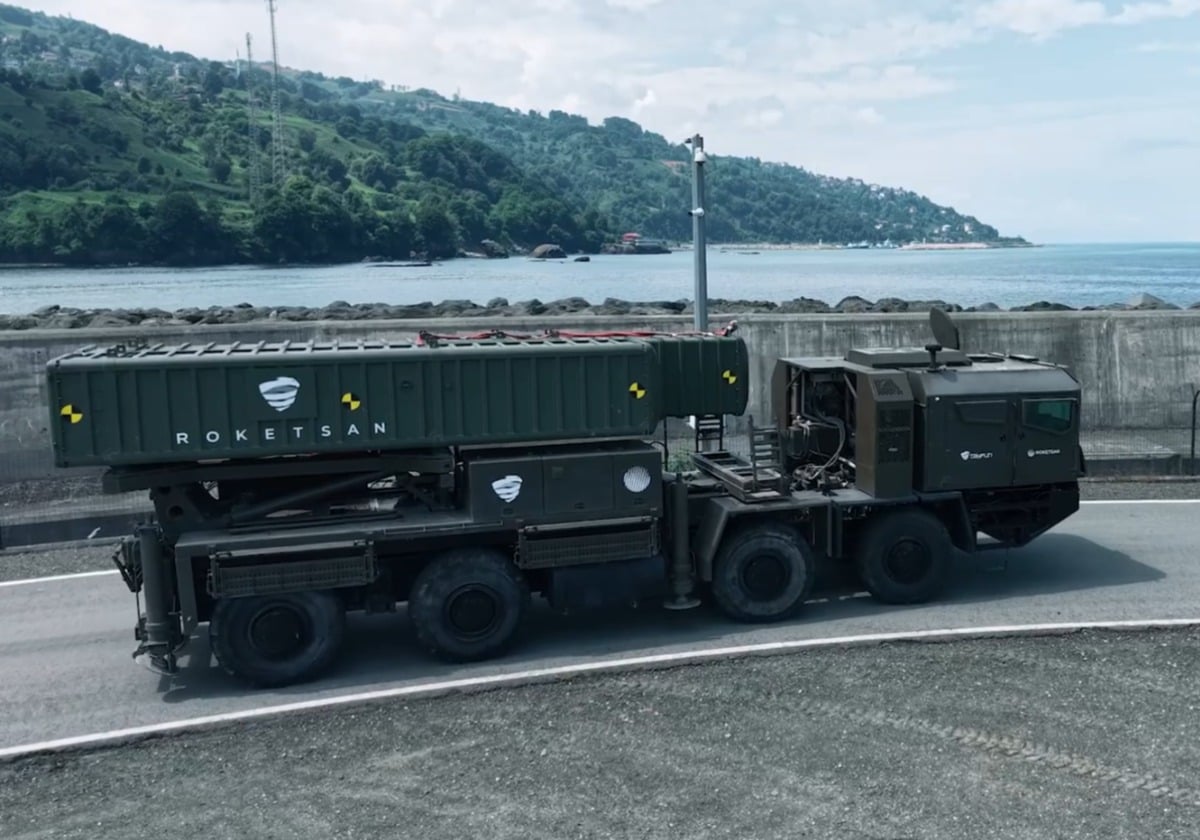
Suddenly, the sky above the horizon tore open. A roaring column of fire, birthed from a truck-mounted launcher, screamed into the upper atmosphere. It was the TAYFUN Block 3 ballistic missile, engineered by the Turkish defense company Roketsan. Within minutes, the missile reached the apex of its suborbital arc and turned downward, accelerating through the friction of the air until it was traveling at hypersonic speeds—five times the speed of sound.
At that velocity, the air around the nosecone becomes a superheated shroud of plasma. But beneath a specialized, jettisonable heatshield, an optical seeker eye opened. The missile’s brain scanned the vast, featureless water, ignored the waves, locked onto the tiny fishing boat, and adjusted its fins.
A kinetic strike at Mach 5 does not merely destroy. It vaporizes. When the metal met the wood, the fishing boat ceased to exist in a flash of white heat and displaced water.
With that single, violent pinpoint strike, the geopolitical geometry of the Mediterranean and the Black Sea changed forever. Turkey did not just test a new weapon. It forced its way into an incredibly exclusive, highly volatile global club.
The Tyranny of the Horizon
To understand why a dead fishing boat in Sinop matters to a naval commander in Washington, Athens, or Moscow, you have to understand the nightmare of modern naval warfare.
For decades, the math of defending a coast was relatively straightforward. If an enemy fleet approached, you fired anti-ship cruise missiles like the American Harpoon or the Turkish ATMACA. These weapons are essentially small, robotic airplanes. They fly low, skimming just feet above the crest of the waves to hide from shipboard radar.
But cruise missiles have a weakness. They are slow. They cruise at subsonic speeds, giving a modern destroyer's automated defense systems—like the Phalanx Gatling guns or rolling airframe missiles—precious minutes to track, target, and shoot them down.
A ballistic missile is an entirely different beast. Instead of hugging the water, it arches into space and crashes straight down like a falling meteor.
For a long time, military scientists believed hitting a moving ship with a ballistic missile was an impossible engineering riddle. Think of the variables. A ship is moving in three dimensions—pitching, rolling, and steaming forward. The missile is traveling so fast that its own friction blinds its sensors. If your targeting data is even three seconds old, the ship will have moved, and the missile will splash harmlessly into the empty ocean.
Only three nations had publicly mastered this dark art of physics: China, with its feared DF-21D "carrier killer"; Iran, with its Khalij Fars; and Pakistan. Even the United States is only just catching up, working to field its own anti-ship variant of the Precision Strike Missile (PrSM).
Now, Turkey is the fourth.
The Invisible Web
The missile is the fist, but a fist is useless without eyes. A hypersonic piece of flying metal cannot find a ship on its own.
Consider a hypothetical naval officer named Commander Marcus, stationed aboard a foreign destroyer navigating the international waters of the Aegean Sea. For years, his primary worry was electronic jamming or a swarm of low-flying drones. He knew exactly where the Turkish coastal radar stations were. He knew their range.
But the TAYFUN Block 3 changes the calculus of his survival. The test at Sinop proved that Turkey has successfully woven together an invisible, over-the-horizon web.
When the TAYFUN is deployed, it relies on an interconnected ecosystem of intelligence. High-altitude drones, equipped with ultra-advanced optical sensors, loiter unseen in the clouds, feeding real-time target coordinates into a digital datalink. On the coast, long-range high-frequency radars peer past the curvature of the Earth, tracking the wake of distant ships.
When the missile is launched, it does not fly blind. It receives continuous, midcourse corrections mid-flight, constantly updating where the enemy ship will be. Only in the final, terrifying seconds of its descent does the missile drop its thermal shield, activate its own internal seeker, and guide itself home.
For Commander Marcus, the warning time drops from twenty minutes to less than three. The vertical dive angle means his ship’s standard radar systems might not even see the threat until it is already breaking the sound barrier directly overhead.
The Ghost in the Aegean
Geography is destiny, and Turkey's destiny is written in water. The nation sits at the literal crossroads of continents, controlling the Bosporus and the Dardanelles—the only watery gates into and out of the Black Sea.
For the past few years, tension has simmered quietly in these waters. Maritime boundaries are disputed. Underwater gas reserves are fiercely contested. Every time a naval exercise is conducted, nations watch each other through binoculars, measuring intentions by the turning of a rudder.
The introduction of an anti-ship ballistic missile (ASBM) throws a massive rock into this fragile glass house.
It is a strategy known in military circles as Anti-Access/Area Denial. In plain terms, it means creating a zone so dangerous that an enemy fleet cannot enter without risking total annihilation. By extending its reach hundreds of miles off its coast with hypersonic precision, Ankara has effectively built an invisible wall across the eastern Mediterranean.
It alters the balance of power without firing a shot in anger. A nation no longer needs a massive, multi-billion-dollar fleet of aircraft carriers and cruisers to control the sea. They just need a few highly mobile trucks hidden in the olive groves of the Anatolian coast, holding weapons that cannot be stopped.
The empty fishing boat that disintegrated in the waters of Sinop was a demonstration. It was a message typed in hyper-velocity steel, sent to every naval power within a thousand miles. The message was simple: the old rules of the sea no longer apply, and the club just got a new member.