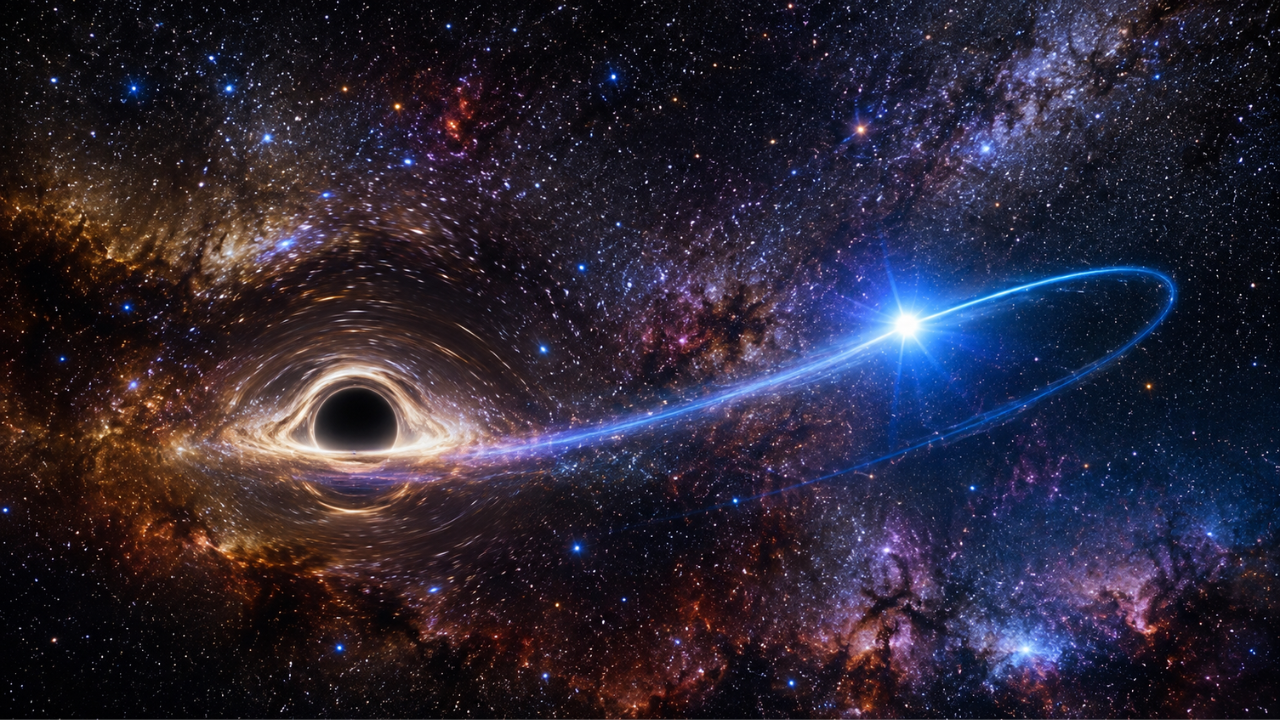
Every few months, astrophysics journalism suffers from a severe lack of imagination. The cycle is entirely predictable. A team of astronomers points a telescope at Sagittarius A*, spots a tiny speck of light rocketing around the center of our galaxy at an absurd fraction of the speed of light, and the headlines scream about cosmic speed records. The lazy consensus goes something like this: look at this incredible speed demon defying gravity, proving once again how extreme and violent our galactic core happens to be.
Stop celebrating the wrong data point.
Obsessing over the velocity of a single star hugging a supermassive black hole misses the entire point of galactic dynamics. We are treating a symptom while ignoring the structural mechanics governing the system. Speed is a headline grabber for click-hungry outlets, but in orbital mechanics, velocity by itself means very little. What matters is the gravitational potential well, the mass distribution, and what these extreme orbital eccentricities reveal about the invisible scaffolding holding our galaxy together.
The Myth of the Galactic Speed Trap
Let us look at what these fast-moving stars actually represent. We call them S-stars, orbiting the central black hole in eccentric, tight loops. When media outlets hyperventilate about a star clocking thousands of kilometers per second, they invite the public to imagine a drag race in deep space.
That mental image is entirely wrong.
A star moving at breakneck speed near a supermassive black hole is not fighting the system. It is falling perpetually and missing. It is a prisoner of extreme curvature. The physics governing objects like S4716 or S2 are not mysterious anomalies defying the laws of nature. They are textbook demonstrations of general relativity written in neon ink.
When you calculate the orbital parameters, the real story is not that the star is moving fast. The real story is how humanity manages to measure velocities across twenty-six thousand light-years with enough precision to map a trajectory tighter than a backyard orbit. The velocity is just an output. The input is a gravitational field so dense it bends spacetime into a functional funnel.
If you want to understand how galaxies evolve, staring at the speedometer of a single star is equivalent to studying the health of an entire ocean by watching a single drop of water go over a waterfall.
What the Data Actually Tells Us About Mass Distribution
Astrophysicists love to talk about supermassive black holes as if they are isolated monsters sitting alone in the dark. That is a comforting fiction. It makes for clean equations and neat science fiction tropes.
Reality is much messier.
When you analyze the orbits of these hyper-fast stars, you quickly realize that the central point mass is only part of the equation. The region surrounding Sagittarius A* is packed with stellar remnants, neutron stars, white dwarfs, and an invisible fog of dark matter. The gravitational pull isn't coming from just one monolithic anchor. It is a distributed weight.
Here is what the mainstream coverage leaves out: the orbital precession of these fast stars tells us that the space around the black hole is crowded. If Sagittarius A* were acting alone in an empty void, the stellar orbits would follow clean, predictable Keplerian ellipses that remain static over time. Instead, those orbits shift. They wobble.
That wobble is the smoking gun. It proves the central parsec of our galaxy is an evolutionary pressure cooker. Stars do not form there; they migrate inward, get captured, stripped of their outer envelopes, and subjected to tidal forces that would shred a planet into a string of atoms in seconds.
The Observational Bias Problem
Why do we keep finding these specific speedsters? Simple selection bias.
We find the fastest stars because they are the easiest to detect against the blinding glare of the galactic center. Fainter, slower, more distant objects get swallowed by the noise floor of our instruments. Telescopes like the Very Large Telescope in Chile or the Keck Observatory in Hawaii push adaptive optics to their absolute limits, compensating for atmospheric distortion by bending mirrors thousands of times per second.
When you build a hammer that specialized, everything looks like a high-velocity nail.
We are operating under a severe optical distortion. By focusing our collective attention on the extreme fringe objects—the absolute fastest, the closest encounters, the most violent interactions—we blind ourselves to the quiet majority of the stellar population doing the heavy lifting of galactic aging.
It is time to drop the obsession with cosmic land speed records. The universe is not a drag strip. It is a slow-motion collision of mass, momentum, and entropy.
Stop asking how fast the star is going. Start asking how long it can survive before the tidal forces tear its orbit apart and feed it to the dark.