The Aegean Sea stretches out below like a sheet of hammered silver, dotted with whitewashed islands and sun-baked cliffs that seem to rise straight from myth. For most travelers, this is the backdrop of a lifetime, the scenery painted across postcards and daydreams. It is the place where ordinary routines are shed, replaced by the slow, rhythmic ticking of Mediterranean time.
Alexander Cromie and Marie Ebert knew this view well as their private helicopter banked toward the island of Sifnos. They were thirty-one and thirty, respectively, London-based, and freshly married. This was supposed to be the opening chapter of a shared lifetime—the honeymoon.
Consider what happens next: a flight plan executed with routine precision suddenly fracturing against the indifferent wind.
They had taken off earlier from Markopoulo, a village southeast of Athens, charting a course across the blue toward the Cyclades. At the controls was Giorgos Raikos, a fifty-three-year-old former Hellenic Army veteran with thousands of hours in the sky—a pilot whose professional life had trained him for every predictable contingency.
As the afternoon sun began its slow descent toward the horizon on Monday evening, the helicopter approached its destination. The landing pad on Sifnos was just minutes away. The air was clear, the weather normal.
Then came the sound.
Local residents in the Tholos area of Sifnos would later describe it to investigators: a strange, mechanical dissonance tearing through the quiet late afternoon. It was an aberrant engine noise, stark and wrong, cutting through the heavy rotor beat like a structural cry for help. Deputy Mayor Manolis Foundoulakis would later note that eyewitnesses heard the aircraft struggling against an unseen force in the air.
In aviation, the margins between safety and catastrophe are measured in fractions of a second and millimeters of metal. When a component fails at low altitude during a final approach, the pilot has virtually no vertical real estate left to buy time. Radio contact vanished. Closed-circuit footage captured the horrifying trajectory of the aircraft spinning out of control before it plummeted toward the ground just meters from the island's designated landing zone.
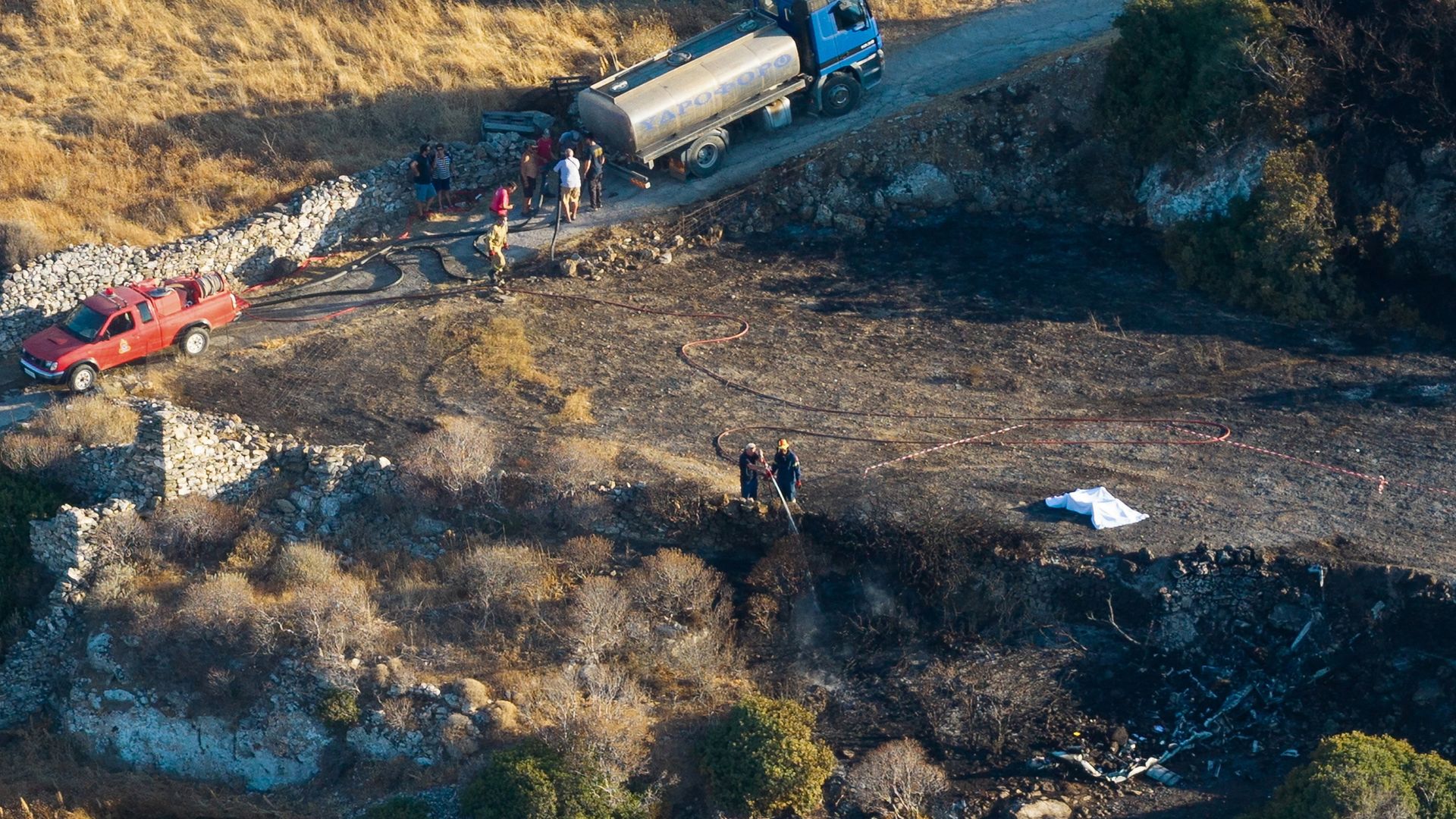
An impact. A sudden, violent bloom of fire and dark smoke billowing against the serene island backdrop.
When emergency responders and firefighters reached the wreckage, the stark reality of the tragedy set in. There was little left of the aircraft. The lives of Alexander, Marie, and Giorgos had been extinguished in an instant, turning a celebration of union into an unimaginable sorrow.
Back in London and across corporate networks, the news arrived with the blunt force of an unreality. Colleagues at Blackstone, where Alexander worked as a vice president in private wealth solutions, released statements grappling with a sudden emptiness. They remembered a man who was deeply beloved, marking a cruel contrast between the vibrant trajectories of young careers and the abrupt finality of a Greek hillside.
Investigators from aviation authorities and Greek police are now left piecing together the fragments. Current hypotheses lean toward a sudden mechanical failure—a stark reminder that beneath the glamour of private charters and luxury travel lie the unyielding laws of physics.
The tragedy on Sifnos leaves behind a quiet devastation. It forces those left behind to confront the fragility underpinning our most cherished milestones. Honeymoons are designed to look toward decades yet unlived, built on the promise of tomorrow. When a journey ends before it can truly begin, the silence that lingers on the island is heavy with everything left unsaid.


