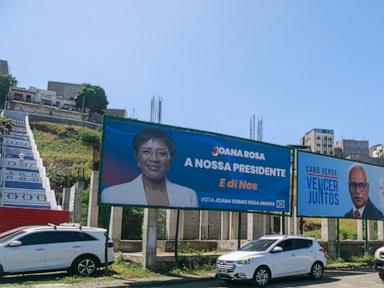
Since gaining independence from Portugal in 1975, Cape Verde has held seven presidential elections and produced five presidents, every single one of them a man. That fifty-year streak faces its most serious challenge yet as political shifts, grassroots advocacy, and a changing electorate converge to make the election of Cape Verde's first woman president a realistic political outcome rather than a symbolic talking point.
International coverage tends to frame this possibility as a sudden progressive awakening in a small island nation. That reading misses the actual mechanics of Cape Verdean politics. The push to put a woman in the Palácio da Presidência in Praia is not an overnight cultural shift, nor is it a guaranteed victory. It is the result of decades of institutional groundwork colliding with deep-seated voter skepticism, rigid party gatekeeping, and the structural realities of a semi-presidential system where the head of state wields soft power rather than direct executive control. Discover more on a similar issue: this related article.
The Myth of the Sudden Breakthrough
To understand why a woman could win the presidency now, you first have to look at why it did not happen in 2011, 2016, or 2021. Cape Verde is routinely cited by international observers as one of Africa's most stable democracies. Power transfers peacefully between its two dominant political parties, the African Party for the Independence of Cape Verde (PAICV) and the Movement for Democracy (MpD). Yet for half a century, the highest office in the land remained an exclusively male club, occupied successively by Aristides Pereira, António Mascarenhas Monteiro, Pedro Pires, Jorge Carlos Fonseca, and José Maria Neves.
The absence of a female president was never due to a lack of qualified women in public life. Women have long led ministries, directed central banking operations, and managed major municipal governments across the archipelago's ten islands. The bottleneck was always the nomination process. Further reporting by USA Today explores similar views on this issue.
In Cape Verde, presidential candidates run technically as independents, requiring signatures from registered voters rather than a formal party ticket. In practice, however, no candidate has ever won the presidency without the financial machinery, island-by-island mobilization networks, and media apparatus of either the PAICV or the MpD. For decades, party leadership treated the presidential nomination as a reward for senior male statesmen nearing the end of their active legislative careers. Women were encouraged to run for parliament or local councils, where their presence bolstered party lists, while the presidency was quietly reserved for the old guard.
How the Parity Law Changed the Political Math
The turning point did not come from a presidential campaign. It came from legislative reform.
In 2019, Cape Verde passed its landmark Parity Law, requiring that women make up at least 40 percent of candidates on electoral lists for the National Assembly and municipal bodies. Skeptics at the time dismissed the law as window dressing that would fill backbench seats without altering who actually holds power. They miscalculated how political pipelines work.
By forcing both the PAICV and the MpD to recruit, fund, and campaign for dozens of women across every municipality from Santo Antão to Brava, the Parity Law inadvertently shattered the parties' traditional talent monopolies. Women who entered politics through municipal assemblies and parliamentary committees built their own regional donor bases, established direct relationships with local community leaders, and proved they could win tough districts without relying on male patronage.
Once a critical mass of women occupied visible leadership roles in Praia and Mindelo, the standard excuse used by party elders—that voters were not ready for a woman at the top—began to collapse under the weight of actual election results. Female mayors and cabinet ministers were already managing budgets, negotiating infrastructure contracts, and handling crisis response. The presidency, which relies heavily on moral authority, diplomatic representation, and constitutional oversight, suddenly looked less like a leap into the unknown and more like a natural progression.
Understanding the Real Power of the Cape Verdean Presidency
Any serious analysis of this race requires stripping away the romanticism surrounding the office itself. Cape Verde operates under a semi-presidential republic model. Unlike the executive presidencies in the United States or Brazil, the President of Cape Verde does not run the day-to-day government, draft the national budget, or command cabinet ministries. Those powers belong to the Prime Minister, who is chosen by the majority party in the National Assembly.
So why does the gender of the president matter so intensely to both political parties and international observers?
First, the president serves as the Supreme Commander of the Armed Forces and holds the constitutional power to veto legislation, dissolve parliament under specific deadlock conditions, and refer laws to the Constitutional Court for review. In a country where single-party majorities occasionally tempt prime ministers to push through controversial judicial or economic reforms, an independent-minded president acts as the primary institutional check.
Second, the presidency is Cape Verde's chief diplomatic megaphone. Because the country has few natural resources and relies heavily on tourism, remittances from its massive global diaspora, and foreign development partnerships, the head of state's international standing directly affects economic confidence. A woman occupying the Palácio da Presidência alters how Cape Verde is perceived in Brussels, Washington, Lisbon, and across the Economic Community of West African States (ECOWAS).
Third, there is the domestic psychological barrier. Political scientists who study post-colonial democracies note that executive offices carry disproportionate symbolic weight. Until a woman holds the top ceremonial and constitutional post, political equality remains theoretical in the minds of younger voters.
The Hidden Obstacles Nobody Wants to Discuss
If the structural conditions are finally aligned, what could still derail a female candidate's path to victory? Three major hurdles stand in the way, and none of them have simple fixes.
The Diaspora Factor
Cape Verde is one of the few nations on earth where more citizens live abroad than inside the country's borders. Hundreds of thousands of Cape Verdeans reside in the United States, Portugal, France, the Netherlands, and Senegal. Under Cape Verdean law, registered diaspora voters cast ballots in presidential elections, and their turnout frequently swings tight races.
While diaspora communities are vital economic lifelines, their political views do not always mirror the progressive shifts happening in urban centers like Praia. Many older diaspora voters remain deeply tied to traditional party loyalties formed during the independence struggle or the multi-party transition of 1991. Reaching these voters requires expensive international campaigning and trusted community intermediaries—networks that have historically favored established male politicians.
The Double Standard on Governance
Voters across the archipelago are exhausted by rising living costs, inter-island transport bottlenecks, and youth unemployment. When a male candidate campaigns on broad themes of national unity and institutional stability, voters largely accept it as standard presidential rhetoric. Female candidates, by contrast, routinely face sharper scrutiny over their specific economic credentials and administrative toughness.
If a female candidate leans too heavily into social issues or gender representation, opponents quietly paint her as a single-issue activist unsuited for sovereign defense and macroeconomic diplomacy. If she adopts a hard-nosed, technocratic posture, critics accuse her of lacking the warmth and unifying presence expected of a head of state. Navigating that narrow corridor without alienating either rural traditionalists or urban reformers is a brutal balancing act.
Party Factionalism and Spoiler Risks
Because presidential candidates run via citizen signatures rather than exclusive party nominations, the biggest threat to a viable woman candidate is rarely the opposing party. It is a split within her own political camp.
If a major party fails to rally unanimously behind a single female contender, rival factions may quietly back a veteran male insider to protect their own internal leverage ahead of future legislative cycles. In a multi-candidate first round, a divided base guarantees that no one clears the 50 percent threshold needed to avoid a runoff, turning the second round into a high-stakes game of backroom endorsements where female candidates have historically had fewer allies among party brokers.
What Makes This Election Different From Past Cycles
Despite these obstacles, three concrete shifts distinguish the current political environment from previous election cycles.
- A generational turnover in the electorate: Voters born after 1990 now form the largest demographic block in Cape Verde. They have no personal memory of the one-party era and exhibit far weaker blind loyalty to traditional party labels than their parents did.
- Visible fatigue with recycled leadership: For years, the same handful of male figures rotated between prime ministerial posts, parliamentary leadership, and presidential runs. Voters across Mindelo, Assomada, and Santa Maria have increasingly signaled their frustration with this closed loop, creating an opening for candidates who represent a genuine break in style and background.
- Media decentralization: Independent digital news outlets, local radio call-in shows, and social media platforms have weakened the ability of traditional party newspapers and state broadcasters to dictate who is considered "presidential." A candidate with sharp communication skills can now build national momentum without waiting for permission from party headquarters in Praia.
Measuring What Actually Changes if a Woman Wins
Electing a woman president will not magically solve Cape Verde's structural vulnerabilities. The archipelago will still face acute climate risks, water scarcity, dependence on imported food and fuel, and the persistent challenge of diversifying an economy overly reliant on European tourism. The president does not control interest rates, airline routes, or municipal zoning laws.
What changes immediately is the baseline of political possibility. In a region where democratic norms have faced severe backsliding—marked by military coups and constitutional manipulations across parts of West Africa—Cape Verde's ability to expand representation through peaceful, constitutional means carries weight far beyond its 4,033 square kilometers of volcanic islands.
More importantly, it permanently alters the internal calculus of Cape Verdean political parties. Once a woman wins the presidency, party leaders can no longer treat female politicians as secondary vote-gatherers for legislative lists. Campaign finance committees, diplomatic corps appointments, and judicial nominations will face immediate pressure to reflect the new reality at the top of the state.
For fifty years, Cape Verdeans have watched men take the oath of office while women carried the logistical weight of every campaign, every local council, and every household economy across the islands. Whether the electorate finally closes that gap at the ballot box comes down to a simple test of political maturity: judging candidates by their command of the constitution rather than their adherence to a half-century habit.