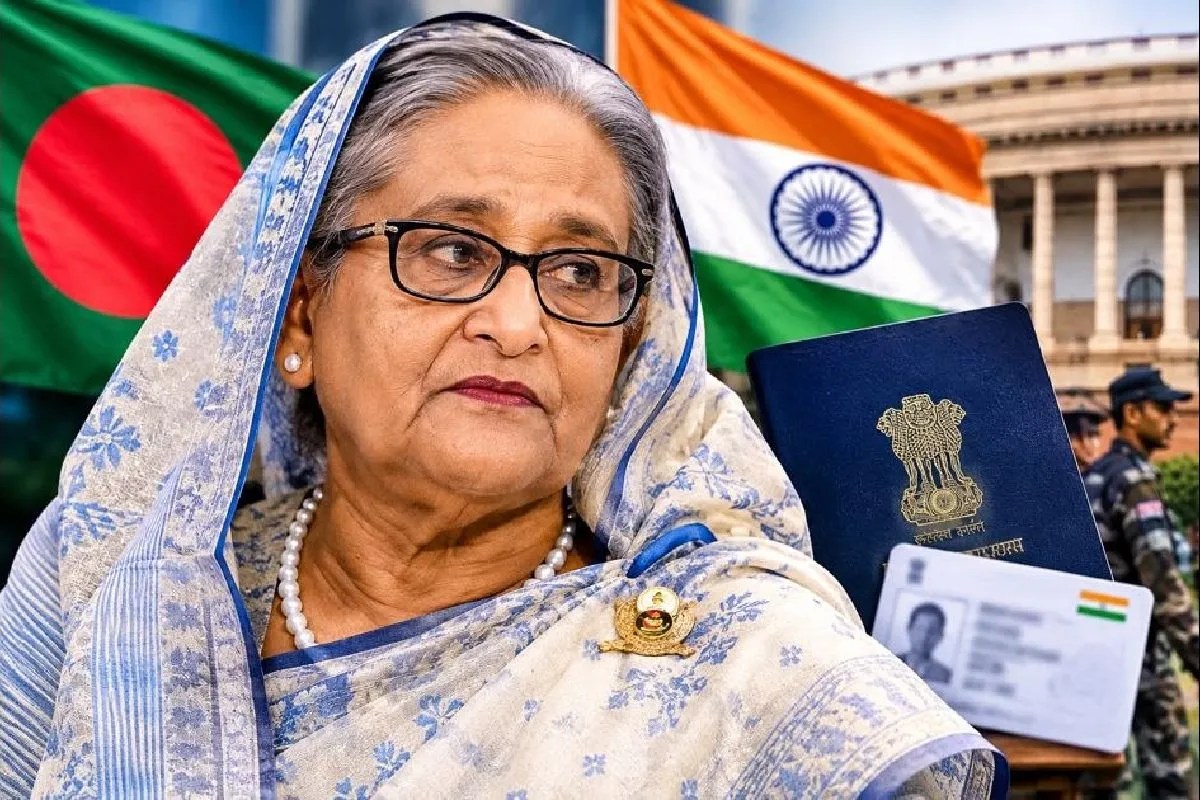
The diplomatic standoff between Dhaka and New Delhi over former Prime Minister Sheikh Hasina exposes a fundamental clash between domestic political signaling and international legal mechanics. According to statements attributed to former Indian High Commissioner to Bangladesh Veena Sikri, the interim administration in Dhaka faces a self-inflicted procedural contradiction: demanding the extradition of a citizen whose travel credentials it has simultaneously invalidated, while avoiding the bilateral institutional mechanisms required to execute a lawful transfer.
A rigorous examination of this dispute requires separating rhetorical posturing from the operational realities of international law, bilateral treaty obligations, and domestic administrative procedures. Rather than a straightforward question of diplomatic reluctance on India's part, the impasse functions as a multi-layered legal and political deadlock driven by competing incentives in Dhaka.
The Structural Contradiction in Dhaka's Strategy
In international relations, demanding the return of a former head of state involves two distinct legal pathways: administrative repatriation via valid travel documentation, or formal judicial extradition under a bilateral treaty. As highlighted in Veena Sikri's commentary, Dhaka's current posture undermines both pathways simultaneously.
1. The Travel Document Bottleneck
Following Sheikh Hasina's departure from Bangladesh in August 2024, the interim government moved swiftly to revoke her diplomatic passport. While revoking the privileges of a deposed leader aligns with domestic political expectations, it creates an immediate administrative barrier to repatriation.
- Legal Identity and Transit: Under international aviation and border control standards, a sovereign state cannot compel another state to deport an individual who lacks a valid travel document verifying nationality and right of entry.
- The Administrative Remedy: If a government genuinely intends for a citizen to return voluntarily or through simplified administrative channels, the standard protocol is issuing an Emergency Certificate or a temporary travel document.
- The Operational Reality: By withholding a valid travel document while publicly insisting on her return, Dhaka shifts the burden of custody onto New Delhi without providing the basic legal instrument required to facilitate transit.
2. The Extradition Treaty Threshold
When administrative repatriation is bypassed, the alternative is formal extradition governed by the 2013 India-Bangladesh Extradition Treaty (amended in 2016 to streamline the process). However, invoking an extradition treaty is not a political speech act; it is an evidentiary legal process.
- Evidentiary Standards: Under the amended treaty, while the requirement to provide prima facie evidence of guilt was relaxed to expedite proceedings against fugitives, the requesting state must still transmit formal arrest warrants, specific criminal charges, and authenticated judicial documentation through designated diplomatic channels.
- The Political Offense Exception: Standard extradition frameworks, including the Indo-Bangladesh treaty, contain provisions allowing the requested state to refuse extradition if the offenses are deemed to be of a political character, or if the prosecution appears motivated by political persecution rather than standard criminal justice.
- Institutional Friction: Publicly framing the demand through media statements rather than submitting airtight, non-political criminal dossiers invites immediate legal challenges within the requested state's judicial system.
Competing Political Incentives in the Interim Administration
To understand why Dhaka maintains a legally contradictory stance, one must analyze the domestic political calculus of an unelected interim administration managing a volatile post-revolution environment.
Domestic Legitimacy vs. Operational Execution
For the interim government in Dhaka, the demand for Sheikh Hasina's return serves a critical domestic stabilization function. Student groups, opposition factions, and victims' families view accountability for the July-August 2024 crackdown as the primary mandate of the post-Hasina transition. Loudly demanding extradition satisfies this constituency without requiring immediate institutional deliverables.
Conversely, actually securing Sheikh Hasina's physical return introduces severe operational risks for the interim administration:
- Security and Detention Liabilities: Housing a former four-term Prime Minister with deep residual networks within the bureaucracy, judiciary, and security apparatus presents an acute internal security challenge.
- Trial Management: Conducting high-profile trials under the International Crimes Tribunal (ICT) requires meeting international due process standards to retain Western diplomatic and financial support. Any perceived procedural flaw risks transforming a domestic villain into an international symbol of political retribution.
- Polarization Triggers: Her physical presence in Dhaka—even inside a high-security facility—would serve as a permanent focal point for Awami League mobilization, potentially destabilizing the interim administration's timeline for institutional reforms and elections.
From a strategic standpoint, keeping Sheikh Hasina in India while blaming New Delhi for obstructing justice allows Dhaka to harvest domestic political capital while externalizing the security and judicial risks of her return.
New Delhi's Strategic Calculus and Legal Constraints
India's position is governed by a combination of domestic legal obligations, historical diplomatic precedent, and regional security interests. Critics in Dhaka often characterize New Delhi's posture as partisan protection of a longtime ally, yet the constraints operating on India are structural.
The Rule of Law Constraint
India operates under a constitutional framework where executive decisions regarding foreign nationals are subject to judicial review by the Supreme Court. New Delhi cannot simply place a foreign national on an aircraft and hand them over to another government without a valid legal order—either a deportation order backed by valid travel documents from the receiving country, or a judicial extradition order processed under the Indian Extradition Act of 1962.
Precedent and Regional Credibility
India has a long-established record of granting refuge to political figures from neighboring states during periods of acute upheaval—ranging from the Dalai Lama to figures from Nepal, Afghanistan, and Myanmar. Abruptly surrendering a former head of state without exhausting rigorous judicial scrutiny would severely degrade India's credibility as a reliable partner among political elites across South Asia.
Bilateral Leverage and Stability
Beyond legalities, New Delhi must balance its response against broader bilateral dependencies. India and Bangladesh share a 4,096-kilometer border, integrated power grids, transit corridors connecting mainland India to its northeastern states, and deep trade ties. Escalating the dispute over Sheikh Hasina into an outright diplomatic rupture carries unacceptable economic and security costs for both capitals. Consequently, New Delhi has adopted a posture of strategic patience—acknowledging Dhaka's communications while adhering strictly to formal diplomatic and legal protocols.
The Mechanism of Diplomatic Stalemate
When both parties derive distinct advantages from the status quo, a conflict settles into a stable equilibrium of diplomatic friction. The mechanics of this stalemate operate across three dimensions:
- Asymmetric Communication: Dhaka communicates primarily through public briefings and domestic media cycles to project resolve, while New Delhi restricts its engagement to formal, confidential diplomatic channels to avoid escalating public rhetoric.
- Procedural Shifting: By focusing on the technical prerequisites—such as valid travel documentation and formal judicial dossiers—analysts like Veena Sikri highlight how procedural norms act as a buffer against impulsive political demands.
- Time Horizon Mismatch: The interim administration in Dhaka operates on a compressed political timeline driven by immediate street pressure, whereas the Indian foreign policy establishment operates on a multi-year strategic horizon focused on long-term state-to-state stability regardless of which party governs Dhaka.
Limitations of the Current Approaches
Neither the administrative travel-document route nor the formal extradition route offers a clean resolution to this impasse.
- Limitations of the Travel Document Route: Even if Dhaka were to issue an Emergency Certificate tomorrow, a travel document merely enables movement; it does not compel an individual to board a flight against their will, nor does it authorize Indian authorities to forcibly deport someone who has not violated Indian law and may seek asylum protections.
- Limitations of the Extradition Route: Even if Dhaka submits a comprehensive judicial dossier under the 2013 treaty, extradition proceedings in Indian courts—complete with appeals up to the Supreme Court—routinely take several years to conclude. By the time a final judicial ruling is rendered, the political landscape in Bangladesh will likely have shifted through national elections.
Strategic Resolution Pathways
Resolving this impasse requires both capitals to decouple domestic political theater from functional bilateral governance.
For Dhaka, the immediate tactical necessity is aligning its legal instruments with its stated objectives. If the interim administration intends to pursue accountability seriously, it must transition from public rhetoric to rigorous institutional execution: issuing the requisite travel credentials to establish legal clarity, compiling verifiable, non-political criminal evidence that meets international judicial standards, and conducting transparent domestic proceedings that withstand external scrutiny. Until Dhaka resolves the contradiction between revoking travel documents and demanding repatriation, its extradition posture will remain a domestic political signal rather than an actionable diplomatic mechanism.