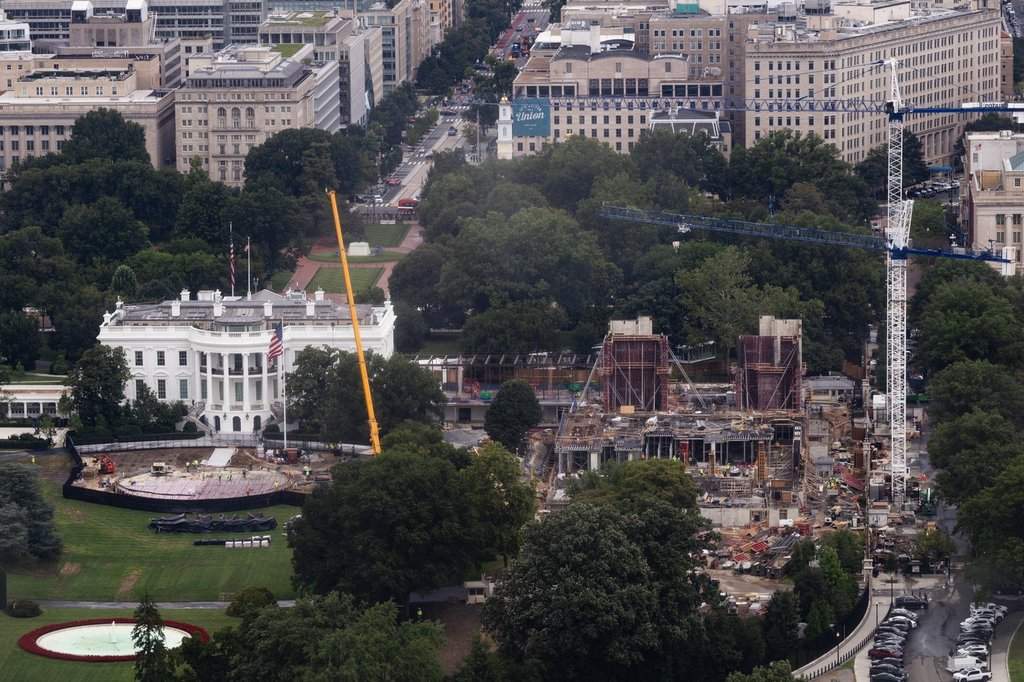
The legal confrontation between the executive branch and the federal judiciary over the construction of a new White House facility exposes fundamental tensions in constitutional architecture. When the United States Court of Appeals for the District of Columbia Circuit ruled that the administration lacked the statutory authority to construct a massive ballroom on the site of the demolished East Wing without legislative backing, it triggered an emergency appeal to the Supreme Court. This dispute transcends architectural preferences or partisan disagreements, functioning instead as a stress test for the limits of executive power over federal property, the doctrine of separation of powers, and the justiciable boundaries of national security claims.
The Structural Mechanics of Executive Overreach Versus Legislative Authority
At the heart of the litigation brought by the National Trust for Historic Preservation is a fundamental question of resource allocation and constitutional custody. Article I, Section 8 and Article IV, Section 3 of the United States Constitution grant Congress plenary control over federal property and the appropriations power. The executive branch operates as a steward of these public assets rather than an absolute proprietor.
When a lower federal court issued a preliminary injunction halting aboveground construction of the 90,000-square-foot project, and the D.C. Circuit subsequently affirmed that decision in a 2-1 vote, the judiciary relied on a strict reading of statutory delegation. The majority opinion established that routine maintenance or emergency security upgrades authorized by historical precedent do not extend to the wholesale demolition of a historic wing and the erection of a multi-million-dollar superstructure funded through alternative arrangements.
The executive defense, led by the Solicitor General's filings, pivots away from pure architectural modification toward an integrated security framework. By classifying the project as a military installation housing critical command, control, and communication nodes designed to withstand conventional or nuclear strikes, the administration attempts to anchor its authority within the commander-in-chief clause. This legal maneuver sets up a direct clash between judicial review of domestic property laws and executive privilege over national defense infrastructure.
The Cost Function and Funding Vectors of Federal Construction
The financial architecture of the project introduces another layer of regulatory friction. Initially framed as a private endeavor funded entirely through donations, the project's financial parameters evolved as structural requirements expanded. Projects of this magnitude typically require meticulous oversight by agencies such as the National Capital Planning Commission to evaluate compliance with federal laws, historical preservation mandates, and aesthetic continuity.
When an enterprise on federal land shifts from standard upkeep to a monumental capital project, the absence of explicit congressional authorization creates a systemic risk. The judiciary's intervention functions as a procedural brake on self-executing capital allocation. Without a clear statutory line permitting the executive branch to bypass legislative appropriations for non-defense superstructures affixed to federal landmarks, the risk profile for executive unilateralism expands significantly. The courts have signaled that the blending of security necessities with commercial or ceremonial spaces does not immunize the entire footprint from congressional scrutiny.
Institutional Fallout and the Supreme Court Arbitration
The emergency petition filed with the Supreme Court forces the justices to weigh immediate operational disruption against long-term constitutional norms. The administration argues that an injunction halting a project claimed to be substantially complete creates an irreversible bottleneck, whereas opponents maintain that allowing construction to proceed without legislative authorization permanently alters a national landmark.
Review the Supreme Court Docket for filings and subsequent orders regarding the stay application, or consult the U.S. Court of Appeals for the D.C. Circuit for the underlying judicial opinions governing the stay expiration. For broader context on federal property management regulations, the General Services Administration provides documentation on public building authorities.
To resolve the impasse, the high court must determine whether the executive branch possesses inherent emergency powers that override statutory appropriations clauses when national security integration is claimed. The resolution will redefine the operational boundaries for presidential authority over federal real estate for decades to come, establishing a definitive precedent on whether executive agencies can utilize private funding and security justifications to execute capital projects in the absence of legislative consent.