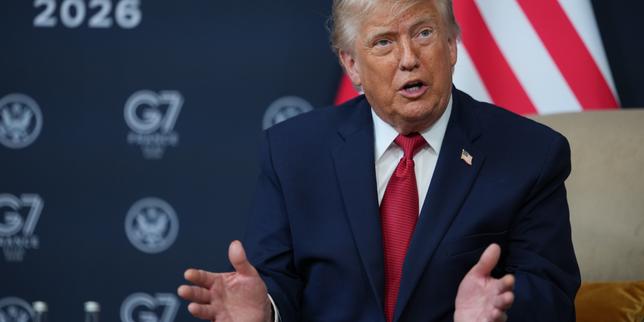
Donald Trump walked into the G7 working session in Evian, took a quick look at the assembled world leaders, and didn't bother with diplomatic pleasantries. He stood at the edge of the table, smiled wide, and announced exactly what he was thinking.
"I am the boss." Read more on a similar subject: this related article.
The room broke into uneasy laughter. Some took it as a joke. Others knew better. This wasn't just a classic piece of Trump theater designed to grab headlines back home. It was a blunt statement of fact about how the balance of power shifts when Washington decides to throw its weight around. While critics love to paint his international appearances as unhinged chaos, the reality unfolding right now in France tells a completely different story.
The Power Dynamic Behind the Jokes
Diplomacy usually runs on carefully scripted statements and polite nods. Trump prefers to break the script entirely. Walking into a room full of allies and declaring yourself the boss sounds incredibly arrogant. It is. But it also reveals how he views multilateral organizations. To him, these summits aren't meetings of equals. They're stages where the biggest player dictates the terms. Further journalism by The New York Times highlights comparable perspectives on the subject.
Look at who was sitting at that table in Evian. You had French President Emmanuel Macron, Italian Prime Minister Giorgia Meloni, Canadian Prime Minister Mark Carney, British Prime Minister Keir Starmer, German Chancellor Friedrich Merz, and Japanese Prime Minister Sanae Takaichi. Most of these leaders spent months preparing complex policy positions on global trade, climate goals, and security frameworks. Trump arrived late, complained that the room was too hot because the air conditioning wasn't turned up high enough, and completely disrupted the serious mood.
He shook hands with Macron, who asked him how he was doing in English. The mood seemed light on the surface. Meloni even got the room laughing earlier in the day to break the tension. But beneath the smiles, the dynamic is tense. European leaders are terrified of what a second Trump term means for their economies and their defense structures. They don't laugh because the joke is funny. They laugh because they don't know what else to do when the most powerful man in the world treats a high-level summit like a boardroom meeting.
The Art of Forcing a Agreement
Everyone expected Trump to wreck this summit. During his first presidency, he famously blew up a G7 meeting in Canada, pulling out of the joint communique via tweet while flying away on Air Force One. Allies braced themselves for a repeat performance in Evian, especially with his recent threats to slap massive tariffs on European goods and French wine.
Instead, something strange happened. Trump didn't just sign the joint statement. He actively shaped it to serve his own narrative.
The G7 leaders agreed to a major text on Ukraine. The document details a collective commitment to ramp up pressure on Russia's war economy, specifically targeting Russian hydrocarbon exports with harsher sanctions. It promises more air defense systems, interceptors, and long-range capabilities for Kyiv. For an American president who has repeatedly questioned US funding for Ukraine, signing onto this seemed like a major concession.
It wasn't a concession. Trump got exactly what he wanted wrapped inside that text.
Hidden deeper in the official declaration is a direct nod to American diplomatic victories. The G7 text explicitly praises the recent deal between the United States and Iran, noting that it was obtained under the firm leadership of President Donald Trump. This deal paves the way for the reopening of the Strait of Hormuz, a critical bottleneck for global oil and gas shipping. Trump already promised that the strait will be completely open by Friday. By getting the G7 to put his name in the official document alongside a major victory for global energy security, Trump turned a multilateral summit into a personal press release.
Why European Leaders Are Playing Along
You might wonder why leaders like Macron or Merz would agree to insert praise for Trump into a joint G7 text. The answer is simple survival.
European nations are dealing with severe economic stagnation, underfunded militaries, and domestic political instability. They can't afford an open trade war with the United States right now. France framed the global economic issue as a shared problem, arguing that China overproduces, America overconsumes, and Europe underinvests. That's a nice academic theory. Trump doesn't care about theories. He cares about bilateral deficits.
Macron understands this better than most. Instead of fighting Trump's ego, the French president decided to feed it. Macron arranged to extend Trump's stay in France for a lavish dinner at the Palace of Versailles. It is a calculated move. Versailles represents the peak of historic French grandeur, the kind of gold-plated luxury that appeals directly to a billionaire real estate developer.
This isn't the first time Macron has used this playbook. He tried it years ago with a Bastille Day military parade. It works because it bypasses the bureaucratic machinery of the State Department and appeals directly to the man at the top. If a fancy dinner in a historic palace keeps American tariffs off European products for a few more months, Macron views that as a cheap price to pay.
The Reality of American Dominance
The phrase "I am the boss" might sound crude, but the geopolitical reality backs it up. The United States remains the ultimate guarantor of European security through NATO. It is the largest consumer market for European exports. When Washington moves, the rest of the West has no choice but to adjust.
Consider the discussions around technology and digital regulations at the summit. G7 nations tried to project unity by agreeing on principles to protect minors and ban social media for users under 15 or 16. It sounds great on paper. But the major platforms driving these issues are almost entirely American companies. Without Washington enforcing those rules or holding Silicon Valley accountable, European regulations don't have teeth.
The same applies to global finance. Canadian Prime Minister Mark Carney reportedly spoke with Trump seven or eight times during the summit, mostly focused on trade and economic stability. Leaders are realizing that traditional diplomatic channels are broken. If you want to protect your country's economic interests, you have to talk directly to Trump.
What Happens After Evian
The summit wraps up, but the real test happens when these leaders return to their capitals. Trump got his praise, his signatures on the text, and his Versailles dinner. The allies got a brief moment of stability and a promise that the Strait of Hormuz will stay open for oil shipments.
If you want to understand where global politics is heading, stop looking at the polite press conferences. Watch the body language. Watch the last-minute additions to joint texts. The international order built after World War II was designed to prevent any single nation from dominating its allies. Trump's behavior in Evian proves that the old rules are fading.
The next step for international businesses and political analysts isn't to wait for the next formal summit. Start tracking the implementation of the US-Iran shipping agreements and the actual flow of air defense systems to Ukraine. Ignore the theater, focus on the leverage, and recognize that when the president of the United States says he's in charge, he's usually right.