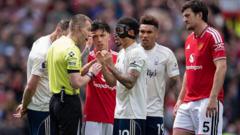
We are doing this again. Another Monday morning, another frantic phone call from refereeing chief Howard Webb, and another useless apology delivered to a furious Premier League manager.
This time, Nottingham Forest are the victims. Manchester United walked away with a 3-2 victory at Old Trafford, but the defining moment wasn't a piece of tactical brilliance. It was referee Michael Salisbury staring at a pitchside monitor, seeing a blatant handball, and deciding to ignore his own eyes anyway.
The Professional Game Match Officials Limited (PGMOL) has already admitted the blunder. Webb reportedly rang Forest officials directly to concede that Matheus Cunha’s go-ahead goal should have been scratched off. But this apology doesn't fix the glaring issues with how the handball rule is interpreted, implemented, and understood by the people paid to enforce it.
The Old Trafford Breakdown
Let's look at what actually happened in the 55th minute. With the match locked at 1-1, Diogo Dalot swung a cross into the box. The ball missed the Forest defenders and caught United striker Bryan Mbeumo by surprise. He lifted his knee, the ball popped up, and he trapped it securely between his hip and his right arm. It was a wedge.
Mbeumo’s subsequent shot was blocked, and Cunha buried the rebound.
VAR official Matthew Donohue spent nearly two minutes looking at the footage. He saw what everyone at home saw: Mbeumo used his arm to control the ball and gain a massive advantage. Donohue did his job and sent Salisbury to the monitor, fully expecting the goal to be overturned.
Instead, Salisbury looked at the screen and doubled down on his original mistake. He walked back onto the pitch and announced to the stadium that the goal stood because the handball was "accidental."
It was a baffling moment. Sky Sports commentator Gary Neville called it an "absolute shocker in every single way." He was right. You can't just wedge the ball against your body with your arm, pass it to a teammate, and call it a day.
The Myth of the Accidental Teammate Rule
Why did Salisbury think he was in the right? He was hiding behind a 2021 update to Law 12 of the FA Handbook.
That update states that a player will not be penalized for an accidental handball if it leads to a teammate scoring or creating a goalscoring chance. The rule was designed to stop goals from being disallowed for microscopic, unavoidable deflections that happened way back in the build-up. If Mbeumo had scored the goal himself, it would have been automatically disallowed, accidental or not. But because Cunha scored the rebound, Salisbury assumed the "accidental teammate" loophole saved it.
Here is the problem: an accidental handball is supposed to mean a ball hitting an arm that is in a natural position close to the body, or a ball deflecting unexpectedly from a fraction of an inch away.
Mbeumo’s arm was out. He adjusted his body. He controlled the flight of the ball using his upper arm to keep the play alive. That isn't an accidental brush. It is a functional control mechanism. By ruling that specific motion as legal just because a teammate finished the play, Salisbury fundamentally misinterpreted the spirit of the law. PGMOL's rapid apology proves it. The referees' body clearly believes the contact crossed the line from an unfortunate deflection into an active, unnatural handling offense.
Pereira’s Fury and the Demand for Clarity
Nottingham Forest head coach Vitor Pereira didn't hold back after the final whistle. His team fought back to level the score, only to see their eight-game unbeaten Premier League run snapped by a refereeing hallucination.
Pereira spent his post-match press duties demanding a high-level summit with PGMOL to establish what actually constitutes a handball in 2026. "For me, it was handball, very clear," Pereira said. "It is sad not to cancel the goal. For me, it was the decision that decided the game."
You can understand his anger. Managers are losing matches, points, and potentially millions of pounds in prize money while officials try to untangle the messy, over-complicated wording of the rulebook.
The PGMOL’s current strategy of issuing post-match apologies is broken. It does nothing to salvage the dropped points. It just breeds cynicism among fans who feel like the VAR process is a weekly lottery based on the whims of whoever is holding the whistle.
What Referees Need to Do Next
The solution isn't to rewrite Law 12 yet again. The sport doesn't need more sub-clauses, paragraphs, or footnotes. It needs common sense.
Referees must stop overthinking the mechanics of the human body when looking at slow-motion replays. If a player’s arm alters the trajectory of the ball in a way that directly creates a goalscoring opportunity, it needs to be disallowed. The distinction between the goalscorer handling the ball and a creator handling the ball has created a massive gray area that officials clearly cannot manage consistently.
If you are a manager, player, or fan looking for consistency, don't expect it anytime soon. Until PGMOL strips away the bureaucratic clutter from the rulebook and instructs on-field referees to defer to the clear evidence on the VAR screens, we are going to see Michael Salisbury-style meltdowns happen again and again.
The next step is simple: the Premier League needs to use this specific Old Trafford error as a baseline case study for what constitutes an unnatural handling offense. Show the clip to every official in the country and make it clear that this goal can never stand again. Until that happens, the apologies mean absolutely nothing.


.jpg?t=170918294849)