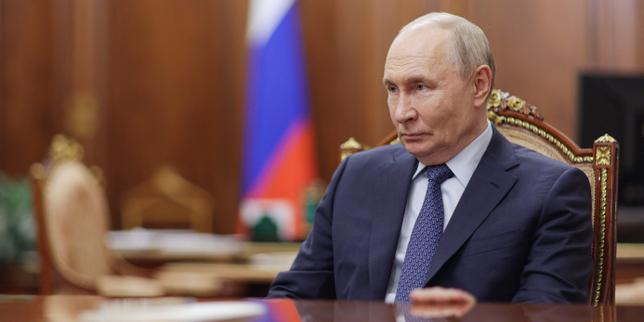
According to statements reported from Moscow, Russian President Vladimir Putin explicitly accuses the European Union and NATO of deliberately prolonging the war in Ukraine through sustained military, financial, and intelligence assistance. Conversely, officials in Brussels, Washington, and Kyiv maintain that Western material support is a defensive necessity under Article 51 of the United Nations Charter, designed to prevent territorial conquest and uphold European security architecture. Analyzing this diplomatic deadlock requires stripping away rhetoric and examining the underlying game-theoretic incentives, industrial attrition rates, and deterrent signaling that govern both blocs.
The Structural Logic of Asymmetric Attribution
In interstate conflicts involving indirect superpower confrontation, rhetoric functions as an operational instrument rather than a literal description of events. When the Kremlin attributes the duration of the conflict to Western intervention, it applies a specific causal model: without external inflows of artillery shells, air defense interceptors, and sovereign debt financing, the Ukrainian state apparatus would reach a point of systemic exhaustion, forcing capitulation on Russian terms. From Moscow’s strategic perspective, external support artificially alters the local balance of power, extending a war whose outcome Moscow views as predetermined by demographic and industrial asymmetry. Building on this theme, you can find more in: The Pentagon Wants 90-Day Self-Sufficient Bases and It Is a Billion-Dollar Fantasy.
Western policymakers operate on an inverted causal model. From the perspective of NATO and EU leadership, the conflict's initiation and continuation stem directly from the Russian Federation's decision to deploy conventional forces across internationally recognized borders. In this framework, halting aid does not produce peace; it produces a kinetic victory for an aggressor, which would incentivize further revisionist expansion along NATO’s eastern flank.
These two positions represent mutually exclusive definitions of causality: Observers at NPR have shared their thoughts on this matter.
- The Kremlin’s Supply-Side Theory of Conflict: The war persists because external actors subsidize the weaker belligerent’s capacity to resist, thereby delaying an inevitable settlement.
- The Western Deterrence Theory of Conflict: The war persists because the invading force refuses to withdraw, and external aid is the sole mechanism preventing the collapse of collective security norms.
Because neither side accepts the other's premise, diplomatic overtures fail before negotiations begin. A ceasefire proposed by Moscow requires the freezing of current front lines and the cessation of Western arms transfers—terms that Kyiv and its allies interpret as an operational pause allowing Russian forces to reconstitute. A peace formula proposed by Kyiv requires the full restoration of 1991 borders and security guarantees—terms that Moscow views as an existential defeat.
The Three Pillars of Escalation Management
Both Moscow and the Euro-Atlantic alliance are trapped in a classic security dilemma, where defensive measures taken by one actor are perceived as offensive threats by the other. Managing this friction relies on three distinct operational mechanisms.
1. Calibrated Material Attrition
Western support for Ukraine has never been an unconstrained transfer of maximum capability. Instead, Washington and European capitals have practiced incremental escalation, gradually introducing advanced systems—from anti-tank guided munitions to tube artillery, main battle tanks, long-range strike missiles, and fourth-generation fighter aircraft—only after battlefield conditions deteriorated. This calibration aims to prevent an abrupt collapse of Ukrainian lines while avoiding a threshold that would trigger direct kinetic retaliation by Russia against NATO territory. The unintended consequence of incrementalism is a protracted war of attrition, as Kyiv receives enough hardware to hold defensive positions or conduct localized counteroffensives, but rarely the synchronized combined-arms mass required for a decisive operational breakthrough.
2. Strategic Ambiguity and Nuclear Signaling
To deter direct NATO intervention, the Kremlin routinely links Western conventional aid to the risk of nuclear escalation. By lowering the rhetorical threshold for the use of non-strategic nuclear weapons and modifying its nuclear doctrine, Moscow seeks to impose psychological and political friction on European decision-makers. This tactic exploits the asymmetry of stakes: while Ukraine is a core national security interest for NATO, the Kremlin frames the conflict as an existential struggle for the Russian state. This disparity allows Moscow to generate credible deterrence without altering the immediate conventional balance on the ground.
3. Economic Decoupling and Sanctions Resilience
The European Union’s primary non-kinetic lever has been the progressive imposition of financial sanctions, export controls on dual-use technologies, and energy decoupling. The objective is to degrade Russia’s macroeconomic capacity to fund its military-industrial complex over the medium term. Moscow has countered this by reorienting trade flows toward Asian markets, utilizing shadow fleets to bypass oil price caps, and transitioning its domestic economy onto a war footing, where state defense orders drive GDP growth. The result is an economic standoff where neither sanctions nor military spending produces an immediate systemic shock, further locking both sides into a multi-year timeline.
The Industrial Bottleneck and the Time Horizon Problem
A critical variable missed in surface-level political reporting is the divergence between political timelines and industrial production cycles. Statements blaming external actors for prolonging the war obscure the physical constraints governing modern high-intensity warfare.
Modern peer-to-peer conflict consumes munitions at rates that exceed peacetime manufacturing capacities. When NATO allies pledge billions in military aid, the operational impact is delayed by the time required to reactivate dormant production lines, source chemical precursors for propellants, and train specialized personnel. Similarly, Russia’s ability to sustain offensive operations depends on its capacity to refurbish legacy Soviet armor stocks while scaling domestic drone and artillery shell production.
This industrial reality creates a structural time-lag:
- Short-Term Operational Reality (0 to 6 Months): Battlefield momentum is dictated by existing stockpiles, manpower rotation, and immediate air defense coverage. Diplomatic rhetoric has zero effect on kinetic output during this window.
- Medium-Term Industrial Reality (6 to 24 Months): The war shifts from a contest of existing inventories to a contest of manufacturing throughput. Europe’s attempts to consolidate its fragmented defense industrial base compete directly against Russia’s centralized state-directed mobilization.
- Long-Term Demographic and Fiscal Reality (24+ Months): Sustainability hinges on sovereign debt tolerance in the West, inflationary pressures and labor shortages inside Russia, and acute demographic depletion within Ukraine.
Putin’s accusation that the EU and NATO are prolonging the conflict is specifically targeted at this medium-term horizon. By framing European leaders as the primary obstacles to peace, Moscow aims to fracture political consensus within Western democracies before European defense manufacturing reaches peak output. If voter fatigue, energy costs, or fiscal constraints force a reduction in aid packages, Russia gains an asymmetric advantage on the battlefield without needing to achieve a tactical breakthrough.
Systemic Limitations of Current Strategies
Neither the Kremlin’s attrition strategy nor the Euro-Atlantic containment strategy offers a clean exit mechanism. Both approaches carry severe structural limitations that prevent decisive resolution.
For the European Union and NATO, the primary vulnerability lies in political cohesion and alliance coordination. Unlike a unitary state, the EU requires consensus among twenty-seven member states with divergent threat perceptions, fiscal capacities, and domestic political pressures. Relying on incremental aid packages creates chronic uncertainty for Ukrainian military planners, preventing long-term force generation and forcing defensive postures that cede initiative to Russian forces.
For the Russian Federation, the limitation lies in the distortion of its domestic economy and diplomatic isolation from Western capital markets. Sustaining high levels of military expenditure requires continuous state subsidies, which fuel domestic inflation and force the central bank to maintain restrictive interest rates. Over time, cannibalizing civilian sectors to feed defense manufacturing degrades long-term productivity, creating structural vulnerabilities that cannot be resolved through territorial gains in eastern Ukraine.
Tactical Positioning in a Protracted Standoff
Evaluating the trajectory of the conflict requires ignoring declarative statements intended for domestic audiences and tracking objective indicators of material commitment. Observers and policy analysts must monitor three specific metrics to determine whether the conflict is moving toward escalation or a negotiated freeze:
- Multi-Year Defense Procurement Contracts: One-off aid announcements represent political signaling; binding, multi-year contracts signed between European defense ministries and prime contractors indicate preparation for a long-duration containment regime.
- Air Defense Interceptor Ratios: The sustainability of Ukraine’s energy grid and urban centers depends entirely on the mathematical ratio between incoming Russian ballistic/cruise missiles and available Western surface-to-air interceptors. A deficit in interceptors forces operational concessions regardless of diplomatic posture.
- Secondary Sanctions Enforcement: The trajectory of Russia’s military-industrial output correlates directly with the enforcement of secondary sanctions on third-party intermediaries supplying microelectronics and machine tools.
Until these underlying industrial and deterrent equations shift, accusations regarding who is prolonging the war will remain a permanent fixture of the information environment. The conflict will not terminate through rhetorical concession; it will persist until one side’s economic or manpower constraints force a recalibration of its core strategic objectives.