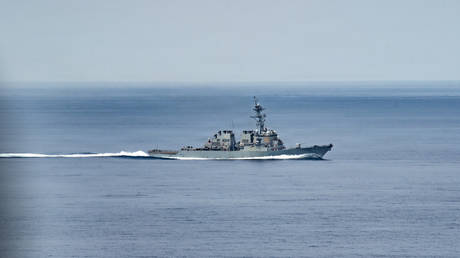
The recent four-day power failure aboard the USS Benfold serves as a diagnostic indicator of systemic stress within the United States surface fleet. While the loss of sanitation, climate control, and propulsion capabilities on a 10,000-ton Arleigh Burke-class destroyer presents as a localized engineering casualty, the recurring nature of these events suggests a misalignment between operational tempo and maintenance bandwidth. Understanding this phenomenon requires an examination of the structural, environmental, and institutional pressures currently acting upon the Navy’s primary surface combatants.
The Engineering Casualty Framework
In maritime operations, an engineering casualty involving power generation is rarely a singular event of mechanical negligence. It is typically the intersection of three variables: duty cycle accumulation, component degradation, and maintenance deferral.
The Arleigh Burke-class destroyer is a high-demand platform. Built for versatility, these ships function as the workhorses of the fleet, undertaking long-duration deployments that exceed original design specifications. When a vessel operates under constant load in extreme environmental conditions—such as the 32°C to 37°C ambient temperatures found in the South China Sea—the thermal load on electrical systems increases exponentially.
Generators operating near peak capacity for extended durations generate significant heat, accelerating the wear of insulation and internal components. In this context, the loss of power is not merely a failure of a specific generator; it is the manifestation of a system pushed beyond its optimal thermal equilibrium. When cooling systems or redundant power sources are not afforded sufficient downtime for preventative service, the failure probability shifts from linear to exponential.
The Operational Bottleneck
The logistical reality of the Indo-Pacific theater compounds these risks. Because the United States maintains a high-visibility, forward-deployed presence to counter increased activity in the region, the operational cadence remains high. Ships are frequently redirected or kept on station to compensate for the movement of larger assets, such as carrier strike groups shifting between regional theaters.
This creates a secondary risk profile: the "relief void." When a carrier strike group is ordered to shift focus—such as the planned redeployment of the USS George Washington to the Middle East—the burden of area dominance often falls upon the escort destroyers. These ships are then tasked with maintaining a persistent presence, often at the expense of their planned maintenance cycles. The result is a fleet that is conceptually intended to be modular and agile but is functionally operating under the strain of a fixed-capacity supply.
Defining Institutional Resilience vs. Failure
The USS Benfold incident, which required external support from the USS Robert Smalls for basic galley services and eventually necessitated a tow to Subic Bay, highlights the dependency chains inherent in strike group operations. While the Navy emphasizes crew resilience as a mitigant, this perspective shifts the burden of systemic failure onto human performance.
- Resource Redundancy: The ability of the strike group to provide food and technical support demonstrates effective lateral resource sharing. However, this is a stopgap measure, not a permanent solution to platform capability loss.
- Technical Dependence: Modern warships are highly integrated. A failure in the electrical bus does not just stop the propellers; it cascades through secondary systems including water desalination, climate control (essential for both computing racks and human performance), and sanitation.
- Recovery Velocity: The timeline—four days without power, followed by a tow, and a subsequent repair period ending on August 8—defines the recovery velocity for a major engineering casualty. In a conflict scenario, the time required to restore a ship to operational status is a critical failure metric.
Strategic Implications for Fleet Management
The repetition of these failures—specifically mentioning the USS Higgins incident earlier in the year—points toward a class-wide trend rather than isolated mechanical anomalies. When a platform class with over 70 units in service encounters similar electrical engineering casualties in the same operational theater, the investigation must look beyond the specific failed components to the total life-cycle management of those systems.
The standard for success in modern naval operations is increasingly defined by "operational uptime." To maintain this, the Navy must reconcile its global strategic commitments with the physical reality of its hardware. The current methodology relies on an assumption of infinite platform availability, which is increasingly contradicted by the frequency of these power-related casualties.
Future strategy must prioritize the institutionalization of mandatory maintenance windows, regardless of the perceived operational cost. Shifting from a reactive posture—where maintenance is performed after a casualty—to a predictive posture requires not just better sensors, but a reduction in the operational tempo that currently necessitates deferring critical repairs. Without this pivot, the fleet risks losing the ability to project power because its platforms are too busy struggling to sustain basic life-support and propulsion, rendering them liabilities rather than assets in a contested environment.


