The stability of India’s energy architecture depends on a narrow corridor of maritime logistics and long-term bilateral contracts that are currently under pressure from regional instability in West Asia. Qatar’s commitment to remain a reliable supplier to India is not merely a diplomatic gesture; it is a calculated economic necessity driven by fixed infrastructure and mutual dependency. To understand the durability of this relationship, one must analyze the structural mechanics of Liquefied Natural Gas (LNG) trade, the logistics of the North Field expansion, and the geopolitical risk-mitigation strategies employed by both New Delhi and Doha.
The Structural Mechanics of the India Qatar Energy Framework
The energy trade between these two nations is governed by the Rigidity of Infrastructure. Unlike crude oil, which can be diverted to different refineries with relative ease, LNG requires specialized regasification terminals and dedicated transport vessels. India’s Petronet LNG holds long-term contracts with QatarEnergy, creating a "locked-in" effect where both parties face high sunk costs if the supply chain breaks.
The relationship operates on three primary pillars of stability:
- Contractual Longevity: Most agreements are structured as 20-year or 25-year Take-or-Pay contracts. This ensures Qatar has a guaranteed buyer for its massive output while India secures a predictable price floor, insulating its economy from the extreme volatility of the spot market.
- Geographic Proximity: The transit time from Ras Laffan in Qatar to Dahej or Kochi in India is significantly lower than imports from the United States or West Africa. This proximity reduces the "Boil-Off Gas" (BOG) loss during transit and lowers the overall carbon footprint of the fuel.
- Infrastructure Integration: Indian public sector undertakings (PSUs) have invested heavily in the infrastructure required to process Qatari gas. This technical alignment creates a barrier to entry for other suppliers who may not meet the specific caloric or chemical specifications of the existing Indian grid.
Quantifying the Risk Variables in West Asia
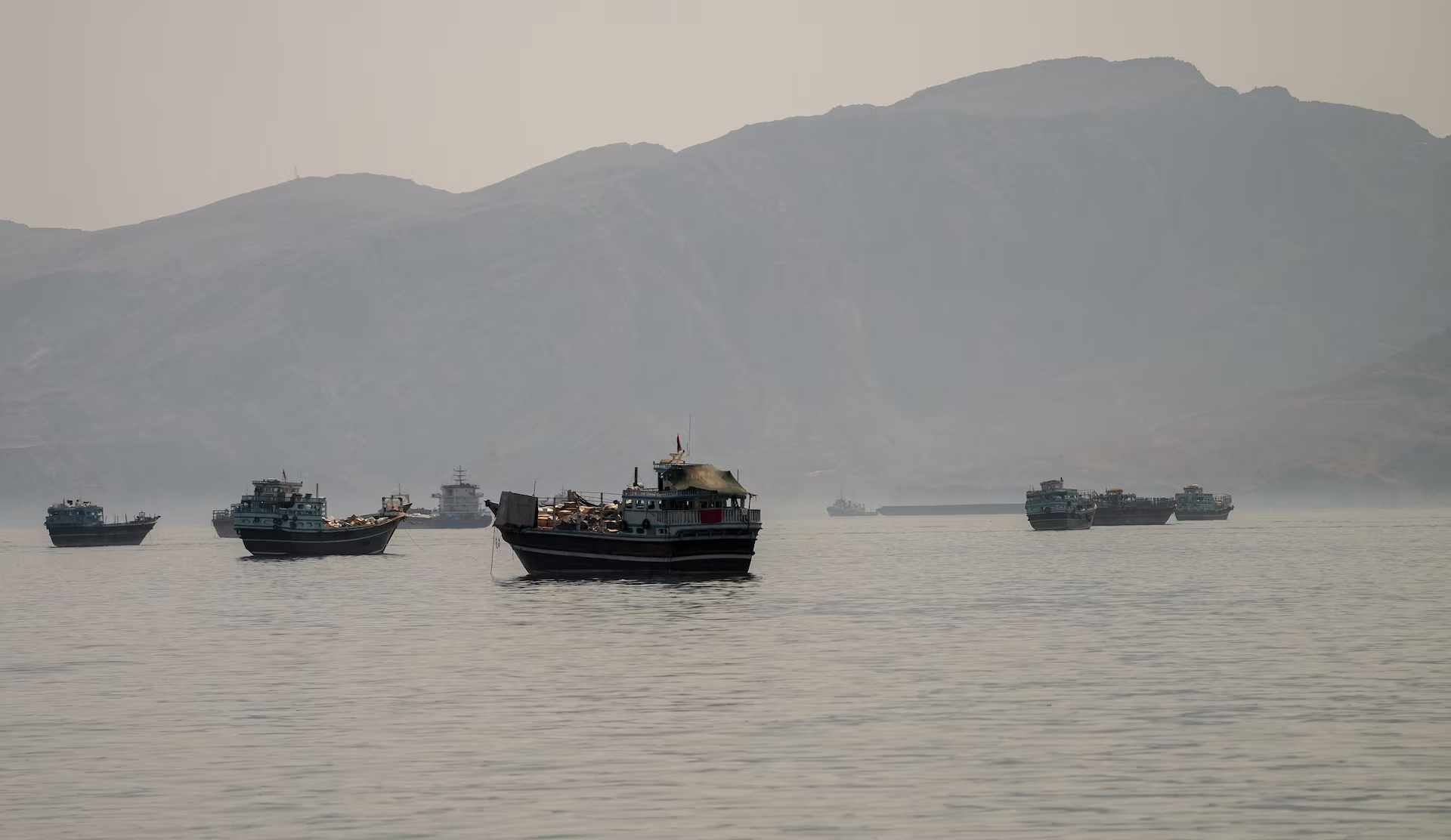
While the diplomatic rhetoric emphasizes reliability, a data-driven analysis must account for the Conflict Probability Matrix in the Persian Gulf. The primary threat to supply is not a lack of Qatari resolve, but the physical vulnerability of the Strait of Hormuz. Approximately 20% of the world's total LNG consumption passes through this chokepoint.
The risk to Indian energy security can be categorized into three distinct tiers:
Kinetic Disruption of Maritime Lanes
A localized conflict involving regional powers could lead to the mining of shipping lanes or the seizure of tankers. In this scenario, the "reliability" of a supplier becomes irrelevant if the physical commodity cannot exit the Gulf. India’s strategic response involves the expansion of its Strategic Petroleum Reserves (SPR) and, more importantly, the diversification of its LNG receiving points to the eastern seaboard to allow for alternative sourcing from Australia or Southeast Asia if the western routes are compromised.
Sovereign Policy Shifts
Qatar’s foreign policy often occupies a unique space as a mediator between disparate factions. While this provides diplomatic leverage, it also exposes the state to pressure from larger regional neighbors. The 2017-2021 blockade of Qatar demonstrated that even during periods of intense diplomatic isolation, gas flows remained uninterrupted. This historical precedent serves as the strongest empirical evidence for the "Reliability Thesis."
Price Arbitrage and Global Demand Shifts
The North Field Expansion project aims to increase Qatar’s LNG production capacity from 77 million tonnes per annum (mtpa) to 126 mtpa by 2027. This massive influx of supply creates a buyer’s market. India’s strategy is to use this volume to renegotiate legacy contracts that were signed when prices were significantly higher. The "reliability" Qatar offers is partly a defensive move to ensure India does not pivot toward cheaper American shale gas or Russian pipeline alternatives.
The Cost Function of Energy Transitions
India’s shift toward a gas-based economy—aiming to increase the share of natural gas in its energy mix from 6% to 15% by 2030—relies on the assumption of a Price-Volume Equilibrium. If Qatari gas becomes too expensive due to risk premiums associated with West Asian tensions, India’s industrial sectors (specifically fertilizers and power) will face a margin squeeze.
The cost of this energy is not just the landed price per Million British Thermal Units (MMBtu). It includes the Geopolitical Risk Premium. To calculate the true cost of reliance on Qatar, Indian planners must factor in:
- Insurance Freights: War risk insurance for tankers in the Gulf can spike by 500% in a week of heightened tension.
- Alternative Sourcing Costs: The price delta between long-term Qatari contracts and the Henry Hub (US) spot price plus liquefaction and transport.
- Strategic Hedging: The capital expenditure required to build floating storage and regasification units (FSRUs) that can be moved if a specific port becomes a target.
Strategic Asymmetry and Mutual Dependency
The "Reliability Vow" is often framed as Qatar doing India a favor. However, the economic reality reveals a Strategic Asymmetry. Qatar’s economy is fundamentally built on the extraction and export of gas. As Europe shifts toward renewables and the US becomes a net exporter, the Asian market—specifically India and China—becomes the only viable long-term outlet for Qatari production.
India is not just a customer; it is an anchor for Qatari capital. The sovereign wealth fund, Qatar Investment Authority (QIA), has significant holdings in Indian retail and energy sectors. This cross-pollination of assets ensures that any disruption in gas supply would directly devalue Qatar’s own investment portfolio in the subcontinent.
Evaluating the "Reliability" Metric
In rigorous consulting terms, reliability is measured by the Probability of Default (PoD) on delivery schedules. Qatar has maintained a near-zero PoD for two decades. However, past performance is not a guarantee of future stability when the variables include non-state actors and hybrid warfare.
The current tension in West Asia introduces a Systemic Shock Variable. Unlike the 2017 blockade, which was a diplomatic and logistical challenge, a direct regional conflict would represent a physical barrier. India’s "Masterclass" in energy strategy involves moving beyond the "Reliability Vow" and toward a Multi-Channel Supply Chain.
This involves:
- Equity Oil and Gas: Investing directly in Qatari upstream assets to have "skin in the game" rather than just being a buyer.
- Currency Swaps: Moving away from USD-denominated energy trade to insulate the transaction from Western sanctions or US banking volatility, potentially using the Rupee-Riyal framework.
- The Middle East-Europe Economic Corridor (IMEC): While currently stalled by conflict, the long-term logic of IMEC is to create a multi-modal alternative that reduces the total reliance on the Strait of Hormuz.
The Bottleneck of Domestic Distribution
The gas arriving from Qatar meets a second challenge once it reaches Indian shores: the Inland Infrastructure Deficit. Reliability at the port does not equate to reliability at the factory gate if the National Gas Grid is not completed. The "Jagdishpur-Haldia-Bokaro-Dhamra" pipeline and similar projects are the essential "Last Mile" components that determine whether Qatari gas can actually fuel Indian growth.
The mismatch between import capacity and pipeline connectivity creates a "stranded asset" risk. Even if Qatar delivers every molecule promised, India cannot utilize the volume without a synchronized expansion of its domestic compression and distribution networks.
Strategic Recommendation for Indian Energy Procurement
The optimal strategy for India is to treat the Qatari vow of reliability as a baseline, not a ceiling. The focus must shift toward Dynamic Contract Flexibility. India should push for "Destination Flexibility" clauses in its contracts with QatarEnergy. This would allow India to re-sell Qatari LNG to other markets if its domestic demand is low or if a specific Indian port is inaccessible, thereby turning a rigid supply chain into a liquid trading asset.
Furthermore, India must accelerate the integration of its strategic gas reserves. Just as it holds 5.33 million tonnes of crude oil in underground salt caverns, it requires a similar buffer for LNG to survive a 30-to-60-day total closure of the Strait of Hormuz.
The reliance on Qatar is a structural reality for the next two decades. The goal is not to eliminate this dependency, but to price it accurately and surround it with enough logistical redundancies to ensure that a flare-up in West Asia does not lead to a blackout in New Delhi. The path forward is a transition from Dependency to Interdependency, where the cost to Qatar of failing to deliver exceeds the cost to India of the missing fuel.
By securing equity stakes in the North Field and integrating Qatari capital into the Indian grid, New Delhi creates a "Mutual Destruction" pact that is far more reliable than any diplomatic statement. The future of this partnership lies in turning gas molecules into geopolitical anchors.