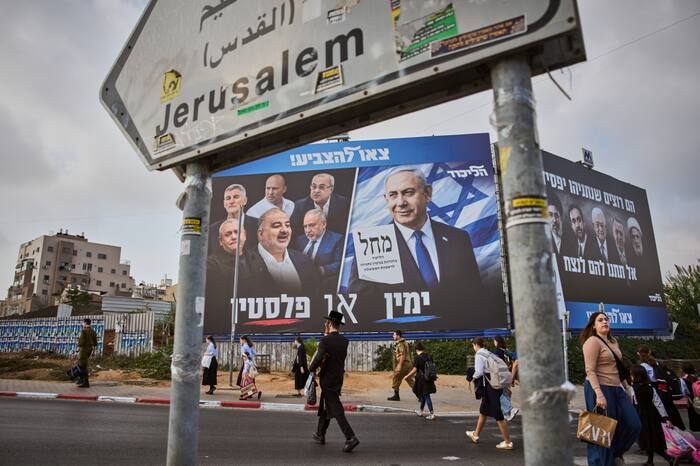
The first Israeli general election following the October 7, 2023 Hamas attacks functions as a structural stress test on two decades of political doctrine rather than a standard referendum on incumbent performance. For Benjamin Netanyahu, the ballot box represents the final arbitration of his "conflict management" thesis—a governance model premised on containing Palestinian militancy through economic incentives, technological surveillance, and diplomatic normalization with Sunni Arab states while deferring a permanent political settlement. That framework collapsed on October 7, creating a severe credibility deficit that pits Netanyahu's survival instincts against a fractured opposition and a deeply traumatized electorate.
To understand the mechanics of this election, analysts must strip away surface-level campaign rhetoric and examine the underlying institutional pressures, demographic shifts, and coalition math driving Israeli voters. The outcome depends on how the electorate weighs pre-war domestic polarization against post-war security failures, and whether any bloc can assemble a stable 61-seat majority in the 120-seat Knesset without triggering immediate internal collapse.
The Failure of the "Mr. Security" Doctrine
For over fifteen years, Netanyahu’s electoral durability rested on a single brand pillar: he was the indispensable guardian of Israeli security who could navigate Washington, deter Tehran, and maintain domestic economic growth without making territorial concessions. This brand relied on an implicit social contract with the Israeli center-right. Voters tolerated prolonged political instability, recurring corruption trials, and divisive judicial reform efforts because the underlying security architecture appeared intact.
The October 7 breach shattered that contract by exposing three systemic vulnerabilities in the pre-war doctrine:
- The Deterrence Illusion: Israeli intelligence and political leadership operated under the assumption that Hamas had been deterred by previous military operations and incentivized by Qatari cash transfers and work permits to prioritize governance over large-scale warfare. The failure to detect or preempt a coordinated, multi-front infiltration proved that containment had merely allowed an existential threat to metastasize along the southern border.
- The Multi-Front Overextension: By focusing military and diplomatic bandwidth on the Iranian nuclear program and maintaining an expansive troop presence in the West Bank, the defense establishment left the Gaza perimeter critically undermanned. The subsequent war of attrition with Hezbollah in the north, which displaced tens of thousands of Israelis from border communities, demonstrated that Israel lacked the strategic depth to fight simultaneous, prolonged campaigns without severe economic and social dislocation.
- The Erosion of Civil-Military Trust: In the months preceding the attack, Netanyahu’s push to overhaul the judiciary fractured the military reserves, with thousands of elite pilots, intelligence officers, and special forces operators threatening to suspend volunteer service. While reservists mobilized en masse on October 7, the perception that domestic political survival had been prioritized over national cohesion permanently damaged Netanyahu’s standing among security-focused centrist voters.
The Four Structural Axes of the Electorate
Conventional political analysis often reduces Israeli elections to a binary battle between "pro-Netanyahu" and "anti-Netanyahu" blocs. In a post-October 7 environment, voter behavior is better modeled across four competing structural axes that cut across traditional left-right boundaries.
The Accountability vs. Continuity Axis
A decisive segment of the electorate prioritizes institutional accountability above ideological alignment. For these voters, the primary failure of the Netanyahu government was not merely the intelligence breakdown on October 7, but the subsequent refusal to establish a state commission of inquiry or accept direct ministerial responsibility. Conversely, Netanyahu’s core base views his removal during an active multi-front conflict as a strategic victory for Hamas and Iran. They frame his political endurance as a necessary bulwark against international pressure—specifically from the United States and European allies—to accept a Palestinian state or premature ceasefires.
The Ultra-Orthodox Conscription Bottleneck
The most acute domestic fault line in Israeli politics is the military exemption granted to ultra-Orthodox (Haredi) yeshiva students. Before October 7, this issue was largely a cultural and fiscal grievance for secular Israelis. Following the deaths of hundreds of soldiers and the extension of mandatory and reserve duty for secular and national-religious citizens, the Haredi exemption transformed into an existential equity crisis.
Netanyahu’s coalition math relies entirely on the loyalty of Haredi parties (Shas and United Torah Judaism), which demand legislative protection for draft exemptions and substantial state funding for religious institutions. Any attempt by Netanyahu to pass a meaningful conscription law risks collapsing his coalition from within; any attempt to preserve the status quo alienates the secular right-wing voters he needs to reclaim a majority.
The National-Religious Ascendancy
The religious Zionist movement, represented in government by figures such as Bezalel Smotrich and Itamar Ben-Gvir, occupies a paradoxical position. On one hand, national-religious soldiers suffered a disproportionately high casualty rate in the Gaza ground offensive, earning the community immense respect across Israeli society. On the other hand, the ideological wing of this movement advocates for the permanent military occupation of Gaza, the re-establishment of Jewish settlements there, and the annexation of the West Bank. This maximalist agenda directly collides with the strategic imperatives of the Israeli defense establishment and threatens to sever Israel’s remaining diplomatic ties with moderate Arab states and Western allies.
The Arab-Israeli Political Marginalization
Representing roughly twenty percent of the population, Arab citizens of Israel experienced a profound chilling effect following October 7. Heightened state surveillance, restrictions on political speech, and the trauma of the war in Gaza depressed political engagement and deepened the rift between Arab parties and the Zionist center-left. While high turnout among Arab voters was instrumental in forming the short-lived 2021 "change government," the deep ideological chasm between Arab lawmakers and right-leaning opposition figures makes a repeat of that alliance mathematically improbable.
Coalition Mechanics and the 61-Seat Threshold
Israel’s proportional representation system, with a low electoral threshold of 3.25 percent, rewards factionalism and penalizes broad consensus. Winning a plurality of the vote does not guarantee governance; power belongs strictly to the leader who can assemble a 61-seat bloc without triggering veto points among incompatible partners.
Netanyahu’s path to 61 seats requires near-total consolidation of the right-wing and religious blocs, coupled with low turnout among center-left and Arab voters. His strategic playbook relies on three operational mechanisms:
- Consolidating the Likud Base: By framing himself as the only leader capable of withstanding American diplomatic pressure, Netanyahu aims to pull back soft-right voters who drifted toward centrist alternatives in the immediate aftermath of October 7.
- Eliminating Wasted Votes: In previous cycles, small right-wing factions failed to cross the 3.25 percent threshold, effectively handing seats to the opposition. Netanyahu actively intervenes to force technical mergers among minor right-wing lists to ensure every ballot cast on the right translates into Knesset mandates.
- Exploiting Opposition Fragmentation: The anti-Netanyahu bloc is unified solely by its desire to replace the prime minister. It encompasses secular centrists, hawkish right-wingers who broke with Netanyahu over personal trust, left-wing peace advocates, and Arab nationalists. Netanyahu’s campaign strategy systematically targets the ideological contradictions within this group, forcing opposition leaders to take definitive stances on divisive issues like Palestinian statehood or Haredi conscription that inevitably alienate one wing of their potential coalition.
Conversely, the opposition’s path to 61 seats requires capturing the "soft right"—voters who hold conservative views on security and settlements but view Netanyahu as a spent force. To achieve this, centrist figures must present a credible security alternative that avoids relying on Arab parties for a majority, a constraint that leaves them with an exceptionally narrow margin for error.
The Washington Variable and Geopolitical Leverage
Israeli elections do not occur in a vacuum; they are heavily influenced by the posture of the United States administration. Netanyahu has historically weaponized friction with Washington to bolster his domestic standing, portraying himself as a strongman willing to defy American presidents to protect core Israeli interests.
However, the post-October 7 reality altered the cost-benefit ratio of this tactic. The Israel Defense Forces rely heavily on continuous American munitions resupply, intelligence sharing, and diplomatic cover at the United Nations Security Council. When friction with Washington escalates to the point of delayed weapons shipments or public diplomatic ruptures, the Israeli public perceives a direct threat to national security rather than a display of strength.
Furthermore, the prospect of a broader regional normalization agreement—specifically involving Saudi Arabia—remains tied to a credible political horizon for the Palestinians and an end to the Gaza conflict. Centrist opposition leaders argue that only a post-Netanyahu government can unlock this regional security architecture to counter Iran, framing Netanyahu’s political survival as the primary obstacle to a historic strategic breakthrough.
Assessing the Legacy Metrics
Evaluating Netanyahu’s legacy requires separating his pre-2023 achievements from the post-October 7 collapse. Over his tenure as Israel’s longest-serving prime minister, Netanyahu fundamentally reshaped the country’s economic and diplomatic profile. He oversaw the liberalization of the Israeli economy, turning the nation into a global technology hub, and engineered the Abraham Accords, which bypassed the Palestinian issue to establish formal relations with four Arab nations.
Yet political legacies are ultimately defined by their endpoints. In Israeli historiography, Golda Meir’s decades of state-building service were permanently overshadowed by the intelligence failures of the 1973 Yom Kippur War. Netanyahu faces a steeper historical reckoning. Unlike Meir, who resigned within months of the 1973 war following an initial inquiry, Netanyahu refused to step down, fighting to preserve his coalition while the war dragged on and hostages remained in captivity.
If Netanyahu secures a governing coalition, his legacy will be cemented as a leader who fundamentally transformed Israel into an illiberal, nationalist democracy, permanently burying the two-state solution while surviving the worst security catastrophe in the nation’s history. If he is ousted, his tenure will be codified as a cautionary study in how the subordination of state institutions to personal political survival can blind a nation to existential threats.
Strategic Forecast and Operational Imperatives
The structural math of the Knesset points toward prolonged legislative paralysis rather than a decisive ideological mandate. Neither the pro-Netanyahu bloc nor the fractured opposition possesses a clear, friction-free path to a stable 65-seat majority. Even if an anti-Netanyahu coalition successfully forms a government, it will immediately face the same intractable dilemmas regarding Gaza’s post-war governance, the northern border with Hezbollah, and Haredi conscription.
For institutional observers, policymakers, and regional stakeholders, three operational realities will dictate the post-election trajectory:
- Expect Immediate Institutional Reckoning: Any government excluding Netanyahu will be compelled by public pressure to establish a formal State Commission of Inquiry into October 7 within its first 100 days. This process will dominate the domestic political cycle, trigger high-profile resignations across the security establishment, and legally restrict Netanyahu’s ability to mount another political comeback.
- Prepare for Fiscal Austerity and Demographic Friction: Regardless of the winning coalition, the next government must address a massive war-induced budget deficit while simultaneously funding expanded military force structures. This will require either raising taxes on the productive secular middle class or slashing subsidies to the ultra-Orthodox sector—a choice that will either trigger widespread civil protests or collapse the ruling coalition.
- Recalibrate Regional Diplomatic Timelines: Do not anticipate an immediate breakthrough on Saudi normalization or a comprehensive Palestinian diplomatic track. Any new Israeli prime minister will prioritize domestic stabilization, northern border security, and military replenishment over high-risk territorial concessions, keeping the region locked in a state of managed, low-intensity conflict for the foreseeable future.