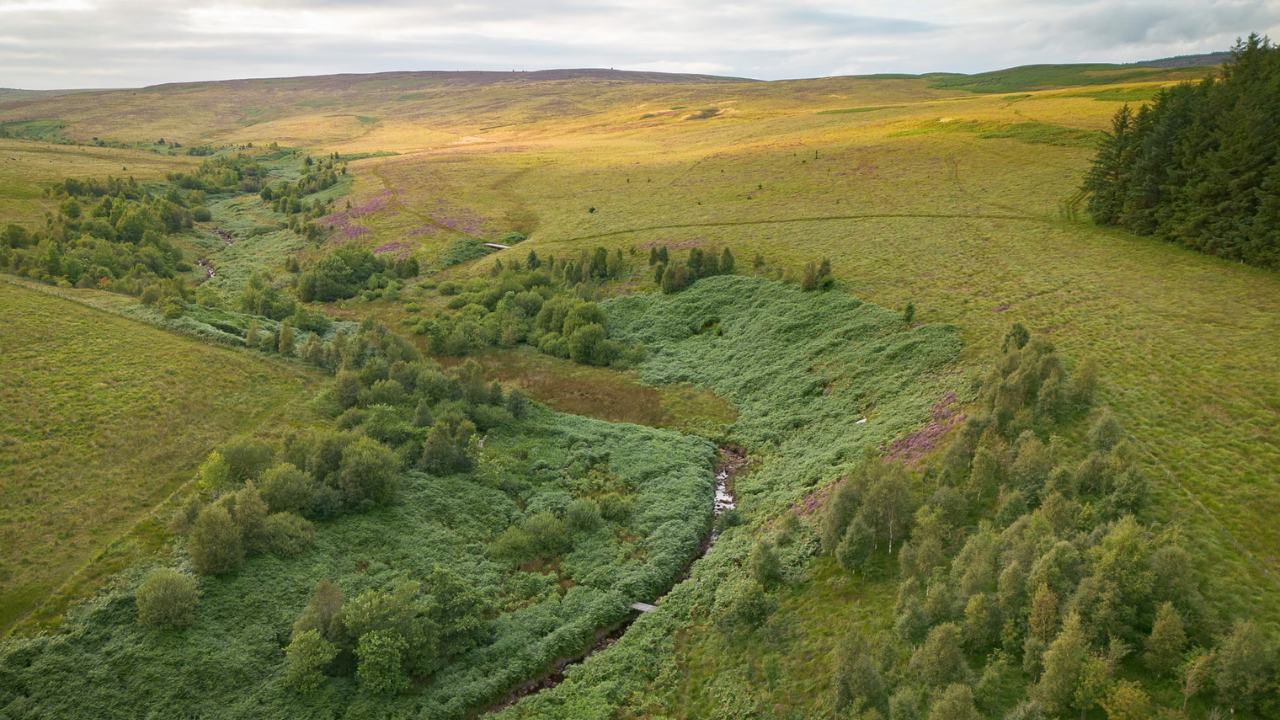
Large-scale ecological restoration projects in the United Kingdom traditionally suffer from a structural tension between private capital accumulation and public environmental goods. When the nature restoration enterprise Restore acquired the 7,500-acre Emblehope Moor in Northumberland for £8.5 million, the transaction introduced an atypical corporate finance mechanism to upland land management. Rather than operating as a permanent landed estate designed to capture long-term asset appreciation or private sporting rents, the corporate vehicle employs a self-liquidating debt and equity redemption structure intended to transition asset ownership to a community trust or charity once financial backers achieve their target returns.
Analyzing the viability of this operational model requires deconstructing the capital stack, the ecological cost functions of historical land use, and the long-term cash flow generation necessary to clear both commercial debt and investor obligations over a twenty-year horizon.
The Capital Stack and Financial Mechanics
The acquisition of Emblehope Moor relies on a blended finance structure combining commercial institutional debt with private risk capital. The capitalization breakdown consists of:
- A £4.5 million commercial debt facility secured from Triodos Bank.
- An initial tranche of private equity investment to cover the remaining acquisition costs and immediate operational overhead.
- An outstanding requirement for approximately £4 million in secondary capital to fully execute the twenty-year restoration roadmap.
The economic architecture dictates that private investors receive a structured two-times return on their principal, alongside the full amortization of the Triodos Bank loan. This creates a precise hurdle rate. The operational cash flow of the estate—derived from a mix of natural capital credits, carbon sequestration monetization, ecosystem service payments, and low-impact eco-tourism—must generate sufficient yield to service interest, pay down principal, and distribute equity multiples before the asset can be legally decoupled from the corporate entity.
By capping investor upside at a fixed multiple rather than holding the land in perpetuity for speculative capital gains, the model removes the speculative land inflation that typically prices local communities out of rural ownership. However, the economic pressure shifts entirely onto the asset's ability to commercialize non-market ecological outputs into verifiable liquid cash flows.
Ecological Cost Functions and Remediation Variables
Emblehope Moor’s previous utility matrix—encompassing intensive sheep farming, commercial grouse management, and dog training by the Royal Kennel Club—imposed distinct ecological externalities that now dictate the remediation cost function. The primary physical deficit lies in hydrological degradation. Decades of historical agricultural drainage networks have systematically parched the upland peat moorland, transforming natural carbon sinks into dry substrates susceptible to erosion and wildfire.
The engineering intervention involves a systematic plugging of underground drainage channels to raise the water table. Hydrological modeling indicates that re-wetting the peat matrix will restore a water storage capacity of approximately 100,000 cubic metres—equivalent to forty Olympic-sized swimming pools. This intervention directly alters the local risk profile regarding downstream flood peaks, providing an ecosystem service that regional water authorities and government environmental agencies are increasingly mandated to subsidize through natural capital markets.
Secondary to hydrological repair is vegetative restructuring. The estate features non-native Sitka spruce plantations, which create closed canopies that suppress native understory flora and elevate artificial predation pressures on ground-nesting species via corvid and raptor perching habitats. The eradication of these stands requires capital expenditure with minimal immediate timber recovery value, representing a pure ecological cost incurred to reset the biological baseline.
Herbivore Management and Biotic Controls
Transitioning from managed agricultural and sporting outputs to self-sustaining wild populations requires shifting from mechanical livestock control to keystone species management. The introduction of native Exmoor ponies serves a specific functional role within the biological control loop:
- Grazing on dense, unpalatable Molinia grasses that choke out delicate moorland vegetation.
- Reducing surface fuel loads to mitigate high-intensity wildfire risks during dry summer cycles.
- Creating structural micro-habitats through hoof action and selective browsing that favor ground-nesting birds such as curlews and golden plovers.
Subsequent phases anticipate the introduction of Eurasian beavers (Castor fiber), whose dam-building mechanics introduce micro-scale hydrological controls that complement the human-engineered peat re-wetting process. These biological agents internalize maintenance labor, replacing high-overhead mechanical intervention with self-replicating ecological feedback loops.
Operational Continuity and Human Capital Retention
A critical risk factor in corporate-led rewilding transitions is the friction between incoming strategic directives and local operational experience. Large-scale ecological conversions frequently fail due to the wholesale replacement of traditional estate workers with metropolitan conservation ideologues who lack tactile understanding of the terrain.
Restore mitigated this operational risk by retaining existing estate staff, including incumbent gamekeepers and tenant farmers whose multi-decade tenure provides granular knowledge of micro-topography, weather patterns, and wildlife distributions. The integration of traditional upland management expertise with contemporary rewilding objectives resolves the execution bottleneck. The local workforce transitions from maintaining artificial game densities for shooting syndicates to managing biological carrying capacities, utilizing their eighteen-hour operational shifts to monitor raptor populations, including resident merlins and prospecting golden eagles.
Revenue Generation and the Transition Threshold
The financial viability of the Emblehope model hinges on diversifying income streams away from traditional subsidies toward verifiable ecosystem metrics:
- Carbon Sequestration Credits: Monetizing the verified carbon captured through restored sphagnum moss growth and re-wetted peat profiles.
- Biodiversity Net Gain (BNG) Units: Selling statutory credits to developers required by law to offset ecological damage elsewhere in the region.
- Catchment Management Agreements: Contracting with water utilities to lower downstream water treatment costs by improving raw water quality at the source.
The strategic test for this corporate vehicle is the velocity at which these emerging revenue streams can clear the £4.5 million bank debt and deliver the promised two-times return to private equity holders. Once those liabilities reach zero, the operational entity dissolves its equity claim, executing a legally binding transfer of the 7,500-acre title deed to a designated community trust or established conservation charity.
If successful, this structure proves that private capital markets can be successfully harnessed to bridge the liquidity gap for large-scale land acquisition without leaving behind a permanent corporate landlord, establishing an institutional blueprint for upland stewardship across the United Kingdom.