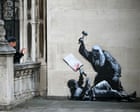
Municipal expenditure on urban interventionism is rarely evaluated through standard economic optimization frameworks. When public bodies allocate capital to preserve unauthorized street art—specifically high-profile works carrying significant market valuations—they enter a complex operational arena defined by asymmetric risks, moral hazards, and unhedged public liabilities. Recent expenditure figures indicating that three Banksy installations in London have cost taxpayers nearly £150,000 reveal a fundamental structural failure in how local authorities manage ephemeral cultural assets.
To understand why protecting transient interventions generates disproportionate financial friction, we must deconstruct the underlying cost function. Urban preservation involves three distinct expenditure vectors: physical hardening, continuous surveillance, and retroactive restoration. Traditional public infrastructure depreciation models fail when applied to street art because the asset's value is derived from speculative private markets, while its protection costs are entirely socialized.
The Three Cost Drivers of Unauthorized Public Art Protection
Physical hardening represents the baseline expenditure. Unlike municipal monuments built from durable, weather-resistant materials designed for longevity, street art is executed on vulnerable urban surfaces using temporary mediums. Securing these works requires transparent polycarbonate shields, specialized UV-filtering sealants, and tamper-resistant framing anchored directly into masonry. Each modification introduces a multi-layered capital outlay that scales with the surface area and the accessibility of the host wall.
Surveillance compounds these recurring costs. Static closed-circuit television installation is insufficient for high-value targets subject to targeted vandalism or theft. Effective monitoring demands active telemetry, motion-triggered audio-visual deterrents, and, in high-threat environments, dedicated physical security personnel. Because municipal budgets cannot absorb infinite labor hours for individual artistic interventions, security operations quickly devolve into a reactive triage model where resources are deployed only after an incident has compromised the asset.
Restoration introduces the highest variance into the municipal ledger. When protective measures fail, reversing environmental degradation or chemical defacement requires specialized conservators. Standard municipal maintenance crews lack the methodological training required to clean aerosol polymers from historical brickwork without altering the underlying substrate. Consequently, cities must contract private art restoration specialists at premium hourly rates, transforming minor acts of localized vandalism into significant fiscal events.
The Moral Hazard of Municipal Valorization
When a local government expends public funds to safeguard an unauthorized work, it implicitly alters the incentive structures governing urban property. This creates a distinct economic feedback loop.
Private property owners face a perverse dilemma. An unauthorized intervention on a commercial or residential facade instantly alters the property's speculative valuation. However, the owner simultaneously inherits an indefinite security burden. If the municipality steps in to absorb these security and maintenance costs, a structural subsidy is established. Public capital is deployed to protect and enhance private equity values without a corresponding transfer of ownership or taxation adjustment.
[Unauthorized Installation]
       │
       ▼
[Private Property Valuation Spike]
       │
       ▼
[Municipal Intervention & Subsidy]
       │
       ▼
[Perverse Incentive: Speculative Vulnerability]
Furthermore, municipal intervention validates a speculative asset class at public expense. The public sector absorbs the downside risk of destruction or theft while capturing zero upside from future private market appreciation or tourism monetization. This asymmetry violates basic principles of fiscal prudence. If a private entity benefits from the preservation of an asset, the cost function must be internalized by that entity rather than externalized onto the municipal tax base.
Opportunity Costs and Resource Allocation
Evaluating the £150,000 aggregate expenditure requires contextualizing public sector budget constraints. Every pound allocated to the defensive preservation of a transient spray-paint intervention is a pound diverted from core municipal obligations.
Urban infrastructure management operates under zero-sum budgetary conditions. Capital expended on polycarbonate casings, overnight security details, and specialized chemical cleaning for three discrete locations represents capital withheld from public transit maintenance, social services, or structural urban renewal projects. The opportunity cost is magnified by the lack of duration certainty. Unlike a bridge or a public library, an unauthorized artwork carries an indefinite lifespan vulnerability. It can be obliterated overnight by competing graffiti artists, structural demolition, or natural weathering, instantly reducing the net present value of the cumulative protective investment to zero.
Municipalities frequently justify these expenditures under the banner of cultural capital and urban tourism enhancement. Yet, empirical evidence linking localized street art preservation to sustained municipal economic output remains thin. Tourism driven by ephemeral installations is typically transient and highly concentrated, benefiting adjacent private commercial operators—such as hospitality and retail venues—while leaving the broader municipal tax pool uncompensated for the underlying security overhead.
Alternative Operational Frameworks for Urban Authorities
To eliminate the fiscal drain associated with defending unauthorized public art, municipal policy must shift from reactive preservation to structural risk transference.
The first necessary mechanism is mandatory private-sector liability assignment. If a property owner benefits from the presence of a high-value street art installation, the local authority should mandate that any protective measures—including structural hardening and private security—be funded entirely through private capital or specialized commercial improvement districts. If the owner declines to assume these operational costs, the municipality must exercise its right to remove or deaccession the work, returning the urban canvas to its neutral state.
The second mechanism involves codified asset classification thresholds. Local governments require objective criteria to determine whether an unauthorized intervention warrants public expenditure. These criteria must evaluate structural integration, public safety impacts, and the ratio of private gain to public cost. If an installation compromises pedestrian flow, requires disproportionate policing resources, or primarily benefits a single private landholder, municipal intervention must be legally barred.
Strategic asset divestment represents the final operational pivot. Cities must recognize that certain cultural artifacts cannot be efficiently managed through public administrative machinery. Rather than attempting to preserve transient interventions in situ against escalating security pressures, authorities should facilitate the legal acquisition and relocation of such works to controlled, climate-regulated indoor public spaces where security overhead drops exponentially.
Urban strategy must reject the premise that all high-visibility cultural phenomena demand public subsidization. By shifting the financial burden of asset defense back to the private beneficiaries and establishing rigorous thresholds for municipal intervention, local authorities can eliminate unhedged liabilities and redirect capital toward foundational civic infrastructure.