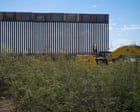
Physical border infrastructure projects operate at the intersection of federal statutory authority, budgetary constraints, and extreme geographic friction. When the Department of Homeland Security advances construction initiatives in ecologically isolated and low-density sectors such as the Big Bend region of West Texas, the endeavor exposes a fundamental tension between centralized security mandates and regional environmental preservation. Deconstructing the mechanics of this infrastructure campaign requires a rigorous examination of executive waiver powers, federal court interventions, cost-per-day delay metrics, and the underlying statistical divergence between border coverage and migrant apprehension density.
The macro-level anatomy of border fortification economics centers on fixed capital expenditure versus variable human mobility. Traditional fortification strategies assume that linear physical barriers act as permanent impedance factors against unauthorized crossings. However, the deployment of thirty-foot steel bollard walls, all-weather patrol roads, and integrated electronic surveillance towers in remote sectors introduces complex logistical variables. Unlike urban or high-traffic sectors where barriers directly compress dense entry flows, rural and desert infrastructure projects must overcome immense supply chain friction, hostile terrain, and prolonged legal challenges that alter the return on investment for federal capital outlays. For a different view, check out: this related article.
The legal foundation supporting accelerated construction rests on statutory delegation enacted decades ago. Under provisions of the Illegal Immigration Reform and Immigrant Responsibility Act of 1996, the Secretary of Homeland Security holds broad, near-plenary authority to waive federal environmental, conservation, and historical preservation laws to expedite barrier installation. This statutory mechanism bypasses standard regulatory reviews, including the National Environmental Policy Act, the Endangered Species Act, and the Clean Water Act, which typically govern major federal civil works. In the Big Bend sector, this waiver authority enabled the administration to bypass multi-year environmental impact statements, setting the stage for direct confrontation with local landowners, tribal representatives, and environmental advocacy groups who argue that the statute was never intended to apply to low-traffic, highly remote wilderness zones.
A central point of contention in the federal litigation revolves around resource allocation efficiency and empirical apprehension data. Critics and plaintiffs challenging the construction point to a stark mathematical mismatch. While the Big Bend sector encompasses roughly twenty-five percent of the total international boundary between the United States and Mexico, historical apprehension metrics place its share of total southern border apprehensions between 0.3 percent and 2.2 percent annually. Opponents argue that deploying massive steel barriers and supporting infrastructure across rugged desert topography addresses a low-traffic zone, creating an inefficient allocation of capital and operational resources when compared to sectors experiencing exponentially higher volume. Further coverage regarding this has been provided by Associated Press.
Conversely, federal defense strategies frame the Big Bend sector through the lens of vulnerability mitigation rather than sheer volume. Agency planners contend that leaving extensive geographic gaps unfortified transforms the region into an operational vacuum. According to federal filings, transnational criminal organizations and trafficking networks frequently exploit remote, unguarded corridors to divert illicit smuggling operations away from heavily monitored urban ports of entry. This rationale establishes the barrier system not merely as an immediate filter for mass crossings, but as a structural deterrent designed to prevent operational displacement and deny cartels unimpeded access to remote highway networks extending north from the border.
Legal friction reached a critical threshold when federal district court intervention temporarily halted ground-disturbing activities. U.S. District Judge Kathleen Cardone issued a preliminary injunction suspending construction across the sector, ruling that executive waiver deployment exceeded statutory intent and that plaintiffs would suffer irreparable environmental harm. The immediate economic impact of this judicial pause manifested in quantifiable terms for the federal government and its private contractors. Federal court documents indicated that halted construction operations incurred a direct financial drag of approximately five hundred thousand dollars per day. This burn rate was driven by idle heavy machinery, specialized contractor standby fees, material warehousing costs, and logistical re-routing expenses incurred while work orders remained frozen.
The legal battle escalated rapidly to the appellate level, culminating in an emergency intervention by the United States Supreme Court. In an unsigned eight-to-one order in the case of Mullin versus Friends of the Ruidosa Church, the Supreme Court stayed the lower court injunction, allowing construction crews to resume physical installations while substantive litigation proceeds in lower courts. The high court action underscores judicial deference to executive authority regarding border enforcement priorities, signaling that statutory waiver mechanisms carry substantial weight when balanced against claims of environmental disruption. Justice Ketanji Brown Jackson dissented from the majority without issuing a written opinion, highlighting the ongoing ideological and jurisprudential division over administrative waiver powers.
Even with judicial clearance, operational execution faces profound logistical and political obstacles. Constructing heavy infrastructure across remote terrain characterized by steep canyons, fragile desert biomes, and protected public lands presents severe engineering challenges. Out-of-state contractors face complex transport logistics for heavy machinery, raw steel, and concrete mixing infrastructure in areas lacking basic municipal services. Water acquisition for concrete pouring in arid environments requires specialized hauling arrangements, while protecting construction crews from extreme heat stress adds significant labor overhead.
Local opposition, spanning political lines in some municipal areas, further complicates community relations. Ranchers, river guides, and municipal leaders have raised concerns regarding the industrialization of the border corridor, arguing that massive steel structures degrade the natural beauty and tourism-driven economies of communities adjacent to Big Bend National Park and surrounding state lands. These dynamics force federal agencies to navigate delicate public outreach efforts even as they assert federal preemption over local and state zoning objections.
The trajectory of the Big Bend infrastructure project illustrates the complex trade-offs inherent in large-scale federal engineering undertakings. The executive branch utilizes statutory waivers to bypass procedural delays, prioritizing construction velocity over protracted environmental review. Federal courts evaluate the outer boundaries of administrative discretion under emergency applications, while local stakeholders measure ecological costs against national security objectives. The ultimate completion of these installations will permanently alter the physical and operational realities of the West Texas border, establishing a permanent structural footprint across one of the country's most isolated geographic frontiers.