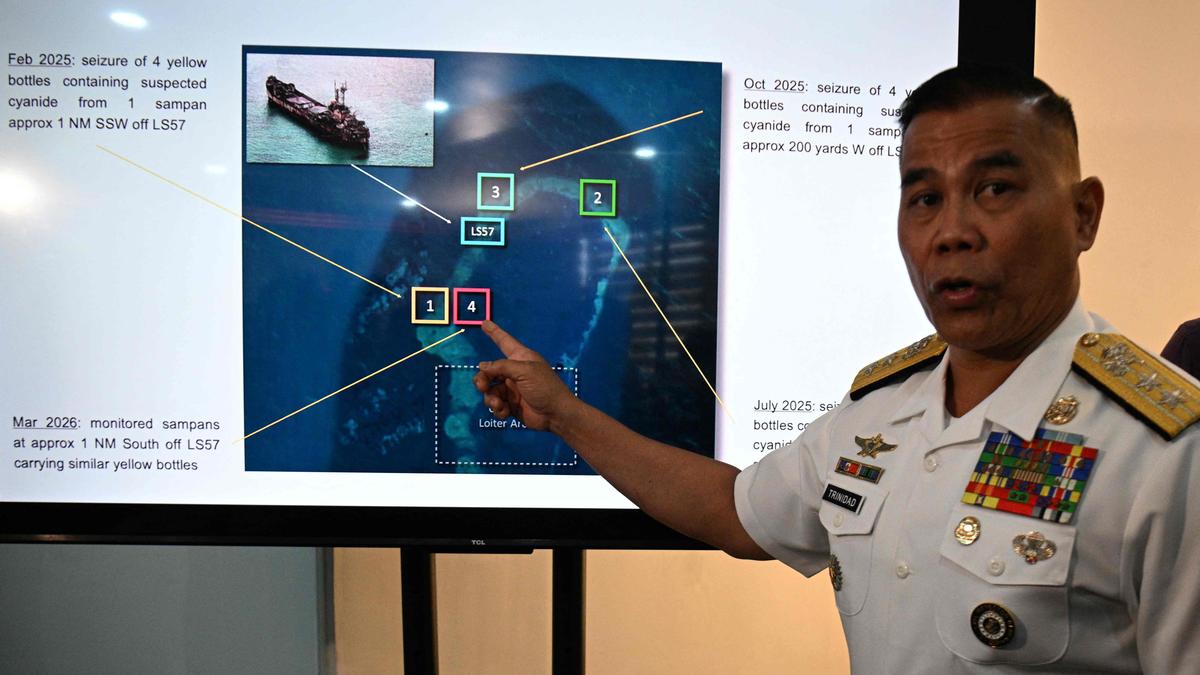
The Philippine government has shifted its strategy from legal filings to environmental whistleblowing, accusing Chinese maritime militia forces of using cyanide to destroy fishing grounds in the South China Sea. Specifically targeting Bajo de Masinloc, also known as Scarborough Shoal, Manila claims these tactics are designed to clear the area of Filipino fishermen while permanently scarring the biodiversity of the disputed reef. This is not merely a dispute over rocks and shipping lanes; it is an accusation of intentional ecological sabotage used as a tool of territorial consolidation.
The Bureau of Fisheries and Aquatic Resources (BFAR) recently raised the alarm, suggesting that the destruction is "intentional" rather than a byproduct of negligent fishing. If these claims hold, it marks a grim evolution in gray zone tactics. Cyanide fishing involves squirt bottles filled with sodium cyanide to stun fish for the aquarium trade or live food markets, but here, the motive appears more sinister. The chemicals kill the coral polyps and the intricate micro-ecosystems that sustain regional food security.
The Chemistry of Displacement
Cyanide fishing is a blunt instrument. When a fisherman squirts cyanide into a coral crevice, the goal is to paralyze the target fish. However, the collateral damage is absolute. It triggers a massive bleaching event almost instantly, suffocating the reef. While traditional dynamite fishing—another scourge of the region—is loud and easily detected by sonar or surveillance, cyanide is a silent killer. It leaves behind a skeletal white wasteland that can take decades to recover, if it recovers at all.
By rendering these waters a biological desert, a state actor can effectively end the economic viability of the region for local communities. If there are no fish, there are no fishermen. Without a constant presence of Filipino outriggers, the "effective occupation" of the shoal becomes easier for the Chinese Coast Guard to maintain. The environmental degradation serves as a physical barrier, more permanent than a steel hull and less provocative than a missile strike.
Satellite Surveillance and the Evidence Gap
Proving these allegations remains the primary hurdle for the Marcos administration. While BFAR and the Philippine Coast Guard have documented the presence of Chinese vessels and the subsequent death of coral reefs, catching a crew in the act of pouring chemicals is difficult. High-resolution satellite imagery can track vessel movements and identify the "scars" left by giant clam harvesting—another ecologically devastating practice—but chemical dispersal requires on-site water sampling and biological testing of dead reef tissue.
Manila is now deploying more scientific assets to the front lines. They are no longer just sending sailors; they are sending marine biologists. This data-driven approach aims to present a case to the international community that moves beyond "he-said, she-said" sovereignty claims. If the Philippines can provide empirical evidence of cyanide use, it shifts the narrative from a bilateral border spat to a violation of the United Nations Convention on the Law of the Sea (UNCLOS) environmental protections.
The Strategic Value of Scarborough Shoal
Scarborough Shoal is a triangle-shaped chain of reefs and rocks with a perimeter of 46 kilometers. It is a vital nursery for the entire South China Sea ecosystem. The currents that flow through this area carry larvae and nutrients to reefs across the region. Destroying the heart of this nursery has a "force multiplier" effect on the food security of every nation bordering these waters, including Vietnam, Malaysia, and China itself.
The tragedy lies in the short-term thinking of maritime militia operations. These fleets, often composed of commercial fishing vessels acting on behalf of the state, operate under a cloak of plausible deniability. By utilizing civilian boats to conduct environmental sabotage, Beijing avoids the direct stain of its official navy engaging in such acts. Yet, the coordination required to sustain a blockade at the shoal suggests a centralized command structure.
The Financial Incentives of Destruction
There is a dark irony in the economics of reef destruction. Beyond the geopolitical aim of clearing the waters, there is immediate profit in the destruction. The harvesting of giant clams involves using boat propellers to grind through the reef to reach the valuable shells. These shells are then sold as a luxury material, often dubbed the "ivory of the sea," used for carvings and jewelry in mainland China.
This process creates massive plumes of silt. These clouds of sediment settle on surrounding corals, blocking sunlight and choking the life out of the reef. When you combine siltation from clam harvesting with the chemical poisoning from cyanide, you are looking at a total ecological collapse. The revenue generated from these shells pays for the very fuel used by the militia boats to maintain their presence, creating a self-sustaining cycle of occupation and extraction.
A New Legal Frontier
The Permanent Court of Arbitration in The Hague already ruled in 2016 that China’s island-building activities caused "irreparable harm" to the marine environment. Despite this, the activities have continued and, according to Manila, escalated into active poisoning. The Philippine government is now weighing the possibility of filing a second case before the court, specifically focusing on environmental crimes.
Legal experts argue that while the 2016 ruling was ignored by Beijing, a second case focused on "ecocide" could isolate China further in the court of global public opinion. Most nations are hesitant to take sides in a territorial dispute, but few are willing to defend the intentional poisoning of the ocean. This is the strategic pivot Manila is banking on. They are trying to make the cost of occupation higher than the reward by branding the Chinese maritime strategy as a war on nature itself.
Regional Ripple Effects
If the reefs die, the fish stocks will inevitably vanish. We are already seeing a sharp decline in catch rates for artisanal fishermen in the Zambales province. These are families that have relied on the shoal for generations. When they return with empty nets, it creates an internal economic crisis for the Philippines. This displacement forces these communities into urban centers, straining local infrastructure and creating a "climate refugee" situation caused by geopolitical maneuvering rather than natural disasters.
Vietnam and Taiwan are watching this development with intense scrutiny. Both have their own claims and have witnessed similar environmental degradation in their respective zones. If the Philippines succeeds in holding China accountable for the state of the reefs, it provides a blueprint for other Southeast Asian nations to push back. Conversely, if the world looks away while cyanide is poured into one of the most biodiverse regions on Earth, it sets a precedent that the environment is fair game in modern warfare.
The Limits of Diplomatic Protest
The Department of Foreign Affairs in Manila has filed hundreds of diplomatic protests over the last few years. Most go unanswered. This has led to the "transparency initiative" led by Commodore Jay Tarriela of the Philippine Coast Guard. By embedding journalists on patrol vessels and releasing drone footage of confrontations, the Philippines has brought the reality of the South China Sea to a global audience.
The environmental angle is the latest chapter in this transparency campaign. It moves the conversation from abstract maps to the tangible loss of a shared natural heritage. However, visibility is not the same as enforcement. The Philippine Navy remains outmatched in terms of tonnage and technology. Without a significant shift in the presence of allied forces or a massive internal policy change in Beijing, the reefs will continue to bear the brunt of the friction.
Technical Challenges in Remediation
Restoring a reef poisoned by cyanide is not as simple as stopping the chemicals. The structural integrity of the coral remains, but the living tissue is gone. Algae quickly takes over the dead coral, preventing new polyps from attaching. To truly "fix" Scarborough Shoal, a massive, decades-long restoration project would be required, involving the transplanting of lab-grown corals.
Such a project is impossible in a contested zone. You cannot plant coral while being harassed by water cannons. The ecological damage is becoming a permanent fact on the ground—or under the water—that will outlast the current political administrations. The reefs are being used as a scorched-earth sacrifice in a game of regional dominance.
The Burden of Proof
The international community requires a chain of custody for biological samples that can withstand legal scrutiny. Manila must ensure that its scientists have the protection they need to conduct thorough, unbiased assessments within the shoal. This means sending research vessels into areas where they are likely to be swarmed by militia boats. It is a high-stakes scientific mission with the potential to rewrite the rules of maritime engagement.
If the Philippines can present a "smoking gun" of chemical canisters or undeniable laboratory results from the dead reefs, the pressure on international bodies to intervene will reach a boiling point. Until then, the silent poisoning of the South China Sea remains a devastating, unpunished reality of modern territorial expansion.
The ocean does not recognize borders, and neither does the toxicity of cyanide. What starts as a tactic to drive away fishermen in a small corner of the sea will eventually deplete the fisheries that feed millions across the entire Pacific rim. The fight for Scarborough Shoal is no longer just about who owns the rocks; it is a fight to stop the intentional murder of an ecosystem before it reaches a point of no return.
The focus must now remain on the water samples, the satellite tracks, and the dying coral.