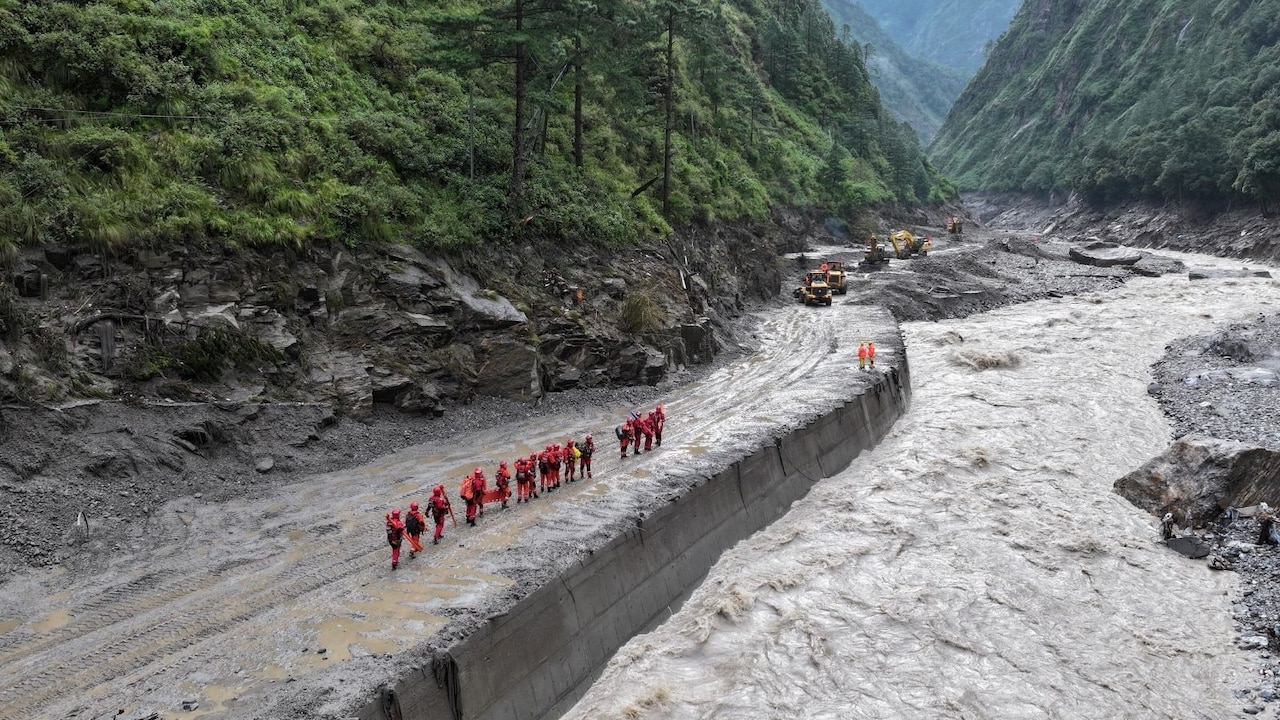
Every time a mountain collapses or a river swallows a town, the post-mortem follows a predictable, lazy script. Analysts dig through the archives, find a dusty assessment written five months prior, and throw their hands up in collective outrage. Two reports! Right there in black and white! The data existed! The warnings were published!
The lazy consensus is that if we only had better hazard maps, louder sirens, or more competent bureaucrats, tragedy would be averted.
This is comforting fiction. It lets us blame a failure of communication rather than a failure of reality. I have spent years watching institutions confuse the production of a PDF with the management of physical risk. We treat warning reports like magical charms that, once written, should somehow anchor boulders to hillsides and reinforce riverbanks through sheer administrative presence.
The uncomfortable truth is that early warnings rarely fail because people are uninformed. They fail because the system is designed to ignore them until the cost of action exceeds the cost of catastrophe.
The Archive Illusion
Let us dismantle the core myth of the pre-disaster warning report. The standard narrative suggests that a warning sits on a desk, ignored by negligent officials who simply forgot to read it.
That is almost never what happens.
In my line of work, I have seen millions of dollars poured into risk assessments, vulnerability indices, and high-resolution hazard zoning maps. These documents are heavy, comprehensive, and universally shelved. Why? Because a warning report is rarely an operational command; it is an administrative insurance policy. Bureaucrats commission studies not to trigger mass evacuations months in advance, but to cover their liability after the fact.
When two reports land on a desk five months before a disaster, they do not arrive in a vacuum. They arrive alongside five hundred other reports detailing failing schools, crumbling bridges, economic stagnation, and political crises. To a local government with zero budget and an election cycle measured in months, a probabilistic risk warning about a slow-moving tectonic or hydrological hazard is just background noise.
Expecting a municipal authority to displace thousands of citizens, halt local commerce, and upend regional supply chains based on a probabilistic assessment months out is politically suicidal. If they act and nothing happens, they are pilloried for economic vandalism. If they do nothing and disaster strikes, they are pilloried for negligence. Given those choices, human nature and perverse incentives dictate inaction every single time.
The Fallacy of More Data
We are drowning in data and starving for decisions.
The technocratic impulse assumes that if we just make the maps sharper, the models more predictive, and the warnings more granular, people will listen. This is a category error. More data does not solve a structural paralysis.
Imagine a scenario where a geological survey team produces a model so precise it predicts the exact hour of a landslide down to a narrow window. Does that change the economic reality of the people living beneath the slope? Does it magically provide alternative housing, transport logistics, or financial compensation for small-business owners whose entire livelihood is tied to that specific valley?
No. It just gives people a front-row seat to their own destruction with higher-resolution graphics.
When we focus solely on the quality of the warning, we absolve ourselves of fixing the underlying conditions of vulnerability. A farmer living on an unstable slope does not stay because he misreads the weather forecast. He stays because moving means starvation. He weighs the statistical certainty of a future disaster against the absolute certainty of immediate poverty. Until our interventions address the economic trapdoor beneath vulnerable populations, shouting louder warnings into the void is nothing more than performative anxiety.
Redefining Preparation
If the standard playbook of writing reports and waiting for compliance is dead on arrival, what actually works?
We must stop treating disaster risk reduction as an information problem and start treating it as a liquidity and power problem. Warnings only matter when the recipient has immediate, frictionless exit options.
First, tie early warnings to automated economic triggers rather than human bureaucratic discretion. If a threshold is crossed, funds must release automatically to relocate populations without waiting for a committee to vote. Second, decentralize hazard mitigation away from centralized ministries that view regions as coordinates on a map. Local communities know the terrain better than any consultant; what they lack is capital and autonomy.
We can keep writing warnings until our fingers bleed. We can archive thousands of pages of forecasts predicting the next collapse, flood, or drought. But until we stop pretending that a memo is the same thing as a mitigation strategy, we will keep reading the same post-mortem, feigning the exact same shock, while the mountain falls all over again.