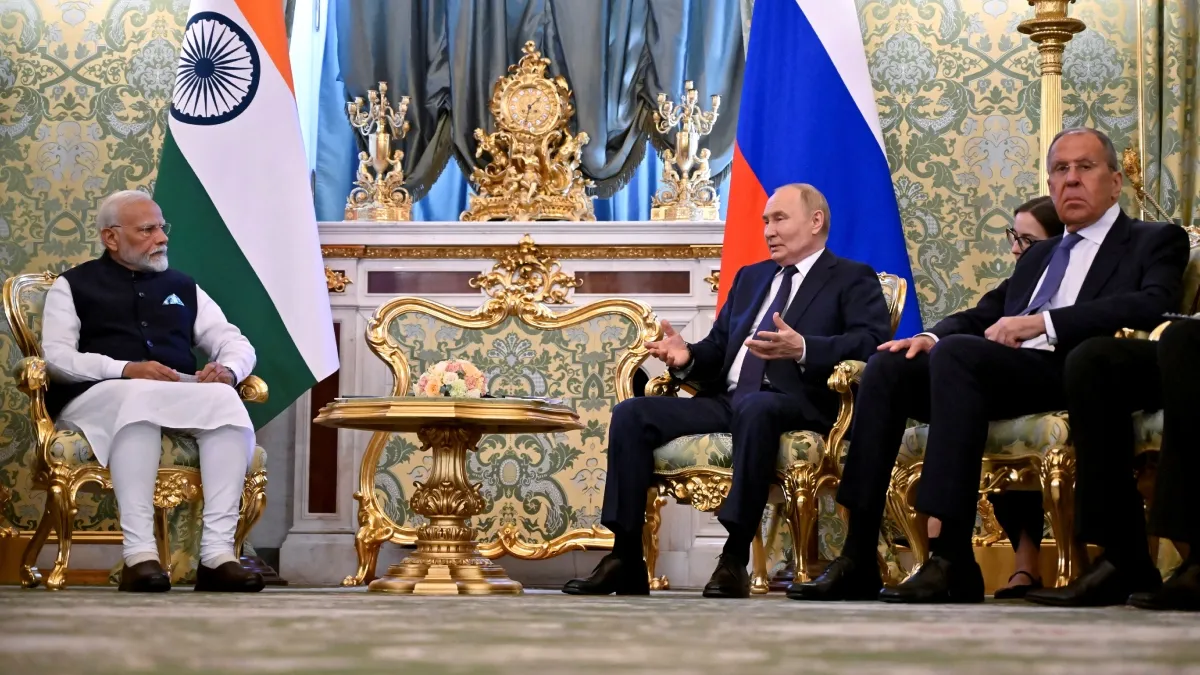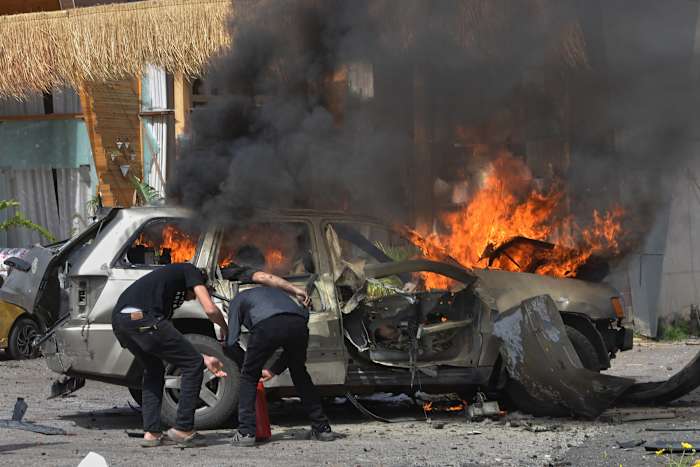
The media remains obsessed with the optics of "shuttle diplomacy." They track the movements of special envoys like they’re reporting on a high-stakes chess match. They breathlessly announce that a new round of talks has "kicked off" while artillery shells are still hot.
It’s a lie.
The idea that these negotiations are a pathway to stability is the "lazy consensus" of the decade. In reality, these talks aren't designed to end the conflict. They are designed to manage the perception of the conflict while both sides prepare for the next inevitable escalation. We are watching a theatrical performance where the script is written in blood and the actors are reading lines they stopped believing years ago.
The Myth of the Rational Actor
Mainstream reporting assumes both Israel and Hezbollah are rational state-like actors seeking a "win-win" scenario. This is a fundamental misunderstanding of the Middle Eastern security apparatus.
Israel isn't looking for a piece of paper signed in a neutral hotel. They are looking for a sterilized border where their citizens can return to the north without the threat of an anti-tank missile hitting their kitchen table. Hezbollah, conversely, does not view "peace" as an objective. For Hezbollah, the conflict is their entire raison d'être. Without the "resistance," they are just another corrupt political party in a failing state.
When you negotiate with a group whose identity is rooted in perpetual struggle, you aren't seeking a solution. You're just haggling over the price of the next ceasefire.
The Buffer Zone Fallacy
Every news outlet talks about UN Resolution 1701 like it’s a sacred text. They suggest that if we could just push Hezbollah north of the Litani River, everything would be fine.
I’ve spent enough time analyzing tactical deployments to tell you: distance is a 20th-century metric for a 21st-century war. In an era of precision-guided munitions and long-range drones, a 20-mile buffer zone is a psychological comfort, not a physical one.
Pushing a fighter back ten kilometers doesn't stop a drone launch. It doesn't stop a rocket barrage. It just changes the flight time by a few seconds. The insistence on 1701 is a classic case of "doing something" so politicians can say they tried, while the underlying military reality remains unchanged.
Lebanon is Not a Country It is a Host
To understand why these talks fail, you have to stop treating Lebanon as a sovereign entity with a unified will. The Lebanese state is a ghost. It has no control over its borders, no monopoly on the use of force, and no ability to enforce any agreement it signs.
Negotiating with the Lebanese government about Hezbollah is like negotiating with a homeowner about the behavior of the grizzly bear living in their basement. The homeowner might agree with you, they might even sign a contract promising the bear will stay quiet, but they have no way to make the bear comply.
- The Lebanese Armed Forces (LAF): Touted as the "neutral" force that will take over the south. In reality, they are underfunded, outgunned, and deeply infiltrated by the very groups they are supposed to police.
- The Political Class: They use the threat of war as a distraction from the fact that they have looted the country’s central bank and left the population in the dark.
If you aren't talking directly to the commanders in the field, you aren't talking. You're just socializing.
The Attrition Trap
The competitor's article focuses on "fighting continuing." This implies the violence is a hurdle to the talks. It’s the opposite. The violence is the currency of the talks.
Each strike is a data point used to adjust the terms of the eventual pause. Israel strikes a command center to show they can. Hezbollah fires a volley at Haifa to show they still have the reach. This isn't "fighting while talking." This is the negotiation itself. The table and the chairs are just where they record the score.
Why "De-escalation" is a Dangerous Term
Diplomats love the word "de-escalation." It sounds sophisticated. In practice, it usually means "let's go back to the status quo that caused this mess in the first place."
The status quo prior to the current flare-up was an environment where Hezbollah built a massive subterranean infrastructure and amassed an arsenal of 150,000 rockets. Why would anyone want to "de-escalate" back to that?
A real solution would require the total dismantling of non-state militias. Since no one in Washington, Paris, or Beirut has the stomach for the massive regional war that would require, they settle for "de-escalation." It’s a band-aid on a gunshot wound.
The Iran Variable
You cannot discuss Israel and Lebanon without acknowledging that the real decision-maker isn't in Beirut. It’s in Tehran.
Hezbollah is the "crown jewel" of Iran’s proxy network. They are a strategic deterrent designed to protect the Iranian nuclear program. Iran will allow a temporary pause if it serves their broader regional interests, but they will never allow Hezbollah to be truly neutralized.
To believe that a local border agreement can succeed without a fundamental shift in Iran’s foreign policy is peak Western arrogance. It assumes that if we just find the right wording for a UN document, centuries of ideological and regional rivalry will simply evaporate.
The Intelligence Gap
We hear about "breakthroughs" in the talks. These are almost always leaks from officials who need to look busy.
If you want to know what’s actually happening, stop reading the transcripts of press conferences. Look at the logistics. Look at the reserve call-ups. Look at the movement of ammunition.
- The "Wait and See" Strategy: Israel is currently testing how much of Hezbollah's leadership they can decapitate before the international community forces a stop.
- The "Endurance" Strategy: Hezbollah is testing how much pain the Lebanese civilian population can take before the internal pressure becomes a threat to their grip on power.
The Hard Truth About Peace
Peace isn't the absence of war. It's the presence of a stable, enforceable order.
There is no stable order in Southern Lebanon. There is only a temporary exhaustion of resources. When the talks eventually produce a "framework for a ceasefire," the media will celebrate. The envoys will get their photoshopped handshakes.
And six months later, or a year later, or five years later, we will be right back here. Because we haven't solved the problem; we’ve just rescheduled the next tragedy.
Stop asking when the talks will succeed. Start asking why we keep pretending that this process is anything other than a managed decline. The only "solution" that has ever worked in this region is clear, overwhelming deterrence—and even that has an expiration date.
The diplomats aren't there to stop the war. They are there to make the war polite enough for the evening news. If you want the truth, watch the borders, not the podiums.
The talks are the distraction. The rockets are the reality.