The Rio Grande does not care about borders. It cuts through the Chihuahuan Desert with an ancient, stubborn indifference, carving canyons through limestone that formed millions of years before humans invented maps or drew lines in the dirt. Along its northern bank sits Big Bend National Park, a cathedral of silence where black bears roam through mountain scrub, golden eagles hunt above sun-baked arroyos, and the night sky is so fiercely dark that the Milky Way looks like a spilled jar of salt.
For most who find their way here, the park is an escape from the noise of modern life. You smell the crushed creosote after a rare flash flood. You feel the grit of caliche dust settling into your skin. You watch the sun paint the Santa Elena Canyon in shades of rust and violet, whispering promises of a world untouched by the frantic machinery of geopolitics.
Then the heavy machinery arrived.
The Concrete Line in the Sand
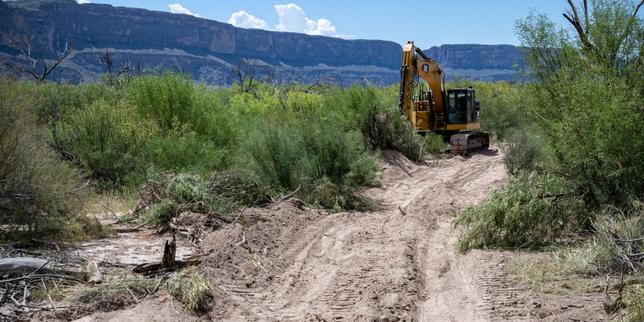
Heavy diesel engines broke the quiet of the desert dawn. Steel-tracked bulldozers gnawed at the fragile earth. Steel barrier walls, towering and indifferent, began to rise against the horizon, slicing through federally protected wilderness with the brutal efficiency of a guillotine.
To understand why this happened, you have to look past the political speeches in Washington and gaze instead at the dust of Brewster County, Texas. This was an administrative push—a rapid, unyielding deployment by federal authorities to extend border infrastructure across terrain that had previously been left to the coyotes, the river turtles, and the wind. The plan was simple on paper: seal the frontier, concrete by concrete, steel post by steel post.
Speed was the weapon of choice. Permits were bypassed or rushed. Environmental impact studies were treated as inconvenient speed bumps on a highway of urgency. The federal government assumed that in the vast, empty expanses of West Texas, nobody would be watching. They forgot about the river. They forgot about the law.
And, crucially, they forgot about the people who treat the desert not as a staging ground, but as a home.
The Halt
A gavel came down in a federal courtroom, and the steel teeth stopped chewing.
A judge’s order brought an abrupt, breathless halt to the construction slicing through Big Bend. It was a legal collision between executive expediency and environmental statute. Conservation groups, local landowners, and tribal voices had banded together, filing lawsuits that argued the administrative shortcuts taken to rush the border wall violated bedrock environmental laws, including the National Environmental Policy Act.
Consider what happens when you build a wall through a floodplain. When the summer monsoons hit, the Rio Grande swells with furious, muddy water, turning dry arroyos into raging torrents overnight. A rigid steel barrier acts not just as a wall, but as a dam. Without proper ecological review, those barriers trap debris, alter natural water flows, and funnel floodwaters onto vulnerable downstream communities and delicate wildlife habitats.
The court recognized this danger. The judge's pen drew a temporary boundary of its own: Stop. Look at what you are destroying. Measure the cost.
The Invisible Stakes
It is easy to view this conflict through the cold lens of political polarization. One side sees national security; the other sees environmental vandalism. But that binary misses the deeper, quieter tragedy unfolding in the canyons.
A border wall through Big Bend is not just a fence. It is a fracture in a living ecosystem. The park is a corridor for endangered species like the Mexican wolf and the ocelot, animals that do not recognize passports or checkpoints. When you sever migration routes, you isolate populations, starving the genetic diversity required for survival.
Imagine tracking a black bear across the arid hills of the Christmas Mountains, watching it navigate ancient pathways forged over centuries. Now imagine dropping a twenty-foot steel wall directly across that path. The bear stops. It paws at the metal, sniffs the unyielding surface, and turns back. The ancient map inside its skull is suddenly rendered obsolete by a bureaucratic decree 1,500 miles away.
This is the human element that gets lost in the spreadsheets of contractors and the press releases of federal agencies. The local river guides, the biologists who have spent decades counting rare cactus species in the backcountry, the multigenerational ranchers whose families settled the borderlands before barbed wire was invented—they carry a quiet grief. They know that once concrete is poured into a pristine wilderness, you cannot simply press undo.
The Dust Settles
For now, the heavy machinery sits idle. The bulldozers wear a coat of fine desert dust, baking under a relentless West Texas sun. The workers are gone. The legal briefs pile up in air-conditioned courtrooms far from the scent of sagebrush and creosote.
The river keeps flowing. The great blue herons stalk the shallows of the Rio Grande, hunting for small fish with absolute disregard for the injunctions, the motions, and the political theater playing out on the banks.
This legal pause is not a permanent victory, nor is it a final defeat. It is a reprieve—a fragile window of silence in a desert that has heard too much noise lately. It forces a fundamental question about what kind of nation we wish to be: one that treats its wild places as collateral damage in the pursuit of security, or one that pauses long enough to ask whether some lines should never be drawn in stone.
The gavel has spoken, but the desert still waits.


