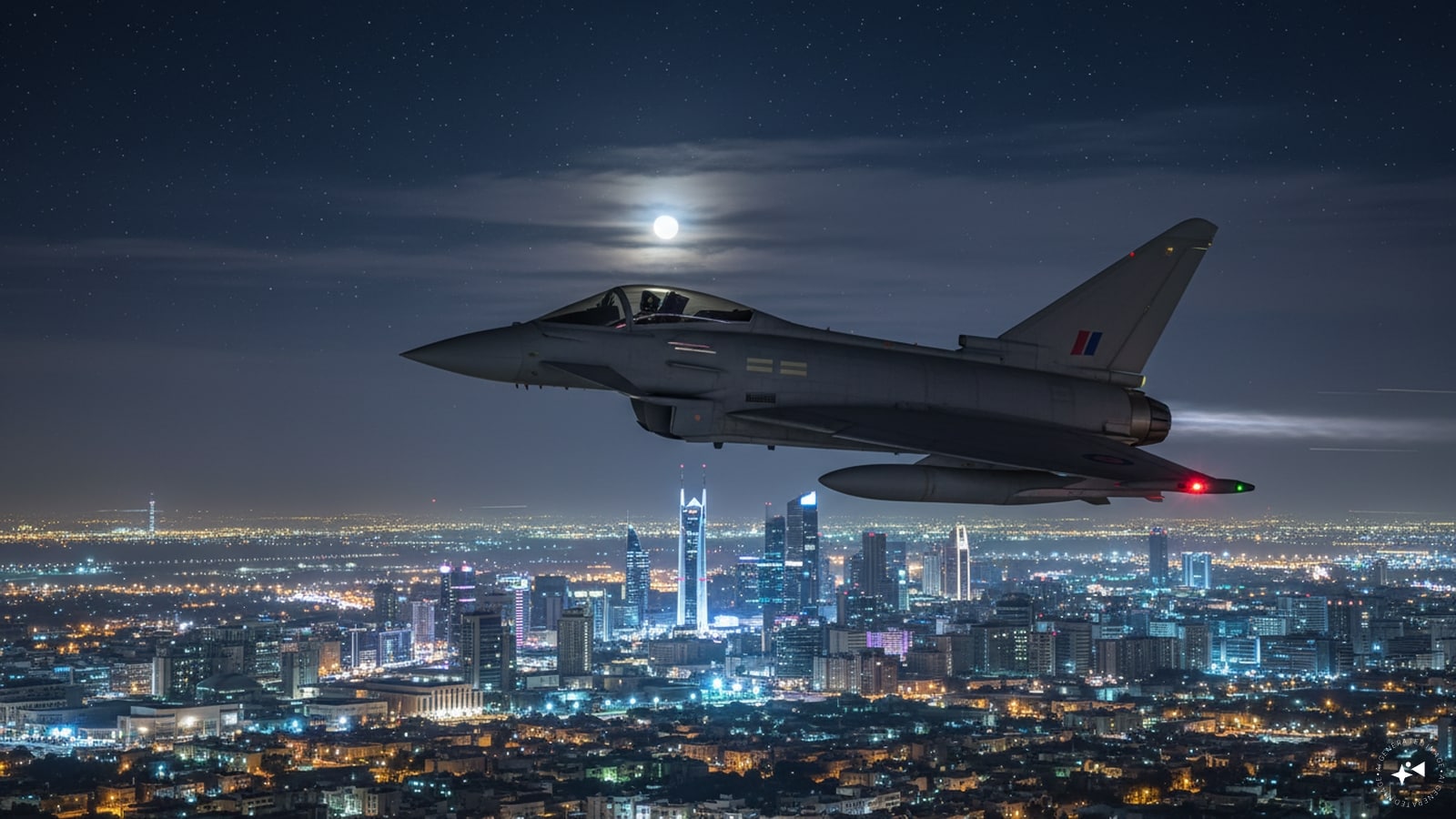
"Defensive" air patrols are not a shield. They are a subsidy for cheap drones. They are an accounting trick. They are a diplomatic fig leaf designed to make a shrinking military look busy over someone else's border.
When headlines talk about the UK expanding military support for Saudi Arabia against the Houthis with "defensive" air patrols, the lazy consensus writes itself. London is stepping up. Riyadh is getting reinforced. Commercial shipping and Saudi cities are getting a layer of protection without dragging Britain into another quagmire.
That consensus is sloppy. Worse, it gets the basic math of modern warfare backward.
A fighter jet patrolling the sky is not a force field. It is an expensive sensor and a scarce shooter operating inside a brutal cost-exchange ratio. When you fly high-end combat aircraft to swat down low-cost drones and cruise missiles, you are playing a game where the attacker wins simply by showing up repeatedly.
If you want to understand what is actually happening when the UK expands defensive air patrols for Saudi Arabia against the Houthis, you have to stop asking how many sorties are flown and start asking what problem those sorties can actually solve.
The Lazy Consensus Around "Defensive" Patrols
Read the standard commentary on expanded air patrols and you will see the same comforting assumptions repeated like scripture.
First comes the assumption that "defensive" means low-risk and escalatory-proof. Politicians love the word defensive because it sounds tidy. It implies you are only reacting to incoming threats, not taking sides in a messy regional war or provoking retaliatory strikes against your own forces.
Second comes the assumption that air patrols provide broad area coverage. People picture a jet orbiting overhead and magically catching whatever flies toward Saudi territory or the Red Sea approaches.
Third comes the assumption that more Western hardware automatically restores deterrence. Add a few more airframes, share a little more intelligence, keep the radar picture humming, and the Houthis will think twice.
None of those assumptions hold up under scrutiny.
In defense analysis, air policing or combat air patrol (CAP) is not the same thing as integrated air and missile defense (IAMD). An aircraft on patrol has limited loiter time, limited payload, and strict line-of-sight constraints against small, low-flying targets cluttering radar screens. Even when a pilot spots a one-way attack drone or a low-altitude cruise missile, shooting it down with an air-to-air missile or cannon requires being in the right place at the right time with the right weapon loaded.
I have spent years watching defense programs and operational deployments burn through budgets chasing neat political labels while ignoring physical reality. I have seen defense contractors and ministries spend fortunes optimizing platforms for prestige and diplomatic signaling while leaving basic magazine depth and electronic warfare bottlenecks unaddressed. When a mission is sold primarily as a "defensive" gesture, the pressure to solve the underlying cost and geometry problem evaporates. You get activity instead of effect.
Why the Cost-Exchange Math Breaks Down
Modern air defense in the Middle East is an arithmetic problem first and an aviation problem second.
Consider what the Houthis have relied on across the Red Sea and Arabian Peninsula: cheap one-way attack drones, ballistic missiles, cruise missiles, and anti-ship systems. Even if a single drone costs a fraction of a million dollars, the cost of launching a multi-million-dollar interceptor missile—plus the fuel, maintenance hours, tanker support, and pilot fatigue of keeping fast jets airborne—adds up fast.
There is an old rule of thumb in attrition warfare: if your cost per interception is ten or fifty times higher than the attacker's cost per shot, you can win tactical engagements and still lose the contest of endurance.
Naval strategists like Wayne Hughes and airpower theorists like John Boyd pointed out decades ago that combat effectiveness is bound by tempo, endurance, and resource trade-offs. Boyd's observation-orientation-decision-action loop matters in the air, sure, but economics sets the ceiling on how long you can keep cycling through the loop. You cannot out-spend an adversary who treats cheap drones as expendable ammunition if your response relies on high-cost, low-volume assets.
Imagine a scenario where a patrol flight orbits for two hours waiting for a threat that never comes, burns tons of aviation fuel, puts wear on airframes and engines, and refuels mid-air—only for a swarm of low-cost drones to launch from a different bearing or fly low enough to complicate detection. Even if every single threat is intercepted, the defender's ledger takes a beating. And if even one or two slip through, the political narrative shifts overnight from "successful patrol" to "why didn't the patrols stop it?"
That is the trap of defensive air patrols. They set a near-impossible standard of perfection while handing the initiative to the side that picks the timing and volume of attacks.
The Real Question Behind UK Support for Saudi Arabia
Most coverage asks: Will UK defensive air patrols protect Saudi Arabia and deter the Houthis?
That is the wrong question. It treats a limited, reactive air presence as if it were a comprehensive security architecture.
A better question is: What is London actually buying with these patrols—diplomatic leverage with Riyadh, interoperability with regional partners, or credible deterrence?
Those are three very different products.
- Diplomatic leverage: Expanding military support signals commitment to a key regional partner and keeps Britain in the room when Gulf security arrangements, defense sales, and diplomatic channels are negotiated.
- Interoperability: Flying patrols, sharing surveillance data, and coordinating airspace management tests command-and-control links and keeps crews sharp in a high-threat environment.
- Credible deterrence: Deterring an actor like the Houthis requires convincing them that launching attacks will cost them more than they gain—not merely that a patrol jet might be nearby.
If the goal is deterrence, defensive patrols alone rarely carry the weight. Deterrence depends on punishment, denial, or both. Purely defensive postures offer denial at best, and often leaky denial at that, while leaving the attacker's launch sites, supply lines, and political calculus untouched.
Let's be honest about the downside of a harder, more offensive or disruptive approach, too. Striking targets on the ground in Yemen carries major risks: civilian harm, regional escalation, wider retaliation against shipping or neighboring states, and political blowback at home. A contrarian critique of "defensive" patrols is not a blank check for reckless escalation. Escalation has real costs. Pretending those costs do not exist is just another kind of lazy thinking.
Dismantling the Common Questions
Do defensive air patrols stop Houthi drone and missile attacks?
They can intercept some threats under the right conditions, which is not the same as stopping attacks. Air patrols help detect, track, and occasionally shoot down incoming aerial threats, especially when paired with ground-based air defenses, radar networks, and naval vessels.
They do not stop the underlying launch cycle. As long as an adversary can assemble, hide, and fire cheap systems at scale, defensive patrols act like a goalie facing endless shots from close range. Sooner or later, volume tests every defense.
Is UK military support for Saudi Arabia purely defensive in practice?
On paper, "defensive" means protecting territory, forces, or shipping lanes rather than conducting offensive strikes. In practice, air patrols sit inside a broader ecosystem of intelligence sharing, airspace deconfliction, early warning, and regional security alignment.
Calling a mission defensive makes it easier to sell politically, especially when domestic audiences are weary of Middle East interventions. Yet in a contested airspace, intelligence, targeting support, and force protection blur together fast. Semantics do not insulate a deployment from political or strategic entanglements.
Why expand air patrols instead of relying only on ground air defense?
Ground-based air defense systems—like surface-to-air missile batteries and radar sites—are vital, but they are fixed in location and bounded by terrain and radar horizons. Aircraft add mobility, elevated sensors that can see further over curved earth and terrain masking, and the ability to reposition quickly.
The catch is persistence and cost. Ground batteries can sit ready for long stretches without burning flight hours or needing aerial tankers; fighter jets cannot. Treating air patrols as a substitute for deep magazines, layered sensors, and industrial replenishment is where trouble starts.
What Actually Works Instead of Performative Patrols
If policymakers and defense planners want real results rather than press-release optics, several unconventional moves make far more sense than simply adding more patrol hours.
- Fix the cost curve before adding sorties. Stop treating high-end missiles as the default answer to cheap drones. Invest aggressively in lower-cost interceptors, electronic warfare, counter-drone jamming, and directed energy or gun-based systems where feasible. If you do not change the cost per shot, more patrols just accelerate the budget drain.
- Prioritize sensor fusion and early warning over lone-wolf chasing. A patrolling jet is far more useful as an eyes-and-ears node tied into a shared sensor grid than as a solo shooter burning expensive ordnance on low-value targets. Let ground systems and cheaper interceptors handle routine threats when possible, and save high-end jets for high-value targets or gaps in coverage.
- Pair defense with supply-chain interdiction and diplomacy. You rarely solve a drone-and-missile problem purely in the sky above the target. Disrupting smuggling networks, component pipelines, and financial backers—while pursuing hard-headed regional de-escalation where leverage exists—attacks the root problem rather than just swatting at symptoms.
- Be honest with the public about limits. Stop telling voters that "defensive" air patrols equal a safe, cheap shield. Explain the trade-offs plainly: limited coverage, high operating costs, and real risks of getting pulled deeper into regional crises.
Defensive air patrols look decisive on a briefing slide. In the real world, they are a band-aid on a math problem.