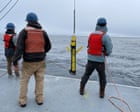
The United States government is pulling the plug on its most sophisticated maritime defense against extreme weather and climate blindness. Under a directive hitting the National Science Foundation, research vessels are heading into the Pacific and Atlantic to dismantle the Ocean Observatories Initiative, a $368 million network of deep-sea sensors that has provided real-time data for more than a decade. By recovering over 900 subsea instruments, the administration is effectively blinding the scientists who track marine heatwaves, coastal flooding risks, and the deep ocean currents that dictate global weather. The immediate operational savings amount to roughly $50 million annually. The long-term cost to coastal economies, fisheries, and storm predictability will likely be measured in the billions.
While mainstream coverage framing this as a routine environmental dispute treats it with mild dismay, the reality is far more calculated. This is not a simple budgetary trim. It is a targeted, structural unwinding of foundational science designed to eliminate the data streams that make climate forecasting possible. You might also find this related story insightful: The Paper Tiger Illusion Why Firepower Cannot Buy Absolute Global Dominance.
The Infrastructure of Enlightenment
To understand what is being lost, one must understand how the deep ocean is actually measured. Satellites can scan the surface, but water blocks their eyes. For decades, the only way to know what was happening in the deep ocean was to drop a bucket over the side of a ship and pull it back up.
The Ocean Observatories Initiative changed that. It replaced sporadic ship expeditions with permanent, cabled networks and autonomous moorings anchored to the seafloor, miles beneath the surface. As highlighted in detailed reports by USA Today, the effects are notable.
Instruments placed at critical chokepoints—like the Irminger Sea between Greenland and Iceland, Station Papa in the North Pacific, and the Endurance Array off the Pacific Northwest—have pumped continuous, real-time data directly into global networks. They measure temperature, salinity, acidity, and velocity. They trace the movement of the Atlantic Meridional Overturning Current, the massive oceanic conveyor belt that keeps Western Europe from freezing over.
The National Science Foundation has characterized this systematic removal as a "descoping" plan. It argues that the move aligns with a strategy to create a nimbler approach to evolving scientific priorities.
The scientists who built the network see it differently. They point out that a continuous, uninterrupted time series is the single most valuable asset in earth science. Once you pull the anchors and break the chain of data, you cannot go back and re-measure yesterday's ocean.
The Economics of a Blind Coastline
The policy memo accompanying the administration’s budget justification frames the cuts as a necessary correction against "environmental alarmism" and non-core agency missions. White House officials argue that federal research infrastructure has been utilized to advance specific policy narratives rather than objective science.
Yet the fallout of a deep-ocean blackout hits commercial reality long before it touches political ideology.
Consider the Pacific Northwest's shellfish industry. A decade ago, ocean acidification began dissolving oyster larvae in their shells, nearly destroying a $270 million regional economy. It was the Endurance Array—the very network currently being dismantled off the coast of Oregon—that allowed hatcheries to monitor real-time pH drops and draw clean water into their tanks before the acidity killed their stock.
Without these sensors, commercial fishermen are flying blind into a projected El Niño year. Marine heatwaves, which can trigger toxic algal blooms and force the immediate closure of Dungeness crab and salmon fisheries, will now materialize out of the dark.
The logic of saving $50 million by removing an established asset collapses when contrasted with the vulnerability of coastal infrastructure.
- Storm Intensification: Ocean heat content is the primary fuel for hurricanes. Forecasters rely on deep-sea temperature data to calculate whether a tropical storm will fizzle or rapidly intensify into a Category 5 monster before making landfall.
- Fisheries Management: Accurate catch limits require knowing how marine populations react to shifting thermal boundaries. Without data, regulators must choose between overfishing or shutting down profitable fisheries out of abundance of caution.
- Port Operations: Major shipping hubs rely on precise sea-level and current tracking to manage the navigation of deep-draft container ships.
The Broader Administrative Purge
The dismantling of the ocean observatories does not happen in a vacuum. It is the logistical culmination of a broader campaign aimed at the heart of the federal scientific apparatus. Over the past year, the National Oceanic and Atmospheric Administration has shed roughly 20 percent of its workforce through targeted layoffs and administrative friction.
The Office of Oceanic and Atmospheric Research, which acts as the core customer for much of this ocean data, faced proposals to be eliminated entirely as a standalone line office. While Congress pushed back to preserve some funding, executive management has found other ways to slow operations. Field offices have faced staffing shortages so severe that basic duties, such as weather balloon launches, have been paused or placed on indefinite hiatus.
The strategic removal of physical instruments represents a permanent shift. It is far easier to rehire a bureaucrat than it is to re-charter a research vessel, steam out to the sub-Arctic, and redeploy a multi-million-dollar cabled instrument array that has been dragged to a warehouse on land.
The Irony of the High Seas
There is a distinct geopolitical irony to the American withdrawal from ocean monitoring. As the United States pulls its instruments out of the water to save short-term capital, international competitors are moving in the opposite direction. China and the European Union have steadily expanded their autonomous ocean gliders and deep-sea monitoring networks, recognizing that maritime intelligence is a cornerstone of future economic security and resource dominance.
Ocean data is a global public good. For a quarter of a century, the United States was the unquestioned leader in sharing this data freely with the world. The collection networks operated on the principle that a more predictable planet is safer for everyone.
The ships currently reeling in the cables off the Oregon coast are winding down that era. The instruments are coming up. The data streams are flickering out. The ocean remains just as volatile, but the charts are going blank.


