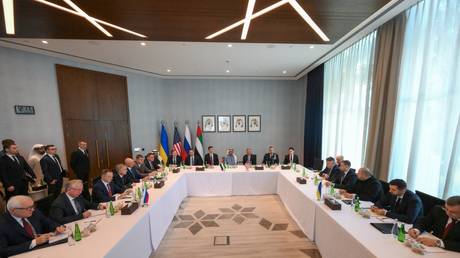
Diplomatic summits held in neutral Gulf capitals rarely produce immediate, binding treaties; instead, they function as high-stakes clearinghouses for asymmetric intelligence, sanctions arbitrage, and backchannel signaling. Standard media coverage of the Abu Dhabi talks fails because it treats public communiqués as literal outcomes rather than calculated diplomatic theater. To extract actual predictive value from Russian expert assessments of these negotiations, analysts must strip away state-aligned rhetoric and map the underlying structural incentives driving Moscow, Washington, and the United Arab Emirates.
The Structural Function of Neutral Gulf Venues
When geopolitical friction renders traditional European diplomatic hubs inoperable, capital and diplomacy migrate to jurisdictions with low regulatory friction and high strategic autonomy. The United Arab Emirates operates not merely as a passive host, but as an active liquidity provider in international relations.
In game-theoretic terms, Abu Dhabi provides a credible commitment mechanism for preliminary de-escalation. Neither Russia nor Western coalitions can afford the domestic political cost of initiating direct, publicized concessions. By routing negotiations through an Emirati intermediary, both sides achieve plausible deniability while testing the elasticity of opposing red lines.
Russian foreign policy analysts view this venue selection through three distinct operational filters:
- Sanctions Insulation: Financial and logistical channels in the Gulf remain partially decoupled from Western secondary sanctions regimes, allowing discussions to link diplomatic concessions directly to trade and payment clearing mechanisms.
- Multipolar Validation: Moscow uses the physical setting of the UAE to demonstrate to domestic and Global South audiences that Western efforts to isolate Russian statecraft have reached a structural ceiling.
- Asymmetric Information Extraction: Neutral venues permit Russian delegations to engage directly with non-state actors, sovereign wealth representatives, and secondary European diplomats outside the rigid choreography of formal multilateral institutions.
Categorizing Russian Expert Assessments
Public commentary from Moscow-based think tanks—such as the Valdai Discussion Club, the Russian International Affairs Council (RIAC), and the Institute of World Economy and International Relations (IMEMO)—is rarely monolithic. While Western observers often dismiss these voices as uniform state propaganda, an empirical breakdown reveals three distinct analytical cohorts, each serving a specific signaling function for the Kremlin.
The Realist-Transactionalist Cohort
This group evaluates the Abu Dhabi talks strictly through balance-of-power metrics and economic utility. Their assessments focus on tangible deliverables: prisoner exchanges, grain and fertilizer transit corridors, and energy price stabilization.
- Core Thesis: Diplomatic engagements in the Gulf are successful only if they yield immediate, verifiable reductions in operational friction for the Russian economy.
- Analytical Blind Spot: Realist-transactionalists systematically underestimate the ideological and institutional inertia within Western bureaucracies, assuming Washington or Brussels can pivot policy as rapidly as an executive-dominated system.
The Ideological-Sovereigntist Cohort
Dominating state television and hardline policy journals, these commentators frame the Abu Dhabi meetings as evidence of Western exhaustion. They interpret any willingness by Western or Ukrainian representatives to sit in the same proximity as Russian officials as a precursor to capitulation.
- Core Thesis: Time favors Moscow’s attrition strategy, and neutral venues are merely stages where the opposing coalition negotiates the terms of its strategic retreat.
- Analytical Blind Spot: This cohort confuses tactical diplomatic probing with strategic surrender, ignoring the reality that adversaries often use backchannels to buy time for defense-industrial rearmament.
The Technocratic-Economic Cohort
Often operating closer to the Central Bank of Russia and the Ministry of Finance than the Ministry of Foreign Affairs, these analysts assess diplomatic outcomes by monitoring currency volatility, sovereign risk premiums, and correspondent banking access.
- Core Thesis: The primary value of the Abu Dhabi talks lies in preventing the total weaponization of Gulf financial infrastructure against Russian energy exports and parallel import networks.
- Analytical Blind Spot: Technocrats frequently treat geopolitical security dilemmas as solvable optimization problems, failing to account for non-rational escalation spirals driven by domestic political survival.
The Mechanics of Diplomatic Signaling vs. Operational Reality
A fundamental error in secondary reporting is equating the tone of post