The sun is dipping behind the grandstands at Monza, casting long, jagged shadows across the asphalt. Inside the garage, a mechanic wipes a smudge of grease from a carbon-fiber wing with the tenderness of a surgeon. He knows that at 200 miles per hour, that wing isn't just an aerodynamic component; it is the only thing keeping a human being pinned to the earth.
Formula 1 used to be a binary world. You were fast, or you were slow. You were brave, or you were sensible. But lately, the air in the paddock has grown heavy with a different kind of tension. It isn't just about who wins the next trophy. It is about whether the sport is losing its soul to the very thing that saved it: the spectacle.
The Traffic Jam at 200 Miles Per Hour
Think about the last time you were stuck in a gridlocked highway, fuming as the minutes ticked away. Now, imagine that frustration multiplied by a factor of ten, while you are strapped into a cockpit that costs millions of dollars, wearing a fireproof suit in 100-degree heat.
This is the reality of modern qualifying.
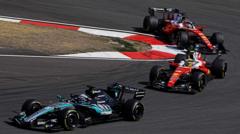
We see it every Saturday. Twenty of the greatest drivers on the planet crawling along the backstraight, weaving like drunkards, trying to find a gap in the air. They are looking for a "tow"—a slipstream from the car ahead that might shave a tenth of a second off their lap time. It is a high-stakes game of chicken. If you go too early, you provide the tow for everyone else. If you go too late, you miss the checkered flag and don't get a lap at all.
But the human cost is hidden behind the visor. When Max Verstappen or Lewis Hamilton screams over the radio about "traffic," it isn't just petulance. It is fear. When a car is moving at a snail's pace on the racing line while another is approaching at full tilt from behind, the closing speed is astronomical. It is like trying to sprint through a crowded mall while everyone else is standing perfectly still. One wrong twitch of the steering wheel and the carbon fiber shatters.
The governing bodies suggest "minimum lap times" to keep things moving. It's a band-aid on a bullet wound. By forcing drivers to maintain a certain speed, they are inadvertently forcing them to burn through their tires or overheat their engines before the "real" lap even begins. We are watching the world's fastest athletes play a game of musical chairs where the chairs are moving at lethal speeds.
The Invisible Wall
Then there is the dirty air.
Aerodynamics is a cruel mistress. A modern F1 car is designed to be a vacuum, sucking itself onto the road. But in doing so, it leaves a wake of "dirty," turbulent air behind it. For the driver following, this wake feels like driving through a hurricane. The front tires lose grip. The car slides. The brakes overheat.
The 2022 regulation changes were supposed to fix this. They introduced "ground effect" floors—using the underside of the car to generate downforce rather than just the wings. For a while, it worked. Drivers could follow closer. The racing felt intimate again.
But engineers are paid to find loopholes, not to preserve the spirit of the sport. They have figured out how to push that turbulent air back out, rebuilding the invisible wall. Now, we are right back where we started. A driver might be half a second faster than the man in front, but he can't get close enough to prove it. He is trapped in a cage of physics.
Consider the mental toll on a driver like Lando Norris or Charles Leclerc. They spend twenty years of their lives perfecting the art of the overtake, only to realize that the better their team's engineers do their jobs, the harder it becomes to actually race. It’s a paradox that eats at the heart of the competition. If the fastest car can’t pass because of the wake it creates, is it actually a race, or just a very expensive parade?
The Concrete Tundra
Safety is the third rail of Formula 1. You don't touch it unless you have to. But we have to.
The sport has never been safer, yet the tracks are becoming more dangerous. It sounds like a contradiction. It isn't. We have moved toward "street circuits"—tight, unforgiving corridors of concrete in cities like Las Vegas, Jeddah, and Miami. They look stunning on a 4K television. The neon lights reflect off the bodywork. The celebrities on the grid provide the "lifestyle" content the owners crave.
But look at the walls.
On a traditional track like Spa or Silverstone, if a tire blows, there is grass. There is gravel. There is space to bleed off energy. On a street circuit, there is only the wall. The impact is immediate and total.
We saw it in Jeddah. We saw it in Las Vegas when a loose drain cover nearly sliced a car in half. We are asking these men to dance on a tightrope over a shark tank, and then we act surprised when someone falls. The "thorny issue" isn't just about the barriers; it’s about the philosophy of risk. Are we choosing these locations because they provide the best racing, or because they provide the best backdrop for an Instagram story?
The drivers know the difference. They feel the vibration of the concrete through their spines. They know that in a city circuit, a minor mistake isn't a trip through the gravel; it's a season-ending trip to the hospital.
The Weight of the Battery
Then there is the physical heft of the machines themselves.
An F1 car used to be a dart. Small, nimble, terrifyingly light. Today, they are tanks. The hybrid power units and the massive safety structures have pushed the weight of the cars toward 800 kilograms.
A heavier car is harder to stop. It carries more kinetic energy into a crash. It is less responsive in the slow corners. It eats tires for breakfast. The drivers describe them as "boats." It’s a metaphor that highlights the loss of that razor-edge feeling that defined the sport for decades.
The engineers will tell you the hybrid tech is necessary for "road relevance" and "sustainability." And they are right. The world is changing, and F1 must change with it. But there is a human price to pay for that relevance. The driver is no longer just fighting the G-forces; he is fighting the momentum of a massive, heavy battery pack sitting inches behind his head.
He has to manage the "harvesting" of energy, the "deployment" of power, and the "degradation" of the rubber, all while trying to hit a clipping point at 150 miles per hour. The mental load is staggering. It isn't just driving anymore; it's high-speed data management.
The Soul in the Machine
Where does this leave us?
We are at a crossroads. On one side is the path of the "Show." More street races, more gimmicks, more overtaking aids like DRS (Drag Reduction System) that make passing feel like a button-press rather than an act of courage. This path leads to record profits and a global fan base that cares more about the drama in the paddock than the physics on the track.
On the other side is the path of the "Sport." It’s the path that prioritizes lighter cars, tracks with "consequence," and a qualifying format that allows a driver to go out and set a lap without having to navigate a parking lot of rivals.
The problem is that you can't have both.
You can't have a 1,000-horsepower hybrid monster that is also light and nimble. You can't have the glamour of a Las Vegas night race without the inherent danger of a concrete-lined corridor. You can't have twenty cars searching for a tow without the chaos that ensues.
The "thorny issues" isn't a list of technical glitches to be solved by a committee in Paris. It is a fundamental question of identity.
Watch a driver climb out of the car after a grueling race. He is drenched in sweat, his hands are shaking from the adrenaline, and his eyes have that thousand-yard stare of someone who has just cheated death a hundred times in two hours. He doesn't care about the "brand engagement" or the "hybrid efficiency." He cares about the moment the visor went down and he felt, for a fleeting second, like he was in control of his own destiny.
If we keep prioritizing the spectacle over the purity of that moment, we will eventually lose the very thing that makes people watch in the first place. We don't watch F1 because it's "relevant." We watch it because it is the only place on earth where the limits of human capability and mechanical genius collide in a way that feels like magic.
The mechanic in the Monza garage finishes his work. He steps back, looking at the car. It is a masterpiece of engineering, a terrifying weapon, and a fragile cage. Tomorrow, a human being will climb inside and ask it to do the impossible. We can only hope that the people running the sport remember that the most important component in that car isn't the battery, the wing, or the engine.
It’s the person holding the wheel.


